


TL; DR
- Tesla unveiled a redesigned Roadster in Texas, with production targeted for 2028.
- Its Rocket tier is a single-seater using SpaceX-derived cold-gas thrusters for brief flight.
- No final price, battery data, or safety details exist yet; India plans are unconfirmed.
Tesla has a habit of promising science fiction and either delivering it late or never delivering it at all. Case in point: the Tesla Roadster. In 2017, the American EV maker showcased the second-generation Roadster.
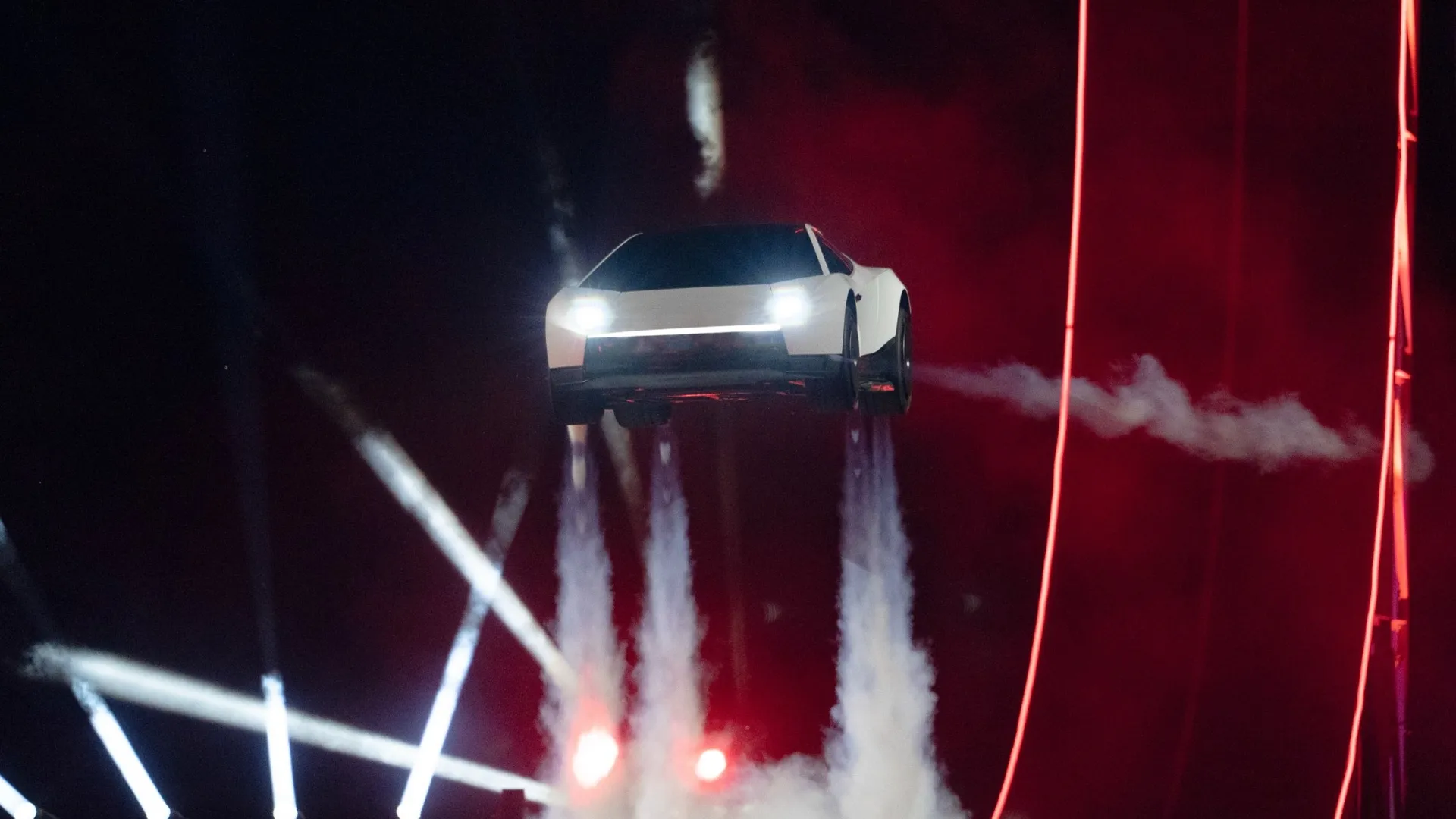
But for nine long years, the company stayed silent. The 2017 Roadster was fast, but the automaker’s inability to scale production and deliver booked units made fans furious. However, that changed on October 15, 2026, when Tesla drove the new-generation Roadster upside down, launched it off a ramp, and used rocket thrusters to land it safely.

Also Read: Apple Reportedly Invites Media To An October 28 Mac Launch In Los Angeles
The company’s CEO, Elon Musk, was there for it all. After reviewing about a dozen reports and the event’s segment focused on the flying Roadster, here’s what’s confirmed, what is merely claimed (for now), and what nobody has talked about the 2026 Roadster yet. It’s the full picture, including the parts Tesla would rather you skimmed.
Nine Years Late, The Roadster 2026 Arrived Upside Down
On 15 October 2026, at a SpaceX test facility in McGregor, Texas, the redesigned Roadster 2026 finally arrived, and it did so in style. The demo was pure theater, and you really had to be there to feel the crowd’s excitement and awe. You can watch the entire event in the X post embedded here.
To give you an idea, the Roadster first climbed an upside-down ramp, stuck to the top like no other car, then jumped off in upside-down orientation, flipped mid-air, and landed on its wheels a few seconds later. In another demonstration, it added a barrel roll over Tesla’s entire fleet, jumping about 8 to 10 feet into the air and landing safely.
Also Read: Six Months With the Galaxy S26 Ultra: The Only Flagship You Need
I’ll come off the “how did that happen part” in a bit, but writing this is quite exciting for me. It’s a big deal not only because the car can apparently fly short distances, but also because the nameplate is important to the company. The original Roadster was its very first production car, built from 2008 to 2012.
Production for the new-generation Roadster 2026 is now targeted for 2028, though Musk put it 12 to 18 months after the demo. He also mentioned Giga Texas plans for 2027 or 2028. Given the automaker’s history, I’d bank on the later date.
Design: Fighter-Jet Looks, Fan-Powered Grip
Tesla says the shape borrows from the SR-71 Blackbird and the F-35, two of the most iconic and advanced aircraft in the entire aviation history (developed by Lockheed Martin). You can see it in the wedge-like body, concealed headlights, full-width rear light, and flush panels. The paint is “Ano White,” which is inspired by aerospace coatings.
Then there’s gold-tinted glass and titanium accents, which add a lot of personality.
Inside, the cabin is Ultrawhite with gray microsuede (for a premium feel), a center touchscreen and two smaller displays (following the company’s love for large screens in cars), plus a yoke that steers by wire. The seat position is fixed; you can’t adjust it for your height or seating position, which might bother people taller or shorter than average.
Also Read: Samsung’s Android XR Smart Glasses Leak in Full, With 12MP Camera and 9-Hour Battery Life
The physics is where the Roadster 2026 gets more interesting than you’d think. Ordinary wings generate a downforce that grows with the square of speed; they do little in slow corners. The Roadster does something different: it adds a multi-mode fan and ground-sealing system that pulls air from beneath the car and presses it onto the road, generating up to 2G of force.
In practice, that can do two things: first, it can hold the car upside down when stationary. Second, it can help maintain control and maneuverability while cornering, something traditional supercars still struggle with. Track Mode lowers the car and raises an active rear wing, and Tesla claims downforce “approaching Formula 1 levels.”
Also Read: iPhone Duo’s A20 Pro Matches iPhone 18 Pro in Early Geekbench 7 Test
Powertrain, Three Tiers and the Thruster Question
Tesla hasn’t shared battery capacity, motor output, or curb weight. It has shared a trio of tiers and some eye-watering acceleration claims.
| Tier | Seats | Claimed 0-60 mph | Implied average acceleration (my arithmetic) | Hardware | Availability |
| Performance | 2 | Under 1.6 s | Over 1.7G | Active aero, multi-mode suction; “road ready” | Reservation |
| Thrust | 2 | Under 0.9 s | Over 3.0G | Performance hardware plus rear-mounted cold-gas thrusters; “race ready” | Limited release |
| Rocket | 1 | Under 0.59 s | Over 4.6G | Perimeter-mounted cold-gas thrusters for upward and forward motion and rotation; “air ready” | Invite-only; not in all regions |

Some quick math from me: 60 mph is about 26.8 meters per second, so reaching that speed in 0.81 seconds works out to roughly 3.4G of acceleration force on the driver, matching the figure circulating after the event. The Rocket’s claimed sub-0.59-second time implies over 4.6G. Tesla also claims a range of over 300 miles (483 km) and a top speed exceeding 230 mph (370 km/h).
The thrusters that make the car fly are cold-gas units borrowed from SpaceX. Cold gas means no fire, so it isn’t a safety hazard for the battery or electronics. The car releases compressed gas stored in carbon-fiber-wrapped pressure vessels through nozzles.

It is the recoil that pushes the car the other way (into air).
Also Read: WhatsApp Guest Calling Lets Anyone Join a Call From a Browser
Tesla says the force can reach four to five times what the tires can deliver. On the Rocket, perimeter thrusters can not only push the car upward and forward, but also spin it in mid-air for performing barrel rolls. One event summary cites over 80 kilonewtons from the Thrust tier’s rear thrusters, but I couldn’t confirm that anywhere, so treat it as unverified.

Air time is yet another question. Tesla hasn’t published a duration for which the Roadster can remain airborne or explained how quickly the system could be ready for another attempt. The idea of replenishing the gas supply while driving has also been discussed.
Cold-gas thrusters produce thrust without combustion, making them relatively simple but limited in how much thrust they can generate. That makes flights lasting seconds seem more plausible than sustained airborne travel.

Also Read: Base Galaxy S27 Phones May Keep a Selfie Camera Samsung Has Used Since 2023
Safety: Mostly Silence, Plus One Blunt Warning
Safety is the thinnest part of this story. None of the reports I went through list the number of airbags, crash structures, or driver aids. What we do have are warnings. Tesla says the car isn’t approved for public roads. In fact, Musk has reportedly said anyone who puts safety first shouldn’t buy it.
Tesla hasn’t said whether the extreme airborne functions can legally operate on public roads. Because the Rocket package replaces the passenger seat with a single-driver layout and surrounds the car with 10 high-pressure cold-gas air thrusters, it doesn’t meet standard automotive safety guidelines for civilian streets.

The middle tier “Thrust” version (which only features rear-mounted acceleration thrusters) is listed on the site as street-legal, but contains a separate warning noting that availability is heavily subject to “each region’s legal requirements and applicable laws.”
Also Read: HP Says You Can Run 300-Billion-Parameter AI Models Locally On Its New 1.9kg ZBook Ultra G3a
Musk also said, “This will actually be long-term the only manually driven car that Tesla makes.”
Pricing and Availability: A Reservation, Not a Price
| Item | US Price | Indian Price |
| Final price | Not announced | Not announced |
| Performance reservation | $50,000 (about ₹48 lakh at roughly ₹97 per dollar) | ₹5,01,000 immediately, ₹45,05,000 due within 10 days |
| Thrust reservation | $250,000 (about ₹2.4 crore); Autopunditz only | ₹5,01,000 immediately, ₹2,45,24,000 due within 10 days |
| Rocket | Invite only; deposit not stated | Invite only; deposit not stated |
| Production | Targeted for 2028 | Targeted for 2028 |
Also Read: Dell’s Pro Essential 14 And 15 Give Small Businesses A Mic-Mute Key, Starting From ₹85,500

My Take: Stunt Star, Movie Star or Road Hazard?
Now to the part I care about most: what will this car become when it’s commercially available? I can think about three possible futures. First, it could be the stunt-show favorite. The reveal was choreographed like one, and a car that Tesla itself says isn’t approved for public roads has a natural home on closed courses and at events. In my view, that is the most plausible outcome.
The second is the Hollywood favorite. A white, aircraft-inspired car that flips and hovers could be a gift for any action director. I wouldn’t be surprised to see it in a high-profile Hollywood action franchise soon, where the director might mount a couple of high-speed cameras and have the car fly between two passing trucks or something like that.

Also Read: iPhone 18 Production Reportedly Starts In Late November For A Spring 2027 Launch
The third is the hazard. A car that may pull 3G launches and thruster-assisted hops is hard to square with ordinary roads. I haven’t seen any regulators weigh in either. If Tesla sells the Performance tier with only the fan and wing, the road question gets more ordinary. The thrusters are the real test. My pick: stunt show first, film set second, public road a distant third.
As for 2028, Tesla has already missed this car by years, so I’d hold my wallet until a proper spec sheet exists.
Key Specifications
| Spec | Detail |
| Unveiled | 15 October 2026, SpaceX test facility, McGregor, Texas |
| Tiers | Performance, Thrust, Rocket (seating for 1) |
| Seats | 2 / 2 / 1 |
| 0-60 mph | 0.81 s in the demo (tier not specified); claims of under 1.6 s, 0.9 s and 0.59 s by tier |
| Top speed | More than 230 mph (370 km/h), claimed |
| Range | More than 300 miles (483 km), reported; tier not specified |
| Cornering | Up to 2 g (Motor1) |
| Grip systems | Multi-mode fan and ground-sealing system; active rear wing; Track Mode |
| Thrusters | Cold gas; rear-mounted on Thrust, perimeter-mounted on Rocket; count and thrust not published |
| Materials | Magnesium, titanium, carbon fiber |
| Interior | Ultrawhite with gray microsuede; center touchscreen plus two smaller displays; steer-by-wire yoke; fixed seat |
| Battery, motors, weight, dimensions | Not disclosed |
| Production | 2028 target |
Also Read: Could Nothing Take On Ray-Ban Meta? Two Smart Glasses Reportedly In The Works

You can follow Smartprix on Twitter, Facebook, Instagram, and Google News. Visit smartprix.com for the latest tech and auto news, reviews, and guides.