

X500 Pro Max vs. X10 Pro Max: Table of Contents
The Vivo X500 Pro Max is finally here, and it takes on the competition head-on with the Find X10 Pro Max (review), which debuted in India a few days ago. Both the phones appeal to the same enthusiastic buyers, those who want the absolute best camera on a smartphone that doesn’t cut corners elsewhere either. In 2026, that ambition comes with a hefty price tag (spoiler alert).
However, from what it looks like, neither the X500 Pro Max nor the Find X10 Pro Max are willing to give up the fierce camera-flagship competition.


Also Read: FCC Approves SpaceX’s Plan For Up To 1 Million Starmind Satellites For A Space-Based AI Data Center
Vivo X500 Pro Max vs. Oppo Find X10 Pro Max: Pricing & Availability
| Spec | vivo X500 Pro Max | OPPO Find X10 Pro Max |
| Variants | 12GB + 256GB; 12GB + 512GB | 12GB + 512GB (only variant) |
| Colours | Eternal Black, Apex Orange | Titanium Grey, Luna White |
| Price | 12GB + 256GB: ₹1,64,999 12GB + 512GB: ₹1,79,999 | ₹1,99,999 (MRP ₹2,39,999), inclusive of all taxes |
| Price Gap vs OPPO | ₹35,000 lower (256GB); ₹20,000 lower (512GB) | Not applicable |
Also Read: Vivo X500s Leak Points To A Customized Dimensity 9600 Pro Variant & An 8,000mAh Battery

Vivo X500 Pro Max vs. Oppo Find X10 Pro Max: Design
| Spec | vivo X500 Pro Max | OPPO Find X10 Pro Max |
| Dimensions | 163.32 × 76.82 × 7.95 mm or 8.12 mm (Apex Orange) | About 161.3 × 76.6 × 8.4 mm |
| Weight | 225 g (Eternal Black); 229 g (Apex Orange) | About 233 g (Luna White); about 235 g (Titanium Grey) |
| Back | Glass fiber (Eternal Black); glass (Apex Orange) | Luna White: single glass panel with two textures, including Velvet Glass; Titanium Grey back material not stated |
| Water and Dust Resistance | IP68 and IP69 | IP66, IP68 and IP69 |
| Fingerprint | 3D ultrasonic, single-point | Under-screen (in-display ultrasound); face unlock supported |
| Colours | Eternal Black, Apex Orange | Titanium Grey, Luna White |
| Haptic Motor | X-axis linear motor | “Ultra-level Bionic Haptic Motor” (marketing name) |
| Cooling | Liquid Cooling Vapor Chamber | 3D Cryo-velocity Cooling System with large VC cooling |
| In the Box | Phone, USB power adapter, Type-C cable, phone case, pre-applied protective film, eject tool, quick start guide, warranty card | Phone, charger, USB cable, SIM ejector tool, protective case, quick guide (may vary by market) |
| Made In | India | India |
Also Read: WhatsApp Will Let You Buy A Travel eSIM Inside the App, With Jio Among Its Partners

First things first, let’s talk about the dimensions of the X500 Pro Max and the Find X10 Pro Max because, unlike some other comparisons, there’s a noticeable difference here. Looking at their side profiles, the X500 Pro Max measures around 7.95mm at its thinnest variant, whereas the Find X10 Pro Max comes in at 8.4mm.
That nearly half-a-millimeter difference might not sound like much on paper, but it’s something you’ll notice when holding the phones side by side.
When it comes to weight, both color variants of the X500 Pro Max are lighter on paper. However, the difference is only a few grams, so it’s unlikely to be as noticeable in everyday use as the difference in thickness.

Moving beyond dimensions, both phones follow the familiar glass-metal-glass sandwich design, a flagship formula we’ve seen for years. It’s hardly groundbreaking, but it’s a tried-and-tested approach that continues to define the premium smartphone segment.
Also Read: OPPO Pad Mini Review: The Mini Tablet We All Wanted
As for durability, both phones carry an IP69 rating. This means they’re designed to withstand accidental submersion as well as high-pressure water jets. That said, I’d still avoid deliberately exposing them to water or taking them along for water-based activities. Water resistance is a safety net, not an invitation to put it to the test.
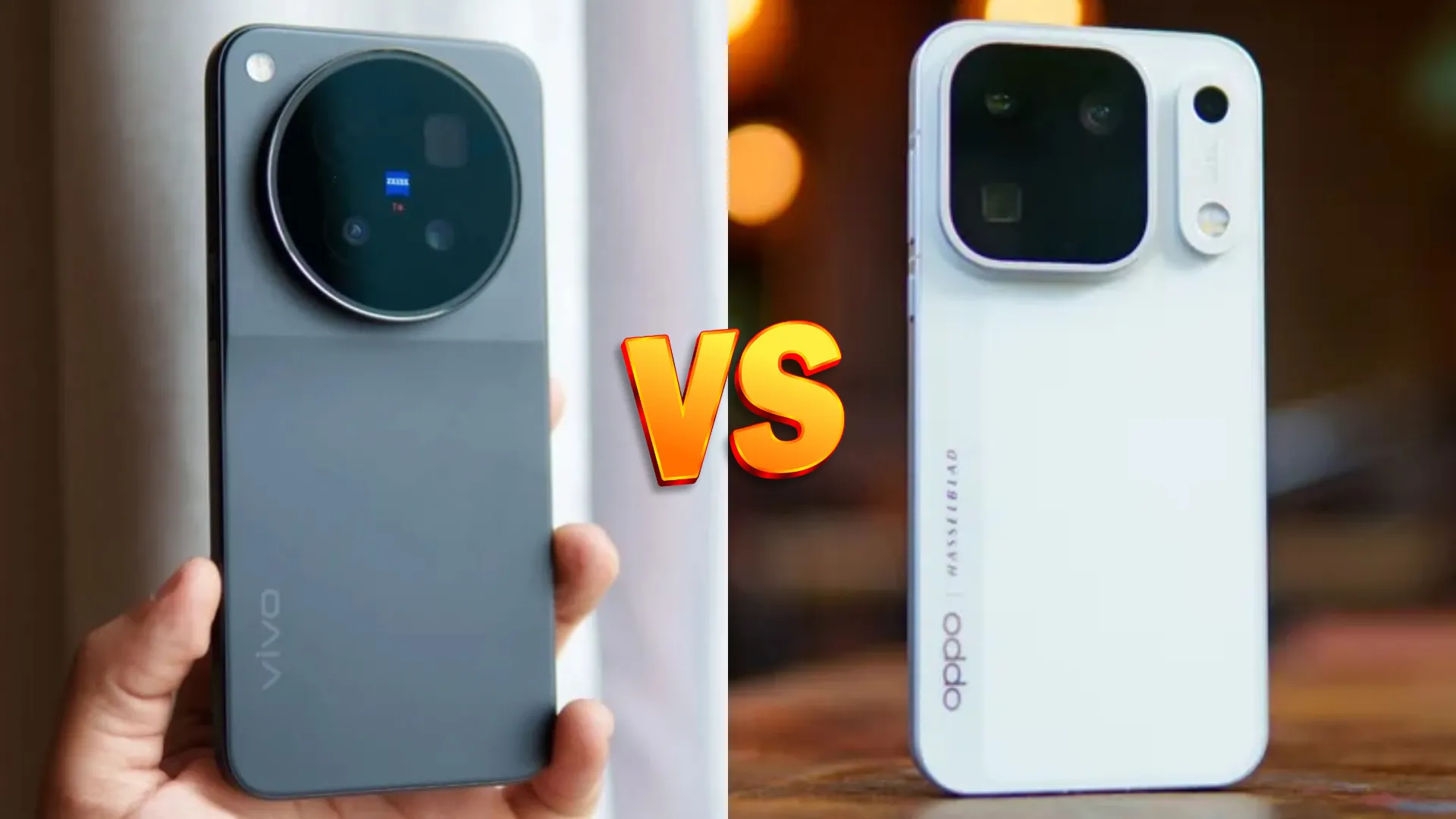
When it comes to visual design, however, the two phones take distinctly different routes, but only for the back panel, and it’s that route that gives them their unique identity.

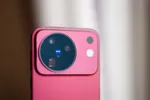
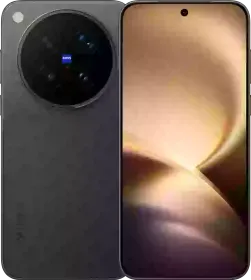
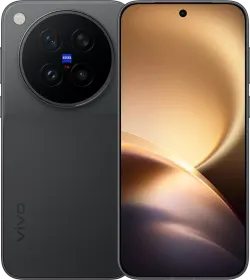
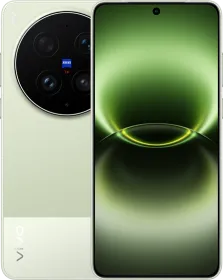
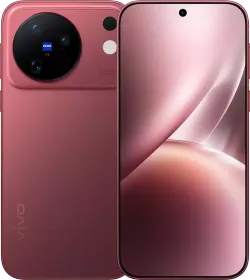
Vivo has retained the gigantic circular camera island at the center of the X500 Pro Max’s rear panel. Despite its sheer size, the module looks well-proportioned against the overall design and form factor.
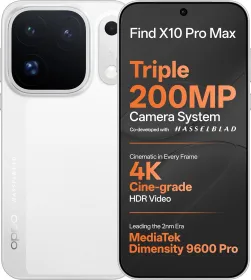
The Find X10 Pro Max, on the other hand, goes with a square-shaped camera module positioned in the top-left corner of the rear panel. This is perhaps the easiest way to tell the two phones apart at a glance.
Also Read: Vivo X500 vs. Oppo Find X10: Two Camera Flagships, But Which One Comes Out on Top?
Up front, both Vivo and Oppo stick to a punch-hole design with symmetrical bezels, and the screen-to-body ratio is quite similar to what Vivo offers. More similarities include the rounded corners, flat edges and frame, and a matte-texture rear glass panel.

Vivo X500 Pro Max vs. Oppo Find X10 Pro Max: Display
| Spec | vivo X500 Pro Max | OPPO Find X10 Pro Max |
| Size | 6.85 in (17.42 cm) | 6.78 in (17.23 cm) |
| Panel | AMOLED; 8T LTPO; Q11 luminescent material | Flexible AMOLED; LTPO |
| Resolution | 3168 × 1440 (507 ppi) | 2772 × 1272 (450 ppi) |
| Refresh Rate | 1 to 144 Hz (144 Hz works with adaptive dimming and in supported apps and games) | 1 to 120 Hz adaptive; up to 144 Hz in supported games only |
| Touch Sampling | Not stated | Up to 288 Hz (default 120 Hz); 1000 Hz instantaneous |
| Brightness | 5,000 nits local peak; 2,000 nits global peak; 1 nit minimum | 800 nits typical; 2,000 nits typical in HBM (global peak); 3,600 nits local peak; 1 nit minimum |
| Colour | 1.07 billion colours; 100% DCI-P3 | 10-bit, 1.07 billion colours; 95% BT.2020 (Standard, Natural and Colorful modes) |
| HDR | HDR10+ and Dolby Vision | HDR10+ Dolby Vision |
| PWM Dimming | 2,160Hz PWM dimming | 3,840 Hz (below 70 nits) |
| Cover Glass | Not stated | Crystal Guard |
Also Read: vivo Watch GT 2 Review: Big AMOLED Display, Excellent Battery Life, and Smooth Software
The screen is arguably the part of your smartphone that you interact with the most, and that’s exactly why it’s important to understand the minute yet crucial differences between the X500 Pro Max and the Find X10 Pro Max.

First things first, the X500 Pro Max boasts a considerably larger 6.85-inch display, offering more screen real estate than the 6.78-inch panel on the Find X10 Pro Max. So, if you’re into multitasking or need a spacious canvas for editing videos, you already know which one has the upper hand.
The underlying technology, however, remains similar, as both phones use AMOLED panels that support a truly variable refresh rate ranging from 1Hz to 144Hz. Despite its larger panel, the X500 Pro Max also manages to pack in a higher pixel density of 507 PPI, compared to 450 PPI on the Find X10 Pro Max.
That’s not an insignificant difference, and the X500 Pro Max’s display should look noticeably sharper, especially if you’re someone who pays attention to finer details such as small fonts, text, and icons.

Also Read: vivo X500 Review: A Camera Flagship That’s Easy to Recommend
Moving on to one of the most important aspects of a display, peak brightness, the X500 Pro Max takes another step ahead. It supports 5,000 nits of local peak brightness, compared to 3,600 nits on the Find X10 Pro Max.
Higher peak brightness usually translates into more pronounced highlights and a punchier appearance when viewing HDR content. It can also work in your favor when using the phone outdoors under direct sunlight, where displays with higher peak brightness generally offer better visibility.
However, it’s worth pointing out that the global peak brightness, or the brightness of the entire screen, remains at 2,000 nits on both phones. So, there’s a level playing field on this front.

Vivo X500 Pro Max vs. Oppo Find X10 Pro Max: Performance
| Spec | vivo X500 Pro Max | OPPO Find X10 Pro Max |
| Chipset | MediaTek Dimensity 9600 Pro (2nm) | MediaTek Dimensity 9600 Pro (2nm) |
| CPU | 8 cores: 2 × 4.55 GHz + 3 × 4.35 GHz + 3 × 3.1 GHz | 8 cores: 2 × 4.55 GHz + 3 × 4.35 GHz + 3 × 3.1 GHz |
| GPU | Arm Mali G2-Ultra at 1.8 GHz | Arm Mali G2-Ultra at 1.8 GHz |
| RAM | 12GB LPDDR5X Ultra; software RAM expansion up to 24 GB | 12GB LPDDR5X |
| Storage | 256GB or 512GB UFS 4.1 | 512GB UFS 4.1 (only India variant) |
Under the hood, both the X500 Pro Max and the Find X10 Pro Max, which are sister flagships, in case you didn’t know, feature the same Dimensity 9600 Pro 2nm chipset.

For those catching up, this is MediaTek’s latest, most advanced, and most efficient chipset to date, and directly rivals the Snapdragon 8 Elite Extreme Gen 6. So, expect top-tier performance from both smartphones.
Whether you’re editing 4K 60fps videos on the go and adding animations or transitions through video editing software on your smartphone, playing Battlegrounds Mobile India at 120fps with relatively higher graphics settings (not the base one), or running Genshin Impact at 60fps, the Dimensity 9600 Pro holds its ground quite well and never makes you feel that the smartphone could have used more raw horsepower.
Also Read: Nothing Ear (note) Turns The Charging Case Into An AI Voice Recorder

During our time with the Find X10 Pro Max, we found that it scores around 3.8 million points on AnTuTu version 12, 2,550 points in the single-core test, and around 9,170 points in the multi-core Geekbench 7 CPU test.
We also conducted the 3DMark Wild Life Extreme Stress Test on the Find X10 Pro Max and found that the chipset’s stability is around 82%, which is exceptional for a smartphone offering this much raw horsepower.
In simpler terms, this means the chipset can sustain its peak or optimal performance more consistently, without significant performance drops or sudden frame-rate dips during demanding sessions.

Also Read: iQOO 16 And iQOO 16s Launch In Malaysia On December 8, While India Keeps Waiting
Even if you can’t put all that CPU and GPU performance to immediate use, getting a flagship can help you maintain decent to excellent performance three to four years down the line, because all that processing power you’re not using right now translates into additional hardware and CPU headroom.
Vivo X500 Pro Max vs. Oppo Find X10 Pro Max: Software
| Spec | vivo X500 Pro Max | OPPO Find X10 Pro Max |
| OS | OriginOS 7 on Android 17 | ColorOS 17.0 (Android version not stated) |
| Update Policy | 5 years of OS upgrades and 7 years of security updates | 5 years of OS upgrades and 6 years of security updates |
| Design and Engine | Origin Smooth Engine; Origin Workbench for multitasking (needs 12GB RAM or more) | Living Flow Design; Luminous Rendering Engine; Unified Rendering Architecture; Laminar Flow Engine with Adaptive Scheduling |
| AI Features | AI Recorder, Capture to note, Snap & Go, AI Cross-App Drag, AI Creative Camera, AI Agent Camera, AI Superlink (availability varies by app, region and language) | AI Mind Pilot, AI Photo Agent, AI Mind Suggest, OSee, AI Call Guard, AI Live Interpreter with Earbuds (needs Enco X4 or later), PCC private cloud for personal data |
| Cross-Device | Quick Share file transfer to iPhone; sync with iPhone, iPad, Mac, Apple Watch and AirPods; iCloud photo access in File Manager; vivo Office Kit | Touch to Share, including with iPhone or Mac through the O+ Connect app (needs ColorOS 15.0+, iOS 15.0+, macOS 10.14+) |
| Security | Security Shield | AI Call Guard |
| Other | Quad-Mic Recording; Infrared Control | OSee payment code works only in India and Indonesia |


Also Read: Best Camera for Photography and Video: A Practical Guide to Picking a Hybrid Camera in 2026
Vivo X500 Pro Max vs. Oppo Find X10 Pro Max: Cameras
| Spec | vivo X500 Pro Max | OPPO Find X10 Pro Max |
| Main Camera | 50MP, LYTIA L910 (IMX09C-AJH5-C), 1/1.28″, ƒ/1.57, 24mm equivalent, 82° FOV, autofocus, OIS, CIPA 7.0 | 200MP, 1/1.3″, ƒ/1.5, 24mm equivalent, 84° FOV, 7P lens, autofocus, 2-axis OIS |
| Ultra-wide | 50MP, S5KJN5SP04, 1/2.75″, ƒ/2.0, 15mm equivalent, 109° FOV, autofocus; no OIS listed | 200MP, 1/1.56″, ƒ/2.2, 13mm equivalent, 124° FOV, 7P lens, autofocus; no OIS listed; 4 cm macro |
| Telephoto | 200MP, S5KHP0SP04, 1/1.4″, ƒ/2.67, 85mm equivalent, 28° FOV, autofocus, OIS, CIPA 7.0; zoom range “10× to 30×” | 200MP, 1/1.56″, ƒ/2.1, 70mm equivalent (3x optical), 34° FOV, 3P+3P lens, autofocus, 2-axis OIS; 10 cm macro |
| Multispectral | Multispectral sensor listed under sensors | 3.2MP, ƒ/2.4, 95° FOV, 3P lens; 24 spectral channels |
| Front Camera | 50MP, ƒ/2.0, 92° FOV, autofocus | 50MP, ƒ/2.0, 100° FOV, 5P lens, autofocus |
| Zoom Accessory | ZEISS Telephoto Extender Gen 2 Ultra, 400mm equivalent, 4.7x magnification, about 248 g | Hasselblad Teleconverter Kit (10x, 20x and 40x equivalents), sold separately |
| Rear Video | 8K@30; 4K 120 fps with Pro AF tracking; 4K 240 fps slow-motion; 17 EV TrueDynamic Log (Log mode, main camera); telephoto AF tracking video; 2.39:1 Film Style | 8K@30; 4K@120/60/30; 1080p@120/60/30; Dolby Vision 4K and 1080p@120/60/30; 8K 30 fps 10-bit Log; 17-stop HDR video (1x standard mode only); professional video, dual-view, HDR video |
| Camera Partner | ZEISS | Hasselblad |
When it comes to cameras, there’s a significant gap, or at least that’s what it seems from the spec sheet unless you try both phones side by side.

Also Read: Car Prices Are Climbing Again Before Year-End: Maruti, Hyundai, Tata, Audi and Mahindra Explained
Though the actual sensor size of the primary camera on both phones is almost similar, it’s the Find X10 Pro Max that features a 200-megapixel sensor, offering four times the resolution or four times the pixels of the 50-megapixel sensor on the X500 Pro Max.
The telephoto camera on both phones carries a 200-megapixel resolution, which is a good thing. However, it’s the X500 Pro Max that flaunts a slightly bigger sensor, which can come in handy if you’re trying to capture portraits in low-light scenarios.
The native optical zoom on the X500 Pro Max is 3.5x, while it’s 3x on the Find X10 Pro Max. However, when it comes to maximum hybrid zoom, it’s the Find X10 Pro Max that goes up to 120x, while the X500 Pro Max limits itself to 100x. As confusing as it may be, the X500 Pro Max takes it back by offering 30x maximum digital zoom when capturing videos, something that’s limited to 18x on the Oppo flagship.

Also Read: Nvidia just brought desktop-class AI to thin Windows laptops in India, starting at ₹2.99 lakh.
The Find X10 Pro Max actually compensates for the lack of a bigger sensor with a brighter aperture.
For the ultrawide camera, the X500 Pro Max has a 50-megapixel sensor, whereas the Find X10 Pro Max has a 200-megapixel sensor, offering more cropping flexibility. The front camera resolution and aperture remain the same, so I’m expecting a fundamentally similar experience from both Chinese flagships.
There’s a key difference when it comes to the maximum frame rate for video recording. While both sister flagships can record 8K videos at 30fps, the Vivo X500 Pro Max can stretch 4K recording to 240fps, double the maximum frame rate that the Find X10 Pro Max can achieve. So, if you’re someone who’s into creating cinematic slow-motion videos at a higher 4K resolution, you know which phone to get.

Other than that, you can record Dolby Vision videos, 10-bit Log videos, or regular 4K videos at 60fps on both smartphones.
Also Read: Apple Is Reportedly Bringing (PRODUCT)RED Back With A Red HomePod mini 2 And Silver AirPods Max 2
Both phones take a clip-on telephoto accessory, sold separately. vivo offers two ZEISS Telephoto Extenders for the X500 Pro Max. The Gen 2 Ultra (400mm equivalent, 4.7x, about 248 g, Pro Max only) costs ₹27,999, and the Gen 2 (200mm equivalent, about 153 g, fits all X500 models) costs ₹15,999.
The ₹2,29,999 Photography Kit bundles both with a strap. OPPO sells one Hasselblad Teleconverter Kit for the Find X10 Pro Max. It extends the 70mm-equivalent (3x optical) telephoto to 10x, 20x, and 40x equivalents through a dedicated camera mode, and OPPO says those figures come from lab testing and software cropping. OPPO’s India pages don’t list a price for the kit.

Vivo X500 Pro Max vs. Oppo Find X10 Pro Max: Battery Life & Charging
| Spec | vivo X500 Pro Max | OPPO Find X10 Pro Max |
| Capacity | 7,800 mAh typical (28.94 Wh) | 8,000 mAh typical (29.76 Wh) |
| Battery Type | Si/C Li-Ion | Si/C Li-Ion |
| Wired Charging | 90W FlashCharge | 80W SUPERVOOC and 80W UFCS (maximum) |
| Wireless Charging | 40W proprietary charging | 50W AIRVOOC |
There isn’t a major difference between the battery capacities of both flagships. While the XY 100 Pro Max features a 7,800mAh silicon-carbon battery, the Find X10 Pro Max edges ahead slightly with its 8,000mAh silicon-carbon battery.
However, given that both phones run on the same Dimensity 9600 Pro chipset, I genuinely don’t think there will be a substantial difference in the actual screen-on time users get on a day-to-day basis, assuming similar usage patterns.

Also Read: Motorola Edge 70 Neo Launched in India at ₹37,999
With this battery and chipset combination, one can easily expect around 10 to 11 hours of screen-on time with moderate usage on a 5G network. However, with heavy usage, this could drop to around 8 to 9 hours.
What’s actually good is that both smartphones come with a fast charger and cable in the box. The XY 100 Pro Max gets 90W charging, while the Find X10 Pro Max supports 80W. Both smartphones should take around 60 to 70 minutes for a complete charge, depending on the ambient temperature.
Also Read: Nothing Enters AI Hardware With Ear (note), Launching December 8

You can follow Smartprix on Twitter, Facebook, Instagram, and Google News. Visit smartprix.com for the latest tech and auto news, reviews, and guides.