


Quick Verdict: 8.5/10
The Tefal Chef Assist 800W is the most complete all-in-one kitchen appliance for Indian cooking I’ve used. It replaced three separate appliances in my kitchen and delivered better grinding performance than any of them. The warranty coverage is also the best I’ve seen. But the 1L grinder jar limits how much batter you can make at once, and the 88-decibel noise level can bother neighbors in an apartment.
Who Should Buy: Urban Indian households with tight counter space, cooking for 4-6 people daily, and looking to cut down on appliances.
Who Should Skip: Large families making bulk idli-dosa batter every week, anyone sensitive to noise, or buyers who are fine with 80% performance at 80% of the price.
My kitchen counter is packed with single-use appliances. My old Bosch mixer makes great coconut chutney, but it sounds like a jet engine. The Philips food processor I bought during lockdown barely gets used because cleaning it is a pain. The juicer that once promised healthy mornings just gathers dust now since washing it takes fifteen minutes.
Urban kitchens in India are small. In my Bangalore apartment, I have just 47 square feet of counter space. Every appliance means giving up something else. That’s why I picked the Tefal Chef Assist 800W. For ₹6,757 after discount, I got a 15-in-1 solution.
I spent 30 days making morning smoothies and weekend biryani with the Tefal. Like any all-in-one, you trade a few things to get the rest. Here’s what I found.
HOW I TESTED
| Reviewed By: Karan Rathor, expert in Consumer Tech, Bikes, and Home Appliances (7 years experience, 50+ reviews) Test Unit: I purchased the review unit at retail price. Manufacturer had influence in the review. Duration and Environment: This review is based on 30 days of daily use across 7 different cooking tasks in an actual Indian kitchen, handling real voltage fluctuations and daily demands. Competitors: Preethi Zodiac Glitter Mixer Grinder Food processor and Philips HL7707 |
Key Specifications
| Feature | Specification |
| Motor | 800W copper-wound motor |
| Jars Included | 1.5L blender (Tritan), 1L grinder (SS), 400ml chutney (SS) |
| Food Processor | 2L bowl with 7 blade attachments |
| Blade Tech | Powelix 4-point serrated system |
| Warranty | 3 years (product) / 5 years (motor) / 7 years (blades) |
| Measured Noise | 88 dB at 1 meter |
| Price | ₹6,757 after discount on Amazon |
Pros
- Replaces your mixer grinder, chopper, juicer, and food processor.
- Powelix Blades Delivers faster, smoother textures
- Pulse Control gives you precise control over chopping textures.
- 7-year blade warranty is an industry first
- Leak-Proof Jars
Cons
- Base unit and multiple jars require dedicated storage space
- You need to learn which blade to use for which task to avoid over-processing
Unboxing: What’s in the Box
The Tefal Chef Assist landed at my door in a hefty 8kg box. I noticed the weight right away. Every part was tightly packed in foam or plastic, so nothing moved during shipping.
Here’s what greeted me inside:
The main unit itself is heavy and solid, with a brushed steel finish and a chunky, old-school dial that’s actually satisfying to turn. You get four jars and bowls:
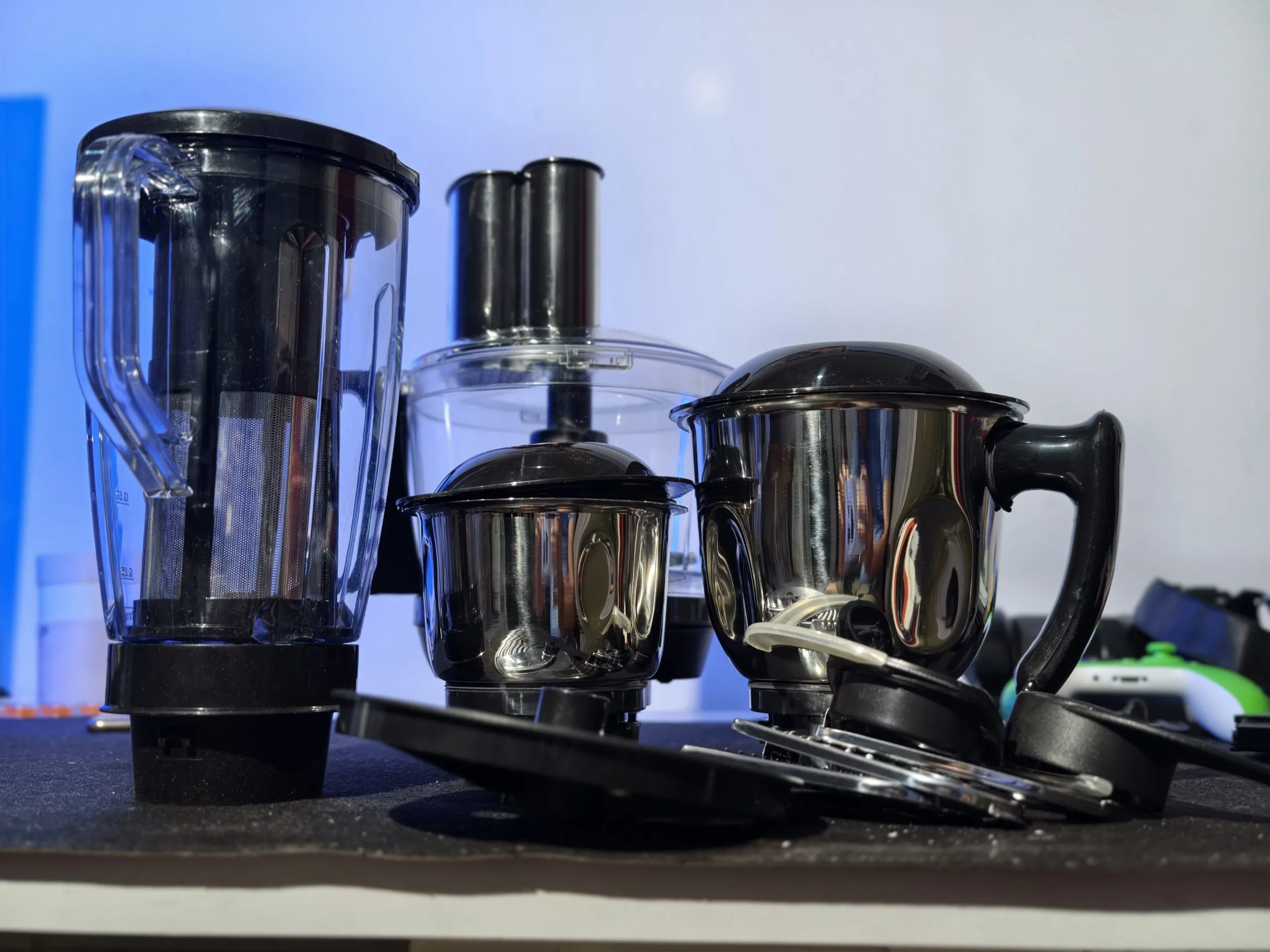
- A big 1.5L blender jar made from sturdy, BPA-free plastic with a comfortable handle. The lid has a built-in fruit filter (handy for juice) and a removable cap for adding ingredients on the fly.
- A 1L stainless steel grinder jar with a secure, leak-proof lid. This is what I reached for when grinding masalas and making dosa batter.
- A compact 400ml chutney jar, which I found just right for whipping up small batches of chutney or grinding spices for one meal.
- A generous 2L food processor bowl that locks onto the base, perfect for shredding, slicing, or kneading dough.

Blades and attachments are where things get serious:
- Chopper blade for onions and herbs (less tears for me)
- Dough kneader (saves my wrists on paratha mornings)
- Slicer and shredder discs for salads and cheese
- Julienne and finger chips blades (potato fries, anyone?)
- Whisking disc for batters and cream
The box also included some essentials: a gearbox to run the food processor, a central shaft and blade holder to keep things steady, a food pusher for safety, and a surprisingly detailed manual in both English and Hindi (with the warranty card tucked inside).
Overall, it’s a big, thoughtfully packed kit—everything you need to hit the ground running in an Indian kitchen.
Design and Build: Surviving the Kitchen Counter
The Chef Assist is a 4.6kg block of high-grade plastic with a dual-tone brushed stainless steel finish. It takes up most of my countertop, but the size has a purpose.

I ran the 800W motor for 15 minutes straight grinding hard turmeric roots and coriander seeds. It never overheated or lost power. That matters because Indian spice grinding creates a massive amount of friction.

The jars are built to survive real life. The 1.5L blender jar is made from BPA-free Tritan—the same material as premium water bottles. I actually knocked it off the counter from waist height during my testing, and it didn’t crack. Meanwhile, the 1L grinder and 400ml chutney jars use food-grade 304 stainless steel.
At first, I thought the simple analog dial was a drawback compared to digital screens. Now I appreciate the tactile feedback. I can feel the resistance as I turn it from low to high.


The Indian Kitchen Test: 30 Days of Real Cooking
Indian cuisine is brutal on equipment. I subjected the Chef Assist to the tasks I do every single day.
1. The Daily Onion Chop (Chopping)
I usually spend 15 minutes each day chopping onions, ginger, and garlic for my meals. To test the chopper, I threw in 500g of peeled, halved red onions.

- The Result: In 90 seconds (about 20 short pulse bursts), I got an even 3-4 mm dice perfect for a tadka.
- The Real Benefit: Because the sharp blades kept the onion cell walls mostly intact instead of crushing them, the onions released less sulfur. That meant zero eye irritation compared to hand-chopping.
2. Weekend Paratha Dough (Kneading)
Each Sunday, I help my wife prepare breakfast by kneading the dough. Traditionally, this means wrestling 500g of whole wheat flour (atta) for 10 minutes.
- The Result: I added the flour and slowly poured in 300ml of water. After two minutes and fifteen seconds, I had perfectly kneaded dough.
- The Verdict: Hand-kneaded dough develops gluten slightly differently because your hands apply pressure from multiple angles. The Chef Assist gets you 95% of the way there. For rumali roti, you might still want to use your hands. For everyday parathas, the difference is unnoticeable.
3. Idli-Dosa Batter (Wet Grinding)
This is the ultimate stress test. I soaked 2 cups of parboiled rice and 1 cup of urad dal for four hours.


- The Result: The urad dal whipped into a light, fluffy batter with the small air bubbles necessary for soft idlis. The rice, however, occasionally left coarse particles that required a second round of grinding.
- The Catch: The 1L jar is a bottleneck. It makes enough batter for 3 to 4 people. If you have a larger family, you will be running multiple batches.
4. Dry Spice Grinding (Masala)
I loaded the grinder with 50g coriander seeds, 20g cumin, black peppercorns, dried chilies, cloves, and a 2-inch cinnamon stick.
- The Result: In 60 seconds, I had a fine, even powder. Tefal’s Powelix blades pulled everything down perfectly. I’ve even used it on oily, dense nutmeg, and it powers right through.
Cleaning Hacks & Noise Levels
Washing jars is usually where all-in-one machines fail. Tefal’s jars are top-rack dishwasher safe, though I recommend hand-washing the blades to keep them sharp.
My personal cleaning tips from a month of use:
- Turmeric Stains: If the plastic gets stained yellow, I rub a cut lemon or a baking soda paste on it, leave it for 10 minutes, and rinse.
- Garlic/Masala Odors: I soak the jar in warm water with a splash of vinegar for 15 minutes to strip out the lingering smells.
The biggest compromise with this machine is the noise. At full speed, I measured 88 decibels at one meter. That is as loud as a lawnmower. I started putting a thick silicone mat under the base to kill the vibrations, but if you have thin apartment walls or sleeping babies, you have to plan your spice grinding carefully.
The Competition: Tefal vs. Preethi and Philips
The real rivals here are the Preethi Zodiac MG-218 (750W) and the Philips HL7707/00 (750W).
The Chef Assist’s 800W motor is noticeably more powerful, handling dense batters with less strain. But the real clincher is the warranty. Tefal offers 3 years on the product, 5 years on the motor, and an industry-leading 7 years on the blades. Neither Preethi nor Philips offers a blade warranty. Since dull blades and burnt motors are exactly how Indian mixer grinders die, Tefal clearly stands behind its build quality.
Review Verdict: After 30 Days, Would I Buy It Again?

Smartprix ⭐ Rating: 8.5/10
Yes, absolutely.
The Tefal Chef Assist 800W does more than mix and grind. I use it for everything. I stopped needing a separate food processor. It tackles tough grinding jobs for Indian cooking with zero fuss.
The Powelix blades work fast. The dough-kneading feature alone saves me hours every week. It takes up some counter space and gets loud at high speeds. Still, the 7-year blade warranty and strong 800W motor make it a smart long-term pick.
If you want to clear your counters and cut down on prep time, this machine is worth it.
First reviewed in August 2026.