



Quick Verdict
The Haier F11 (HWD120-DM14F11BKU1) is the most intelligently designed washing machine I have tested in the ₹60,000 bracket. Its 12 kg drum handles full family laundry loads with genuine ease, and its AI-driven features (auto-dosing, load sensing, app scheduling) simplify daily laundry in ways that feel genuinely useful rather than gimmicky. The drying system works, but on its own schedule and terms. Understand those terms before you buy, and this machine will impress you every day.
Buy it if:
- ou live in a flat without a dryer vent or an outdoor drying space, particularly in Mumbai, Bengaluru, Delhi, or Kolkata, where monsoon humidity makes air-drying impractical for months.
- You need a machine that handles full family loads; the 12 kg drum washes comfortably for a household of four to five.
- You want to schedule washes from your phone, receive alerts, and not think about laundry until it is done.
- You wash baby clothes and need genuinely gentle, low-temperature cycles with precise detergent control.
- You do laundry regularly across the week in manageable loads and value quiet, unobtrusive operation.
Skip it if:
- You need dry laundry in under two hours. A full wash-and-dry cycle takes four to five hours on this machine.
- You plan to wash and dry a full 12 kg load in a single cycle. The drying capacity is approximately six kilograms, so large loads need to be split for drying.
- Your household uses powder detergent exclusively and wants automated dosing. Smart Dosing is liquid-only.
- Water efficiency is a critical household priority. Condenser drying draws water from your inlet pipe continuously throughout the drying phase.
The Indian washing machine market is a $2 billion industry growing at 6-7% annually, fueled by a massive shift toward premium convenience. Fully automatic models now dominate with nearly 60% market share as urban buyers demand effortless “set-and-forget” automation. Yet, affordable semi-automatic units remain vital in rural areas, maintaining steady demand.
In this highly competitive space, Haier sits firmly in the top tier alongside LG and Samsung, capturing an impressive 10-12% market share. These three brands are locked in fierce competition, especially in the premium segment where advanced technology and automation are key selling points. Haier is betting big on AI with its F11 12kg Washer-Dryer (model HWD120-DM14F11BKU1), challenging the dominance of the Korean giants by offering top-tier features like a beltless direct-motion motor, active drum ventilation, and functional load-sensing AI at a more competitive price point. But does it truly live up to the marketing claims? Let’s find out in this Haier F11 Washer-Dryer (HWD120-DM14F11BKU1) review.
HOW I TESTED
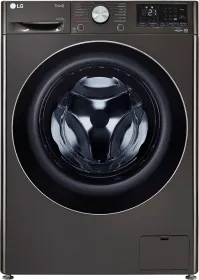
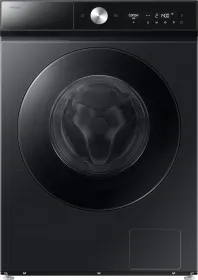
| Reviewed By: Deepak Singh Rajawat, Expert in Smartphones, TVs, Laptops, Audio Gear, Home Appliances, AI and more (10 years experience, 500+ reviews). Test Unit: Haier India provided the review sample. No commercial arrangement. They have no involvement in the review process. Duration and Environment:I used the Haier F11 as the only washing machine in a three-person household that includes two adults and an eight-month-old for four consecutive weeks. Over that period, I ran it through cotton bedsheets, bath towels, sarees, denim, baby vests and muslin swaddles, sportswear, innerwear, silk-blend dupattas, kurtas, and stained kitchen towels. Tests: I tested the AI One-Touch mode across all load types, ran the dedicated stain removal program on coffee, oil, mud, and milk stains, and measured every wash-and-dry cycle with a stopwatch from cycle start to the end-of-cycle alert in the Haismart app. I connected the app to a mid-range Android device and tested remote scheduling, live progress monitoring, and completion alerts across weekday mornings and overnight cycles. I cleaned the pump filter twice during the test period. All cycle times quoted in this review are measured precisely from pressing start to receiving the end-of-cycle notification. Competitors: LG (FHD1207STB) and Samsung (WD12FB8B94GB) |
Haier F11 Washer-Dryer Price & Availability
The Haier F11 washer-dryer (HWD120-DM14F11BKU1) is avialable for ₹56,000 against an MRP of ₹96,700.
Pros
- Handles massive 12kg wash loads.
- Auto-dosing eliminates all detergent residue.
- Active ventilation stops mildew smells.
- AI load sensing actually works.
- Runs quietly under 75 decibels.
- Excellent presets for Indian wardrobes.
- Sensor drying prevents heat damage.
Cons
- Drying capacity limited to 6kg.
- Wash-to-dry takes up to five hours.
- Consumes water during drying phase.
- Requires annoying pump filter cleaning.
- Auto-dosing requires liquid detergent.
- Touchscreen ignores wet fingertips completely.
Haier F11 Washer-Dryer Specs and competitions
| Specification | Haier F11 (HWD120-DM14F11BKU1) | LG (FHD1207STB) | Samsung (WD12FB8B94GB) |
| Wash / Dry Capacity | 12 kg / 7 kg | 12 kg / 7 kg | 12 kg / 7 kg |
| Maximum Spin Speed | 1400 RPM | 1400 RPM | 1400 RPM |
| Motor Style | Direct Motion (Beltless) | Inverter Direct Drive | Digital Inverter |
| Auto-Dosing | Yes | No (Manual dispensing) | Yes |
| App Connectivity | Wi-Fi (HaiSmart App) | Wi-Fi (LG ThinQ) | Wi-Fi (SmartThings) |
| Hardware Controls | Full-color touch panel | Physical dial + LED touch screen | Simplified AI dial |
| Odor/Hygiene Tech | Active Drum Ventilation, Steam | Steam+, Tub Clean | Hygiene Steam, Air Wash |
| Core Differentiator | Vents the drum after cycles to stop mildew smells | 39-minute fast wash for full loads using multidirectional spray | Pre-mixes detergent with air/water before hitting the clothes |
| Dimensions (W x D x H) | 600 x 600 x 850 mm | 600 x 565 x 850 mm | 600 x 600 x 850 mm |
| Standard Warranty | 4 Years Unit / 12 Years Motor | 2 Years Unit / 10 Years Motor | 2 Years Unit / 10 Years Motor |
Haier F11 Washer-Dryer Review: Design and Build
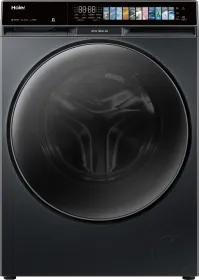
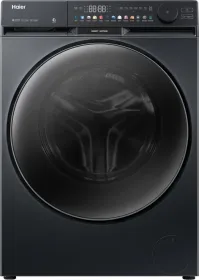
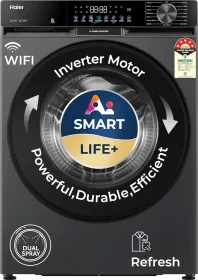
The matte black finish and edge-to-edge touch panel make the Haier F11 look less like a washing machine and more like a premium appliance from an aspirational kitchen. Placed in a compact utility alcove or a bathroom corner, it reads as intentionally designed rather than functionally utilitarian. This impression holds up beyond the first impression.

The drum door closes with a weighted, soft click. Not the hollow thud of budget construction, but the kind of tactile response that communicates deliberate engineering. The glass porthole is large enough to give a clear view of the cycle without requiring you to crouch, and the build through the fascia feels solid at every touch point.
The AI Colorful Touch Panel is the machine’s most defining feature. Full-color icons replace cryptic program numbers with visual, immediate recognition: a saree icon for sarees, an innerwear icon for delicates, a jeans icon for denim. After two or three days of use, operating the machine feels genuinely intuitive. Before that, it feels impressively modern. There is no real learning curve.

One honest observation from daily use: the capacitive panel stops responding reliably to wet fingertips. If you have just sorted damp laundry and reach for the screen, you will land on the wrong program two or three times before realising the issue. Keep a small dry towel near the machine, or dry your hands first. This becomes a non-issue after a few days, but it is worth knowing before you attribute it to a malfunction.
During the first three drying cycles, the machine produced a faint rubbery, plasticky smell, most noticeable during the very first full wash-and-dry run. It disappeared completely by the fourth cycle. Run your first couple of drying cycles on towels or older clothes rather than formal shirts.
Haier F11 Washer-Dryer Review: The Touch Panel and The HaiSmart App
The Haismart app earns its place in a daily routine, but one thing about remote start needs to be stated plainly before it influences your buying decision. To start the machine from your phone, you must first physically load the clothes, close the drum door, and hold the physical Remote Start button on the machine itself for approximately three seconds. Only once the machine is in remote-access mode can the app trigger or schedule the cycle.

This is a safety mechanism, not a flaw. It prevents the machine from running when the drum is open or unloaded. But it does mean you cannot start a wash from your sofa without having first walked to the machine to arm it. Once you build that step into your routine, the scheduling feature is genuinely valuable. I scheduled 2 AM wash cycles across multiple weeknights during testing — loaded the machine before bed, armed it in remote mode, set the schedule from my phone, and woke up to a completion alert. The app’s real-time progress tracking and time-remaining display are accurate and update consistently throughout the cycle.
Haier F11 Washer-Dryer Review: Washing Performance
The 525 mm Super Drum is where the F11 earns its daily-use credentials for a full family. I ran complete family loads like two adult jeans, four shirts, two kurtas, children’s school clothes, and a set of bedding pillow covers in single cycles. Everything came out clean and, critically, far less tangled than I expected from a 12 kg load. The drum’s diameter gives every garment genuine room to move through the water properly, rather than tumbling into a compressed mass against itself.
Here is what washing different fabrics actually felt like across the testing period.
Cotton bedsheets and bath towels are cleaned thoroughly on the bedding program. The 1400 RPM spin extracted a significant amount of water so the sheets came out damp rather than saturated, which cuts air-drying time considerably even when I chose not to run a drying cycle. After the wash, even a king-size bed-sheet came out relatively unknotted, which is something smaller-drum machines consistently fail at.

Denim responded well to the dedicated jeans program. Two pairs of dark jeans across multiple cycles showed no fading artifacts from mechanical action, and no detergent patches around the waistband — the persistent complaint with powder-based manual-dosing approaches.
Sarees and silk-blend dupattas on the delicate program came out clean, undamaged, and without the snag marks that aggressive drum action can leave on fine weaves. The program reduces drum speed and uses a notably gentler tumble pattern, which is audible. The machine sounds lighter and slower, almost immediately different from the cotton or denim programs.
Gym wear and innerwear are cleaned effectively, including the kind of embedded sweat odor in a well-used gym T-shirt that lighter cycles leave behind. The stain removal program removed coffee stains from a gym towel and oil spots from a kitchen towel without any pre-treatment. I also tested it on a milk stain on a cotton bib (relevant for baby laundry), and it came out completely.
Baby Clothes
This is where the Haier F11 surprised me most, and it is the section I would want to read if I were buying this machine for a household with an infant.
We have an eight-month-old at home, and baby laundry carries a specific set of anxieties that adult laundry does not. Too much heat damages delicate fabric. Residual detergent left in the weave can cause skin irritation in newborns. Muslin swaddles and cotton vests are small and light, which means standard wash programs often over-spin and over-dry them into stiff, scratchy shapes.
I ran a full load of baby clothes (cotton vests, muslin swaddles, cotton pants, and a set of bibs with milk and puréed food stains) on the innerwear program at 30 degrees. The Smart Dosing system automatically drew a smaller detergent volume than it would for an adult load, correctly reading the lighter soil level and smaller load weight. The 3D Power Spray evenly distributed the pre-dissolved detergent, and every item came out without a trace of residue.
The muslin swaddles, which crinkle and scratch when over-spun or over-dried, came out soft and undistorted. The cotton vests retained their shape across multiple washes (no collar stretching, no sleeve distortion). When I followed with the Sensor Dry feature on the same baby load, the results were equally good: warm, dry, and soft, not over-processed, not stiff.
For parents of infants, the combination of precise auto-dosing that adjusts for small loads, accurate execution of the low-temperature program, and Sensor Dry’s automatic moisture monitoring is a practically meaningful advantage over machines that require manual configuration every time. It reduces one more variable in a period of life that already has too many.
Night Wash and Noise
The Direct Motion motor, a direct-drive design with no belts or pulleys between motor and drum, keeps the tumble phases genuinely quiet. Under 75 decibels during rinse cycles is quieter than a normal conversation at close range, and in practice, the wash cycle running at midnight in an adjacent utility space does not penetrate bedroom walls in standard flat construction.
The 1400 RPM spin is louder, unavoidably. There is a low-frequency vibration that travels through tiled floors at peak spin, and on wooden floors or a raised surface, it becomes more pronounced. The spin phase lasts only a few minutes at the end of the cycle, but if you are scheduling overnight washes, set the cycle to complete before you go to sleep rather than scheduling it to finish at 3 AM. The tumble phase is genuinely unobtrusive; the spin phase is not.
Ensure the leveling feet are set correctly before first use. An improperly leveled machine at 1400 RPM will vibrate and sound significantly worse than it needs to. This took me about four minutes to adjust on installation, and the difference in spin noise was immediately noticeable.
The 12-year warranty on the Direct Motion motor is a meaningful long-term ownership signal. Motor degradation over three to five years is one of the most common reasons for machine replacement in this category. A 12-year warranty reflects genuine confidence in the component.
The AI One-touch Mode: What That Three-second Press Actually Does
Press and hold the One-Touch button for 3 seconds, and the machine’s AI reads the fabric type, drum weight, and drum soil level. From that analysis, it independently sets the wash program, water temperature, water volume, and cycle duration, without any manual input.
Over four weeks of testing, I used One-Touch as my default for mixed casual loads, and it made consistently accurate decisions. On a load of three T-shirts, gym shorts, and two baby cotton vests, it selected a shorter, cooler cycle, and the clothes came out clean. On a heavier load of two jeans, two shirts, and a cotton kurta, it selected a longer, slightly warmer cycle with an extended rinse. In both cases, the machine’s read of the situation was more precise than a casual manual selection would have been.
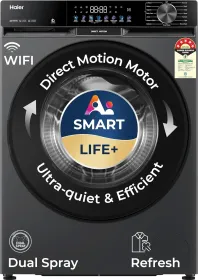
The Smart Dosing system integrates directly with One-Touch. Fill the liquid detergent dispenser, and the machine automatically draws the precise volume needed for each specific load. The 3D Power Spray then pre-dissolves and distributes the concentrated detergent directly onto the fabric before the main wash begins. Across four weeks of regular use, I did not get a single detergent residue mark on any garment, which, for anyone who has pulled a dark kurta out of another front-loader to find blue gel patches near the collar, is a meaningful daily win.
Smart Dosing works exclusively with liquid detergent. Powder detergent requires manual addition, and automated dosing is bypassed entirely. The machine does not alert you to this. It simply stops drawing detergent. If you notice no foam in the first few minutes of a cycle, check what detergent type is in the dispenser.
Haier F11 Washer-Dryer Review: Drying Performance
The Haier F11 has a washing capacity of 12 kilograms. Its effective drying capacity is approximately six kilograms. This is not a Haier limitation; it is a physics constraint that applies to every condenser combo washer-dryer at every price point. Condenser drying requires hot air to circulate freely through the drum. An overpacked drum cannot dry evenly, and attempting to dry a full 12 kg wash load will leave the inner garments still damp at the end of the cycle.
Importantly, this does not limit the machine’s usefulness for a family of four or five. It changes how you plan your laundry workflow. The practical approach that worked well across four weeks of testing: wash a full family load at 12 kg, then remove half the items to air-dry on an indoor rack. The 1400 RPM spin leaves them only lightly damp, so they air-dry significantly faster than unwashed clothes. Tumble-dry the remaining half (prioritize school uniforms, baby clothes, or towels), and the two outputs from one wash cycle are both ready within a practical timeframe.
How Long Does a Full Wash and Dry Cycle Actually Take?
A dedicated tumble dryer handles a standard load in 45 to 60 minutes. The Haier F11 does not.
A complete wash-and-dry cycle, from pressing start to receiving the end-of-cycle app alert, takes between four and five hours for a six-kilogram load. My stopwatch measurements across the testing period:
A four-kilogram load of bath towels completed a full wash-and-dry cycle in four hours and twelve minutes. The towels came out warm and dry, not as forcefully dry as a standalone dryer produces, but sufficiently dry to fold and put away without air-finishing.
A mixed load of eight T-shirts completed in two hours and ten minutes with very good results — soft, warm, and ready to wear.
A baby clothes load of approximately 2 kilograms on the innerwear program with Sensor Dry completed in 1 hour and 40 minutes. Results were the best of any drying cycle I ran: soft, evenly dried, and without any stiffness.
If your household requires dry laundry in under 2 hours as standard, a combo washer-dryer is the wrong appliance category. This applies to every combo unit, not specifically to the Haier F11.
Haier F11 uses Sensor Dry and Condenser Dry
The washer-dryer variant of the Haier F11 actually features both Sensor Dry and Condenser Dry technologies. These refer to different things, and the naming causes genuine confusion.
Condenser Dry describes the drying technology: moisture is condensed from the hot drum air and drained rather than vented outside. This governs the machine’s installation requirements and explains the water usage during drying described above.
Sensor Dry describes a fabric protection behavior. The machine monitors the moisture content of garments during the drying cycle and stops automatically when the clothes reach the desired level of dryness, rather than running for a fixed preset time. This prevents over-drying, the process that turns cotton kurtas and T-shirts stiff and rough after tumbling. With Sensor Dry active, especially on baby clothes, innerwear, and lightweight cotton garments, garments come out noticeably softer and more comfortable than with a timed program that runs past the optimal point.
Does the Haier F11 Use Water While It Dries?
Yes, and this is the most consistently misunderstood aspect of combo washer-dryers, and the one that most directly affects the monthly household bill.
The Haier F11 uses condenser drying. In condenser drying, hot, moist air from the drum passes over a cooled condenser surface, where moisture converts back into water and drains away. To keep the condenser cool throughout the drying cycle, the machine continuously draws cold water from your inlet pipe.
This means the machine consumes water not just during the wash phase, but also throughout the four-to-five-hour drying phase. A complete wash-and-dry cycle uses noticeably more water than a wash-only cycle, and significantly more than a wash cycle followed by a dedicated heat-pump dryer, which recycles heat internally and draws no inlet water during drying.
The Haier F11 uses condenser technology, not heat-pump technology. If water cost or conservation is a meaningful household priority, that is a material factor in your purchase decision and should not be discovered after installation.

The Lint Situation: Where Does It Actually Go?
There is no pull-out lint filter. This surprises nearly every first-time combo washer-dryer buyer, and it catches people off guard because it works so differently from a standalone dryer.
With a dedicated tumble dryer, you pull the lint trap and clean it after every cycle (a 30-second task). On the Haier F11, lint, fine fibers, and fabric fluff drain through the outlet and accumulate in the pump filter, which is located behind a small access panel at the lower front of the machine.
Clean the pump filter every 2 to 4 weeks during regular household use. Neglect it for longer than that, and you will notice drainage slowing, and eventually the machine will throw a drainage error. The first time I cleaned it, I underestimated the volume of water that spills when you unscrew the cap. Have a shallow tray and an old towel positioned before you open the panel. The filter rinses clean under a tap in under a minute. Reinstalling it takes another minute. Budget ten minutes total for the first few times until the process becomes routine.
UltraFresh Air: For the People Who Start Laundry and Then Forget About It
If you are someone who often forget to take on laundry out of washing machine Haier has added a feature called UltraFresh Air Technology. It basically rotates the drum and circulates fresh air every 2 minutes for up to 12 hours after the wash cycle completes. In practice, I started washes before leaving for work on weekday mornings (a 7 AM departure) and came home eight or nine hours later to clothes that smelled genuinely clean when I opened the machine door. Without this feature, damp clothes left in a closed front-load drum for more than two or three hours develop a musty odor that requires re-washing to eliminate. This feature eliminates that problem entirely and without any manual intervention.
Haier F11 Washer-Dryer FAQ
Q: How much does the Haier F11 washer-dryer cost in India?
A: The Haier F11 (HWD120-DM14F11BKU1) has a market operating price of ₹64,000 and an MRP of ₹96,700.
Q: Can the Haier F11 handle the laundry of a family of four or five?
A: Yes, comfortably. The 12 kg washing capacity is designed for exactly this: large family loads of bedsheets, clothes, and towels in a single cycle. The constraint applies to drying: the drying capacity is approximately six kilograms. For large family drying needs, split the load or air-dry half while tumble-drying the priority items.
Q: How long does a full wash-and-dry cycle take?
A: Between four and five hours for a six-kilogram load. A lighter load of around 2 kilograms (such as baby clothes) takes approximately 1 hour and 40 minutes. There is no way to complete a full wash-and-dry cycle in under ninety minutes on any condenser combo washer-dryer.
Q: Does the Haier F11 use water while drying?
A: Yes. The Haier F11 uses condenser drying technology, which draws cold water from the inlet pipe continuously throughout the drying phase to cool the condenser surface. It does not use heat-pump drying, which would recycle heat internally and require no inlet water.
Q: Is the Haier F11 good for washing baby clothes?
A: Yes, and it is one of the machine’s genuine strengths. The innerwear program at 30 degrees with Smart Dosing, which automatically adjusts to a smaller detergent volume for lighter loads, produces zero detergent residue. Sensor Dry prevents over-drying, keeping baby fabrics soft. Across four weeks of testing with an infant’s laundry, the results were consistently excellent.
Q: Where does the lint go in the Haier F11?
A: Into the pump filter at the lower front of the machine. There is no pull-out lint trap. Clean the pump filter every two to four weeks. Have a tray and a towel ready before unscrewing the filter cap; water will spill.
Q: Does Smart Dosing work with powder detergent?
A: No. Smart Dosing is designed exclusively for liquid detergent. Powder detergent must be added manually, and automated dosing is bypassed entirely.
Q: Can I start the Haier F11 from my phone?
A: Yes, via the Haismart app. However, you must first load the clothes, close the drum door, and hold the physical Remote Start button on the machine for approximately three seconds to arm it for remote access. After that, you can start or schedule cycles from anywhere.
Q: Is the Haier F11 suitable for an apartment without a dryer vent?
A: Yes. Condenser drying requires no external vent. Moisture drains through the standard waste outlet, making it ideal for apartments.
Q: What warranty does the Haier F11 come with?
A: The Machine comes 4-years of comprehensive warranty and 12-years of Direct Motion motor warranty. Verify current warranty terms for other components with Haier India’s service center or the retailer at the time of purchase.
Review Verdict: Should You Buy the Haier F11?

Smartprix ⭐ Rating: 8.8/10
The Haier F11 is among the most genuinely capable washing machines available in India at this price point, and it earns that position through engineering depth rather than specification inflation. The 12 kg drum handles full family laundry loads comfortably. The AI One-Touch mode consistently makes accurate, load-specific decisions. Smart Dosing with 3D Power Spray eliminates detergent residue entirely. UltraFresh Air solves the front-loader damp-smell problem that plagues every competing machine in this category. The Haismart app scheduling works reliably and adds genuine daily utility rather than existing purely as a marketing checkbox.
The machine’s constraints are the condenser combo category’s constraints: the six-kilogram drying limit, the four-to-five-hour full cycle time, the water consumption during condenser drying, and the pump filter maintenance routine. None of these is unique to Haier, and none should be attributed to machine quality; they are inherent to the technology. The Haier F11 executes within those constraints as well as any machine in its class.
Buy it if your household needs a capable, intelligent washing machine that also dries, in a space where a separate dryer is not practical. It is a serious appliance that consistently delivers on its promises, provided those promises are clearly understood before the machine arrives at your door.
First reviewed in June 2026.