


TL;DR
- OPPO will reveal pricing for the Find X10 series in India on October 22.
- The Find X10 Pro Max moves to a triple 200MP camera system (main, ultra-wide, and telephoto), up from the previous generation’s 50MP sensors.
- The Pro Max runs on MediaTek’s Dimensity 9600 Pro and packs an 8,000mAh battery rated to retain 80% capacity after five years.
- The on-device AI agent “My Pilot” can read local photos and files to complete multi-step tasks from a single prompt.
- India-specific camera tuning exists separately from the global imaging pipeline.
- Built at OPPO’s Greater Noida facility, backed by 630-plus service centers across 500-plus Indian towns.
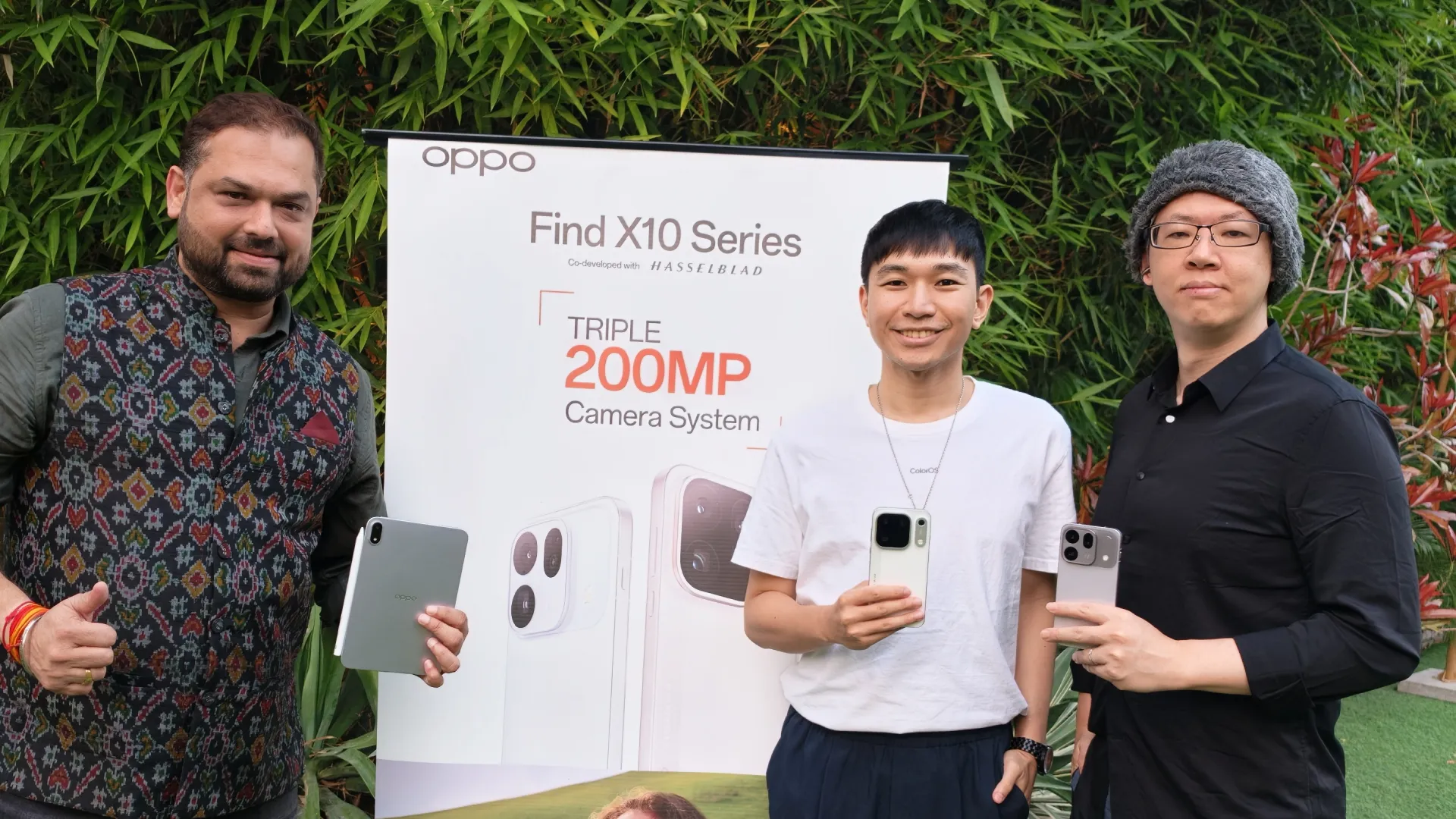
Ahead of the Find X10 series launch in India, I joined a roundtable where OPPO confirmed it will announce pricing on October 22. Simon Liu, Ellis Tai, and Goldee Patnaik outlined their approach to the camera, AI, and why OPPO thinks it can sell a premium phone in a market where component costs keep climbing.
Most smartphone makers chase photographic realism. They want accurate colors, sharp detail, and clean processing. OPPO takes a different route with the Find X10 series. Liu’s team wants the camera to capture what people remember about a moment, not just what a neutral sensor would see.
We discussed the Find X10 Pro Max’s triple 200MP camera, India-specific image tuning, AI, privacy, battery life, and after-sales service. I pressed the executives on what ‘True to Life’ means, how OPPO plans to make AI useful, and what the Find X10 series needs to do to earn its premium price.
Simon Liu on why OPPO wants cameras to capture memories, not just reality
Q: OPPO has been talking about its True to Life philosophy. How does this differ from how smartphone cameras traditionally approach image processing, and what does that mean for image tuning?
Simon Liu, Global Imaging Director, OPPO: “For ‘True to Life,’ we mean imaging in a way that matches your experience.”
Liu explained the philosophy. What you see is different from what you remember. He used a sunset beach as an example. The real scene might not be perfect, but your mind keeps an idealized version. Later, when you look at a photo, you compare it to that memory, not the exact scene.
“We’re aiming not for the physical, but for the memories,” he said.
This shifts the conversation away from camera accuracy alone. OPPO isn’t saying physical accuracy doesn’t matter. Liu’s point is clear: a photo also needs to match the feeling you take away from an experience.
I asked how OPPO’s approach compares with Apple’s focus on natural photos and Vivo’s heavier processing. Liu said the iPhone aims for physical authenticity, Vivo goes the other way, and OPPO sits in the middle. His reasoning: people from different backgrounds remember the same scene differently. Culture and upbringing shape how we see color, light, and atmosphere.
Liu said OPPO talks to users and visits homes to see how people perceive familiar scenes. He mentioned a trip to Kerala, where he learned about Kathakali and its vivid colors. That is how local context shapes their work. The philosophy sounds good, but execution matters most. What looks great to one person might seem oversaturated to someone else.
ALSO READ: Best Dishwasher Deals Under ₹50,000 in India: What to Buy Right Now
Does the Indian market get its own camera tuning?
Q: How does that cultural influence translate into the camera experience for Indian users? Does OPPO use a separate camera pipeline or dedicated camera-tuning tables for India?
Liu said OPPO maintains dedicated camera-tuning tables for India, even though the company would technically prefer a single global imaging pipeline. “Indian user preferences have distinct dynamic preferences, so Indian units receive customised camera tuning,” he said.
Camera hardware is just one piece of the puzzle. Software determines exposure, contrast, skin tones, and saturation. These factors shape how a photo looks. Liu made it clear OPPO treats local tuning seriously. They want their processing to match what Indian buyers prefer, while keeping a common base across markets.
What will the Pro Max’s triple 200MP cameras actually change?
Q: Moving from the previous generation’s 50MP sensors to 200MP sensors across the main, ultra-wide and telephoto cameras on the Find X10 Pro Max sounds like a significant hardware change. What will users actually notice, and how does that affect zoom?
Liu called the triple-200MP setup an industry first. The higher resolution gives OPPO more flexibility with zoom. You can crop into the center of the sensor for better zoom. You can also combine pixels to boost light and color. Before, they could only do this on one sensor. Now, they can do it across the whole zoom range.
When asked how much of the improvement comes from hardware versus processing, Liu broke it down into three parts: hardware, computational processing, and tuning. Better sensors and chipsets lay the groundwork. The Lumo Engine handles tasks like multi-frame stacking. The tuning philosophy shapes the final image. Megapixels alone do not guarantee better photos—lens quality, stabilization, and processing all matter. The real test is whether the camera stays consistent across zoom and lighting.
What has changed with Lumo Engine 2.0?
Q: What is different about the Lumo Engine 2.0 in the Find X10 series compared with the Find X9, and how does it support the camera system?
Liu broke down Lumo into two parts: the imaging engine, which handles sensor input and processing, and Lumo image tuning, which sets the final look. This split ties back to the True to Life philosophy. Even with better sensors and more power, OPPO still decides how much contrast and color to add.
Ellis Tai on OPPO’s next AI ambition: getting things done
Q: MediaTek’s Dimensity 9600 Pro brings new AI processing capabilities. How is OPPO using that for agentic AI in the Find X10 Pro Max, and what does Mind Pilot do?
Ellis Tai, OPPO’s Software Product Director, said OPPO is focused on on-device AI. Mind Pilot is the big new feature. Built into ColorOS, Mind Pilot can understand photos and files on your phone and carry out multi-step actions from a single prompt. The goal is to move beyond AI that answers one question at a time. OPPO wants a system that can follow instructions and handle a whole sequence of tasks, so you don’t have to jump between apps.
ALSO READ: ColorOS 17 Review: A New Benchmark for Design, Smoothness, and AI
Q: How does ColorOS balance cloud processing benefits with protecting personal data?
Tai said sensitive personal information, including photos and identity-document details, stays entirely on-device when relevant AI features access it. For computationally heavy tasks that require cloud processing, he said OPPO anonymizes data before it leaves the device, describing a secure hybrid architecture that combines local and cloud resources.
Q: What about AI Scam Call Detection? Does it fall under security and privacy rather than proactive AI?
Tai said it does not. OPPO treats AI Scam Call Detection, including detection of AI-generated synthetic voices, as part of the phone’s security and privacy layer, separate from Mind Pilot and AI Mind Suggest.
What does proactive AI mean for everyday use?
Q: What other AI experiences can users expect from ColorOS 17?
Tai described proactive AI as a second category, focused on AI Mind Suggest. This feature brings up reminders, flight and train updates, and morning briefs through local Indian partners like MakeMyTrip. The idea is simple: give you useful info without making you open several different apps.

Goldee Patnaik on pricing, premium positioning and the Indian market
Q: RAM and storage costs have been pressuring smartphone pricing. How will OPPO price the Find X10 series for India without compromising the experience?
Goldee Patnaik, Head of Communication, OPPO India: Patnaik acknowledged rising component costs across the industry, linking the pressure to growing AI-related demand. He said OPPO made no compromises on experience or build quality and confirmed it will reveal the launch price on October 22.
Q: Beyond specifications, how is OPPO strengthening the ownership experience in India?
Patnaik pointed to the Find X9’s sales in India, which were three times higher than the previous model. For the Find X10, he highlighted manufacturing at OPPO’s Greater Noida plant. The phones are made in India and engineered for Indian users. He also highlighted the Find X10 Pro Max’s 8,000mAh battery, built to keep 80% of its capacity after five years.
Patnaik pointed to after-sales service. OPPO has over 630 service centers in more than 500 towns, including 100-plus Service Center 3.0 Pro locations with digital queue management, real-time repair tracking, and support in 19 languages. OPPO is also expanding its offline retail and offering flexible EMIs, buybacks, and trade-ins.
Will ColorOS offer a desktop-like experience?
Q: Has OPPO considered a workstation mode similar to Samsung DeX, given how powerful flagship processors have become?
Tai didn’t promise any new desktop features. He said you need three things for a desktop-class experience: strong hardware, a supporting app ecosystem, and OS integration. OPPO also talked about its connected devices, like the OPPO Pad Mini with AMOLED and stylus support, and Enco X4 earbuds made with Dynaudio. ColorOS 17 isn’t the end point. The teams are already working on what’s next.
What OPPO needs to prove with the Find X10 series
Liu’s camera philosophy puts human perception and memory on the same level as technical accuracy. Tai’s software vision is about AI that works with your data and gives you useful updates before you even ask. Patnaik’s comments show how these ambitions fit into India’s premium smartphone market. Price, battery life, and service still matter most.
The Pro Max’s triple-200MP camera has to deliver consistent results, no matter the zoom or lighting. Mind Pilot needs to handle tasks reliably. The battery, software, and service network all have to support OPPO’s push for premium. I’ll see if the Find X10 series is a real leap or just another list of claims after the October 22 price reveal and some hands-on time.
You can follow Smartprix on Twitter, Facebook, Instagram, and Google News. Visit smartprix.com for the latest tech and auto news, reviews, and guides.