


Quick Verdict
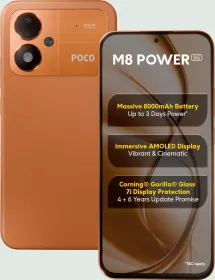
The POCO M8x is the M8 Power with the priorities flipped. You still get a huge battery, HyperOS 3, and a four-year update promise, and this time POCO has added stereo speakers and a headphone jack. What you lose is the thing that made the M8 Power easy to recommend: the AMOLED panel. This is a 6.9-inch 720p LCD, and at a launch price of ₹20,999 that is a real compromise.
Buy it if:
- You want battery life that can stretch past a day without planning around a charger.
- Stereo speakers, a 3.5 mm jack, and a microSD slot matter more than a sharp screen.
- You want the longer HyperOS update promise without spending M8 Power money.
Skip it if:
- You care about display quality. The M8 Power’s AMOLED is the better screen, full stop.
- You want a phone that is easy to use one-handed.
- Cameras, especially video and low light, are anywhere near the top of your list.
POCO’s M-series is still about the basics, and the M8x leans into battery harder than anything else. The M8 Power, which I reviewed in August, did that without giving up the display. This one saves money by going back to LCD, then spends it on a 7,900 mAh cell, the Snapdragon 4 Gen 5, and a second speaker.
With a launch price under ₹21,000, it certainly has a specific audience in mind. How well does the rest of the phone hold up, and are the compromises worth making? Let’s find out in this review.
HOW I TESTED
| Reviewed By: Mehtab Ansari, expert in smartphones, cameras, and consumer tech (5 years experience, 150+ reviews) Test Unit: POCO M8x 5G, 6 GB + 128 GB, Leather Green. Duration and Environment: Used on a Jio connection in India, mixed between indoor use, commuting, and some outdoor use. Tests: Calls, social media, streaming, navigation, light gaming, camera samples in daylight and low light, and battery drain across mixed use. AnTuTu and Geekbench numbers below are from instrumented runs on the 6 GB unit. Competitors: OnePlus N6, iQOO Z11 Lite, realme P4R, moto G57 Power |
POCO M8x Price & Availability
The POCO M8x comes in two configurations:
- 4 GB + 128 GB: ₹20,999
- 6 GB + 128 GB: ₹22,999
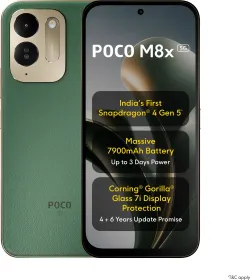
It went on sale from August 27 on Flipkart, and it is also listed on Amazon. Colors are Leather Green, Blue, and Black. Leather Green is the one with the textured back.
Pros
- 7,900 mAh battery
- 45W charging and 22.5W reverse wired charging
- Stereo speakers, which the M8 Power does not have
- 3.5 mm headphone jack
- HyperOS 3 with 4 years of OS updates and 6 years of security patches
- Dedicated microSD slot
- IP64 and Gorilla Glass 7i
- Side fingerprint scanner is fast and accurate
Cons
- 720p LCD, soft text, and weak outdoor brightness
- 232 grams and 8.8 mm, heavier than the M8 Power
- Only one usable rear camera, no OIS, no 4K
- UFS 2.2, and RAM tops out at 6 GB
- Noticeable bloatware
POCO M8x Specifications
| Category | Specifications |
| Display | 6.9-inch IPS LCD, 720 x 1600 resolution, 254 ppi, 120Hz refresh rate, 675 nits typical brightness, 825 nits HBM, Gorilla Glass 7i, Wet Touch 2.0, punch-hole |
| Processor | Qualcomm Snapdragon 4 Gen 5 (4nm), 2x 2.4GHz Cortex-A78 + 6x 2.0GHz Cortex-A55, Adreno 613 GPU |
| RAM | 4GB / 6GB LPDDR4X |
| Storage | 128GB UFS 2.2, dedicated microSD card slot |
| Rear Camera | 50MP, f/1.8, PDAF, LED flash, auxiliary lens, 1080p at 30fps |
| Front Camera | 8MP, f/2.0, 1080p at 30fps |
| Battery | 7,900mAh |
| Charging | 45W wired charging, 22.5W reverse wired charging |
| Audio | Stereo speakers, 3.5mm headphone jack |
| Biometrics | Side-mounted fingerprint scanner, 2D face unlock |
| Dimensions | 170.1 x 78.4 x 8.8mm |
| Weight | 232g |
| Protection | Corning Gorilla Glass 7i, IP64 |
| Connectivity | 5G, Wi-Fi, Bluetooth 5.1, GPS, FM radio, USB-C 2.0, no NFC |
| Software | HyperOS 3 based on Android 16 |
| Software Updates | 4 years of OS updates, 6 years of security patches |
| Colors | Leather Green, Blue, Black |
POCO M8x Review: Unboxing
Inside the box you get the phone, a protective case, a 45W charger, a USB-A to USB-C cable, a SIM ejector tool, and the usual paperwork. The charger is in the box, which still matters on a 7,900 mAh phone.

POCO M8x Review: Design and Build

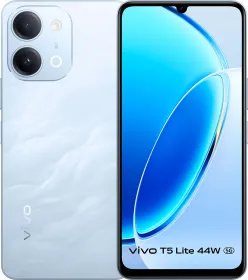
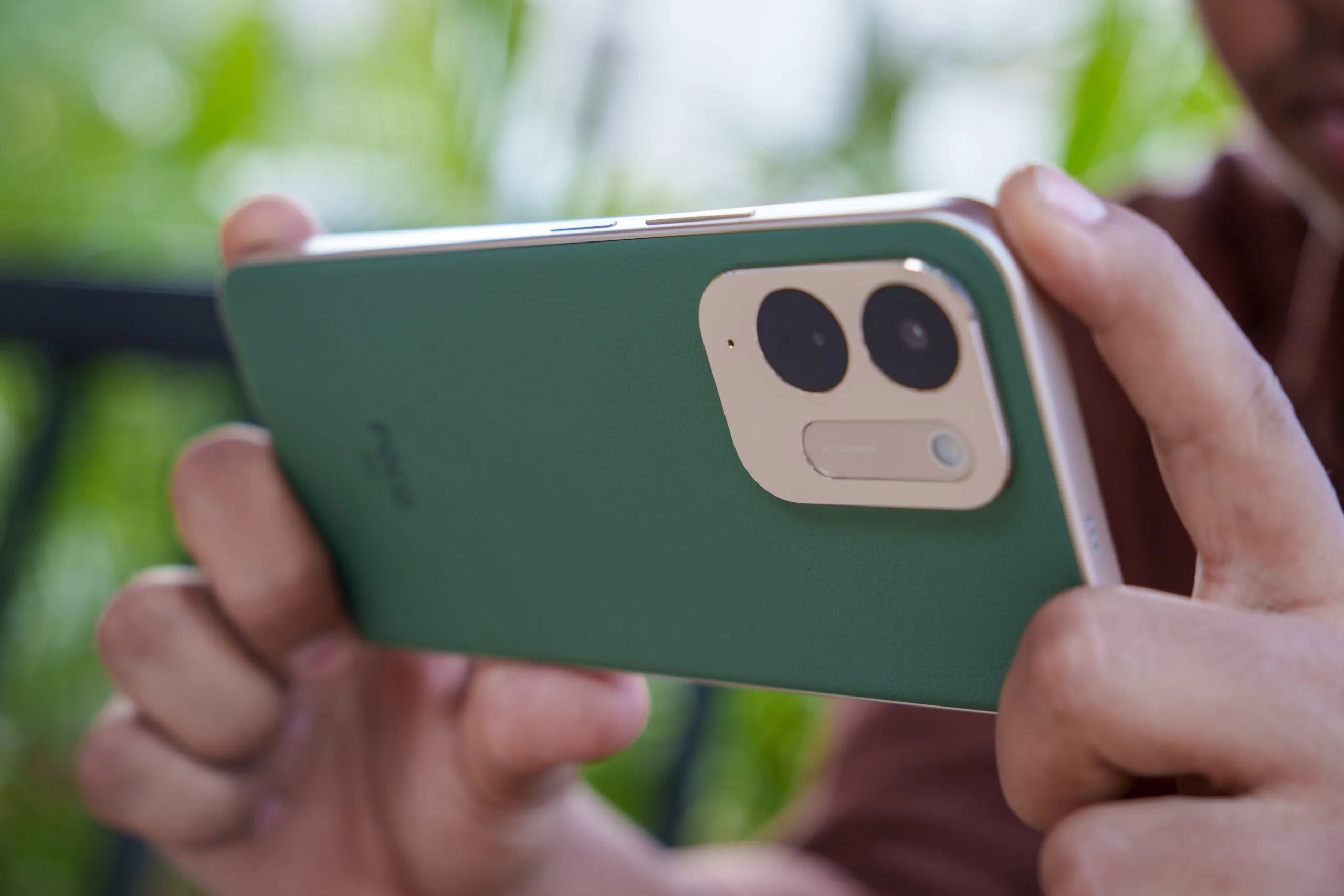
The Leather Green variant has the most interesting finish, with a smooth vegan-leather texture that gives the phone a more premium look. It also offers better grip than glossy plastic, making it comfortable to use without a case. The Blue and Black options have a simpler finish. Around the back, the camera island follows POCO’s familiar design, with a single primary camera and an auxiliary sensor housed inside the module.
It is a big, dense phone. At 232 grams and 8.8 mm, it is heavier and thicker than the M8 Power, which was already 225 grams. The corners are very round, so it does not dig into the palm, but one-handed use is awkward and a pocket feels it. The chin is thick. Side bezels are also not thin, and on a 720p panel they are more obvious.

You get Gorilla Glass 7i and an IP64 rating. That covers dust and splashes, not a rinse under a tap, and it is a small step down from the IP65 on the M8 Power. The useful extras are on the frame: a 3.5 mm jack up top, a second speaker, and a side fingerprint scanner. The SIM tray is dual nano-SIM, with a dedicated microSD slot rather than a hybrid one.
POCO M8x Review: Display
The M8 Power’s 6.9-inch Samsung E4 AMOLED was the reason that phone worked. The M8x keeps the 6.9-inch size and drops to a 720 x 1600 IPS LCD at 120 Hz.

Indoors, at 60 to 70% brightness, it is fine for YouTube, reels, and chat. Colors are acceptable for an LCD. Blacks are grey, contrast is flat, and text is soft because the panel is only about 254 ppi. You notice it next to a FHD+ screen immediately.

Outdoors is worse. Typical brightness is 675 nits and HBM is 825 nits, so direct sun washes the screen out. YouTube also tops out at 1080p on a 720p panel, so the extra stream is wasted.

The 120 Hz mode helps in the launcher. Third-party apps do not always hold it. Wet Touch 2.0 is here for damp fingers. There is no DC-dimming conversation to have, because this is an LCD, not a low-PWM OLED. That is the one flicker complaint the M8x simply does not inherit.
POCO M8x Review: Speakers and Haptics
Stereo speakers are the easy win over the M8 Power, which shipped with a single bottom speaker. Separation is obvious in YouTube and games, volume is good enough for a room, and the 3.5 mm jack means you are not hunting for a dongle. It is not a rich speaker system. Bass is thin, and it gets harsh at the top end. For this price, having two of them still counts.

Haptics are basic. Taps are there, they are not particularly sharp, and you will not confuse this with a linear motor. They are not the thing you buy the phone for.

POCO M8x Review: Software
The M8x runs HyperOS 3 based on Android 16, the same software version as the M8 Power. POCO also promises 4 years of Android updates and 6 years of security patches, which is a good commitment for this price segment.

The interface is a pared-down version of HyperOS. You get customizable lock-screen clocks, different control-center styles, and Hyper Island for showing timers and hotspot status. Circle to Search and Gemini are also supported. Some of the visual effects and smoother animations found on more expensive POCO phones are missing.

Bloatware remains part of the experience. My 6GB review unit came with several preinstalled apps and games, most of which can be uninstalled. The built-in app store and a few Xiaomi services remain. The home screen also shows frequent app suggestions.

POCO M8x Review: Biometrics
The fingerprint scanner is on the power button. It is faster and more consistent than the optical under-display reader on some other phones. Face unlock is the usual 2D camera system. It is fine indoors, useless in the dark, and not something to rely on.

POCO M8x Review: Performance
The Snapdragon 4 Gen 5 is a small step up from the 4 Gen 4 in the M8 Power, and this is the first phone in India with it. There are two Cortex-A78 cores at 2.4 GHz, six A55 cores at 2.0 GHz, Adreno 613, up to 6 GB of LPDDR4X, and UFS 2.2 storage.
Synthetic Benchmarks
| Benchmark | POCO M8x (Snapdragon 4 Gen 5) |
| AnTuTu Score | 633462 |
| Storage (Score, Sequential Read Speed, Write Speed) | Score: 49968; Sequential Read: 858 MB/s; Sequential Write: 742 MB/s |
| Geekbench 6 CPU (Single-Core, Multi-Core) | Single-Core: 742; Multi-Core: 1321 |
| 3DMark Wildlife Extreme Stress Test (Best Loop, Lowest Loop, Stability) | Best Loop: 399; Lowest Loop: 396; Stability: 99% |

For everyday use, the M8x handles the usual workload comfortably. Calls, navigation, YouTube, and casual gaming run smoothly. Apps such as Instagram and X occasionally show minor stutters while scrolling, and the 6GB variant manages around three to four apps in the background before some begin reloading. A little more RAM would have helped with multitasking.

Gaming is suited to casual and moderately demanding titles. Clash of Clans and Free Fire run comfortably, while BGMI is playable with some frame drops during extended sessions. The phone also gets warm under sustained loads.
POCO M8x Review: Cameras
The M8x features a 50 MP primary camera with an f/1.8 aperture, PDAF, and an LED flash. The auxiliary sensor alongside it is similar to the setup on the M8 Power. The camera app also includes several shooting modes to explore.

In daylight, the main camera captures natural-looking colors, decent contrast, and a reasonable amount of detail. The processing keeps saturation in check, which makes photos look fairly true to life. Details hold up well when viewed on the phone’s display, although they appear softer on larger, sharper screens. The camera has a narrower than usual field of view at 1X, with 2X zoom relying on a digital crop.


Low-light photography takes a little more patience. Noise becomes more visible, particularly in darker areas, and keeping the phone steady helps produce sharper results. Night mode lends a hand with exposure, while portrait mode works well for casual photos and sharing on social media.
The 8 MP front camera handles everyday selfies, with its best results coming in good lighting. Skin tones receive a soft treatment, and image quality varies as lighting conditions change. Both front and rear cameras support video recording at 1080p30, with digital stabilization available for handheld clips.


The camera app includes film filters, night mode, portrait, document mode, and dual-video recording. There are several options for casual photography, and the 50 MP main camera remains the centerpiece of the experience.
POCO M8x Review: Battery Life and Charging
The battery is the M8x’s biggest strength. It packs a 7,900 mAh cell, just 100 mAh smaller than the M8 Power. In my usage, it lasted over 11 hours of screen-on time, dropping from 100 to 10%. That’s the highest figure I’ve recorded in this price segment this year. With mixed usage, the M8x comfortably lasts two days as a primary phone. Light users can stretch that even further.

Charging is rated at 45W, and the adapter is included in the box. A 10 to 100% charge takes around 80 minutes. The M8x also supports 22.5W reverse wired charging, which comes in handy for charging earbuds or another phone.
You can comfortably go two days between charges, and that’s the M8x’s biggest selling point.
Review Verdict: Should You Buy the POCO M8x?
The M8x makes a strong case for itself if battery life is your priority. The endurance is excellent, the software update promise remains competitive for this segment, and stereo speakers, a headphone jack, and a more reliable side-mounted fingerprint scanner make for a better overall experience than the M8 Power in a few areas.
The display is the biggest compromise. A 720p LCD at this price is difficult to justify, especially when the M8 Power offers an AMOLED panel for slightly more money. The cameras are also fairly basic, and the 232g weight makes the phone quite heavy to carry.
Ultimately, the M8x is best suited to buyers who value battery life above everything else. It gets that part right, while the display and camera experience leave room for improvement.

Smartprix ⭐ Rating: 8.0/10
- Design and Build: 8/10
- Display: 6.5/10
- Speakers: 7.5/10
- Software: 8/10
- Haptics:6.5/10
- Biometrics: 8.5/10
- Performance: 8/10
- Cameras: 7.5/10
- Battery Life & Charging: 9/10
First reviewed in November 2026.