

Quick Verdict
The POCO M8 Power is one of those rare budget phones that gets the fundamentals right. An 8,000 mAh battery, a genuinely good AMOLED display, and a HyperOS 3 upda
te promise that’s frankly unheard of at this price make it a comfortably strong pick under ₹22,000 at launch. The cameras are still budget-tier, and the mono speaker is a letdown, but almost nothing else here feels like it’s been cut corners just to hit the price point.
Buy it if:
- You want the best battery life you can get in this segment, without exception.
- You care more about display quality and software support than camera performance.
- You’re on a tight budget and want a phone that doesn’t feel compromised everywhere.
Skip it if:
- Camera quality (especially video) is a priority for you.
- You want stereo speakers or NFC support.
- You’re particular about PWM dimming and panel reliability (more on that below).
POCO’s M-series has always been about doing the basics well and skipping the fluff, and the M8 Power leans into that harder than any recent phone in this price bracket. At ₹21,999 onward, it’s going up against a crowded field: realme, OnePlus, vivo, and iQOO all have something to say at this price, but POCO’s pitch here is simple: give people a battery that lasts days, a display that doesn’t feel like a downgrade, and software support that actually matches what pricier phones offer.
I’ve spent over a week with the 8 GB + 128 GB unit, and while my opinion on a few things shifted as I used it longer, the overall picture is that POCO has genuinely nailed the value proposition here. Let’s get into it.
HOW I TESTED
| Reviewed By: Mehtab Ansari, expert in smartphones, cameras, and consumer tech (5 years experience, 150+ reviews) Test Unit: POCO provided the review unit of the POCO M8 Power, though the company had no input in this review. Duration and Environment: I used the phone for over a week in India, running daily tasks alongside gaming sessions to properly stress the battery and thermals. Tests: Daily usage including calls, social media, streaming, and navigation, along with gaming sessions to check performance and heating. AnTuTu was used for a synthetic performance benchmark, and battery drain was tracked across mixed usage over multiple days. Competitors: iQOO Z11 Lite, OnePlus N6, vivo T5 Lite, moto G77 Power |
POCO M8 Power Price & Availability
The POCO M8 Power comes in two configurations:
- 6 GB + 128 GB: ₹24,999 (₹21,999 at launch)
- 8 GB + 128 GB: ₹27,999 (₹24,999 at launch)
The launch price includes a ₹1,000 coupon discount, valid for the first 12 hours of sale, plus a ₹2,000 instant bank discount or exchange bonus. The POCO M8 Power goes on sale starting August 7 on Flipkart.
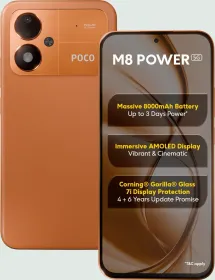
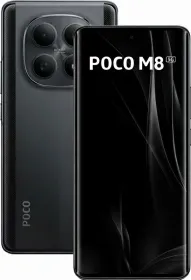
The phone is available in Black, Silver, and Blaze Orange colorways.
Pros
- Genuinely good AMOLED display with punchy colors and deep blacks
- Supports DC dimming, which offsets the low 960 Hz PWM rating
- Gets plenty bright
- Massive 8,000 mAh battery
- 22.5W reverse wired charging included
- HyperOS 3 with 4 years of software updates and 6 years of security patches is exceptional at this price
- Device barely heats up
- Circle to Search and Gemini support included
- IR blaster
Cons
- Mono speaker instead of stereo
- Camera performance is inconsistent, especially in low light
- Haptics feel cheap
- Slow charging
- Fingerprint scanner occasionally fails to register
- Noticeable bloatware, and a few apps can’t be uninstalled at all
- Performance is just decent for daily tasks
POCO M8 Power Specifications
- Display: 6.9-inch AMOLED (Samsung E4), 1080 x 2396, 375 PPI, 120 Hz adaptive (120/90/60 Hz), 960 Hz PWM dimming, DC dimming support, up to 1800 nits peak brightness, Wet Touch 2.0, Sunlight Display, punch-hole cutout
- Processor: Qualcomm Snapdragon 4 Gen 4 (4 nm), 2x 2.3 GHz Cortex-A78 + 6x 1.95 GHz Cortex-A55
- RAM: 6 GB / 8 GB LPDDR4X
- Storage: 128 GB UFS 2.2
- Main Camera: 50 MP Samsung JNS, 1/2.76-inch, f/1.8, 28mm, PDAF, 2X in-sensor zoom, 1080p30
- Front Camera: 8 MP, 1/3.8-inch, , f/2.0, 1080p30
- Battery: 8,000 mAh silicon-carbon, Xiaomi Surge G1
- Charging: 45W wired (PD 3.0 compatible), 22W reverse wired charging
- Cooling: 10,416 mm² graphite cooling system
- Audio: Single (mono) speaker with 200% volume boost, no 3.5mm jack, 24-bit/192kHz Hi-Res audio support
- Biometrics: Optical under-display fingerprint scanner
- Dimensions: 169.7 x 79.1 x 8.3 mm
- Weight: 225 grams
- Protection: Corning Gorilla Glass 7i, IP65
- Connectivity: 5G, WiFi 5, Bluetooth 5.1, GPS, IR blaster, no NFC (India)
- Software: HyperOS 3, 4 years of software updates + 6 years of security patches
- Colors: Black, Silver, Blaze Orange
POCO M8 Power Review: Unboxing
Inside the box, you get the POCO M8 Power itself, a black protective case, the 45W charger, a USB-A to USB-C cable, a SIM ejector tool, and the standard paperwork.
POCO M8 Power Review: Design and Build
The design immediately draws comparisons to the iPhone 17 Pro, especially around the camera island. That said, POCO has been using this island-style camera layout as part of its identity for a while now, so it’s more fair to say the shape isn’t really “inspired.” The color options, though, definitely feel like they’re taking a cue from Apple’s latest.

At 225 grams and 169.7 x 79.1 x 8.45 mm, the phone is noticeably heavy in hand, and that weight makes itself known during longer sessions of one-handed use. It’s not particularly thick on paper, but it feels dense and heavy in practice, which is a fairly direct trade-off for packing in a battery this large.

Port and button layout is fairly standard for this segment. Up top, you get a secondary microphone alongside the IR blaster, and the bottom edge houses the primary microphone, the single speaker, and a USB Type-C port.


The SIM tray takes dual Nano-SIM cards, with one slot doubling up for microSD expansion if you need it. On the right edge, you get the power button paired with the volume rockers, both of which are easy to reach and have a reasonably tactile click to them.


On the durability front, the POCO M8 Power is protected by Corning Gorilla Glass 7i and carries an IP65 rating. That’s a step down from the IP68/IP69 ratings you get on pricier phones, but it’s still acceptable protection against dust and splashes at this price.
POCO M8 Power Review: Display
The M8 Power uses a 6.9-inch AMOLED panel, and this is honestly one of the biggest strengths of the phone. In the current market, an LCD panel at this price would have been the safe, expected choice, so seeing AMOLED here is a genuinely good move from POCO. Also, at 6.9 inches, it is quite big, and also wider than most smartphones.

The panel is a Samsung E4, and that comes with some baggage: the E4 doesn’t have the best reputation, with users on other devices reporting green line issues over time. It’s worth flagging, even though chances are unlikely you’ll run into an issue like that.
Colors are punchy, blacks are deep, and contrast is excellent, which makes content consumption comfortably one of the better experiences you’ll get in this segment. The display runs at 120 Hz, with the option to step down to 90 Hz or 60 Hz, and most apps run smoothly at the top refresh rate. Brightness is strong too, and outdoor visibility isn’t a concern except under harsh sunlight.

One thing worth noting is the 960 Hz PWM dimming, which is on the lower side and might bother users who are sensitive to PWM flicker. Thankfully, POCO includes DC dimming as an option, which is a major relief for anyone who finds the default dimming uncomfortable.

On paper, the panel also gets a DCI-P3 wide color gamut rating, a 5,000,000:1 contrast ratio, TÜV-certified eye protection, and POCO’s Wet Touch 2.0 and Sunlight Display features for better usability outdoors and with wet fingers.
Bezels are fairly good considering what realme, OnePlus, vivo, and iQOO are offering at this price, though the chin is still noticeably thicker than the rest of the borders.
POCO M8 Power Review: Speakers and Haptics

The POCO M8 Power ships with a single, mono speaker, which is disappointing. That said, it does get very loud, helped by a 200% volume boost, so it’s not a complete letdown for casual use.
Haptics are the weaker part of the experience. Even after switching away from the default keyboard, the feedback still feels springy and cheap, and it doesn’t hold up well against pricier phones in the same price bracket.
POCO M8 Power Review: Software

The phone runs HyperOS 3, backed by a promise of 4 years of software updates and 6 years of security patches. For a phone at this price, and especially from POCO, that update commitment is excellent and hard to find elsewhere in this segment.

Out of the box, you’ll find the older MIUI-style control center has made a return, though you can switch to the newer split-style HyperOS control center from the settings if you prefer that layout. Lock screen customization is extensive, and there’s a good amount of personalization on offer overall.

AI features are present too, including Circle to Search and Gemini support, both of which are nice to have on a phone at this price. In the gallery, you get an AI Expand tool for extending images. There’s also an Ask AI feature baked into global search, which lets you ask questions directly and attach images or files, with your chat history saved for later.

Xiaomi HyperConnect and Xiaomi Interconnectivity are both supported, letting you transfer data and connect with other Xiaomi devices easily. The IR blaster is also present, which is a small but useful inclusion.
The experience isn’t without its rough edges, though. Bloatware is noticeable, with several pre-installed games like Bubble Shooter and Blockstar taking up space. Most of these apps can thankfully be uninstalled, but the built-in app store and a handful of others can’t be removed at all. Swiping down on the home screen also surfaces a fair number of ads, which isn’t a great look.

The default keyboard is set to POCO’s Emoji & Font keyboard, which isn’t great, but switching to Gboard is an easy improvement. Hyper Island is present as well, though the animations that trigger with the torch or music playback feel oddly unpolished.
POCO M8 Power Review: Biometrics

The POCO M8 Power uses an on-screen fingerprint scanner, and while it’s decent overall, it occasionally fails to register a fingerprint on the first try. You also get face unlock, but that’s the usual 2D one.
POCO M8 Power Review: Performance
The POCO M8 Power runs on the Snapdragon 4 Gen 4, and this is a decent-ish chipset. It’s essentially in line with the Dimensity 6300, and in fact, it’s the rebranded version of the Snapdragon 4 Gen 2. You get two 2.3 GHz Cortex-A78 cores paired with six 1.95 GHz Cortex-A55 cores, so it’s slightly less powerful than the infamous Dimensity 6300.
That’s paired with up to 8 GB of LPDDR4X RAM (expandable with up to 8 GB of virtual RAM) and 128 GB of UFS 2.2 storage, which is about what you’d expect at this price. On the AnTuTu benchmark, the phone scores around 625K, which is decent-ish for the segment in the current market.
Storage speeds come in at around 1,070 MB/s sequential, thanks to dual-lane UFS 2.2, though not quite as fast as the single-lane setup found on phones like the OnePlus N6X, but reasonable nonetheless.
Synthetic Benchmarks
| Benchmark | POCO M8 Power (Snapdragon 4 Gen 4) |
| AnTuTu Score | 625010 |
| Storage (Score, Sequential Read Speed, Write Speed) | Score: 66925; Sequential Read: 1070 MB/s; Sequential Write: 816 MB/s |
| Geekbench 6 CPU (Single-Core, Multi-Core) | Single-Core: 951; Multi-Core: 2310 |
| Geekbench 6 GPU (OpenCL) | OpenCL: 444 |
| 3DMark Wildlife Extreme (Score, Avg FPS) | Score: 191; Avg FPS: 1.15 |
| 3DMark Wildlife Extreme Stress Test (Best Loop, Lowest Loop, Stability) | Best Loop: 190; Lowest Loop: 188; Stability: 99% |


In daily use, the phone handles everyday tasks without much fuss, and I didn’t run into any real slowdowns during my testing period. The 10,416 mm² graphite cooling system does its job well: the device did not heat up even during outdoor use, which is a pleasant surprise.
The gaming performance of this phone, though, is quite disappointing. On BGMI, you get 60 FPS support with the Super Smooth setting, while the Smooth setting is limited to 40 FPS. The overall gaming experience is quite below average, and the frame rate drops noticeably after a while.
This definitely isn’t a phone built for gaming. You’ll get a similar experience in Call of Duty: Mobile, while lighter games like Clash of Clans run just fine. So if you’re a gamer or someone who frequently multitasks, this phone isn’t the right choice for you.
POCO M8 Power Review: Cameras

The POCO M8 Power uses a 50 MP Samsung JNS main camera with a 1/2.76-inch sensor, f/1.8 aperture, and a 28 mm focal length. That’s narrower than the 23 mm you’d typically find on similar phones, so you’ll capture noticeably less of the field of view than you might expect. There’s also a 2X in-sensor zoom mode available.


Camera performance overall is just decent, and that’s being generous in some conditions. Contrast is decent, colors are good, but sharpness and detail can be missing, and photos indoors or in low light frequently come out blurry. Portrait mode is present and also just decent. Don’t expect much beyond casual use. Although I would say the camera performance is better than the A27 and M47 from Samsung.


Despite the camera module looking like it packs several sensors, there’s really only one usable camera here: there’s no secondary camera doing any meaningful work. The 8 MP front camera uses a small 1/3.8-inch sensor with an f/2.0 aperture, and while selfies are decent in daylight, detail and sharpness are noticeably missing here as well.


Video recording tops out at 1080p30 from both the front and rear cameras, and video stabilization is a genuine weak point. It’s awful enough that you’ll want to avoid recording anything that requires steady footage.

On the software side, POCO bundles in Film Filters, Dynamic Photos, Pro Mode, Time-lapse, Document Mode, and Voice Shutter on the main camera, plus Video Beauty, Fill Light, and a built-in Teleprompter on the front camera. They’re a nice set of tools to have around for casual content creation.

Overall, the cameras are the clearest reminder that this phone had to cut a corner somewhere, and it’s here.
POCO M8 Power Review: Battery Life and Charging

Battery is where the POCO M8 Power fully justifies its name. The phone packs a massive 8,000 mAh silicon-carbon battery, managed by Xiaomi’s Surge G1 battery management chip and rated for 1,600 charge cycles with 80% capacity retention even after 5 years of use, a reassuring number for anyone planning to keep this phone long-term.
POCO promises up to 3 days of usage on a single charge, and while I didn’t quite stretch it that far, I comfortably got around 9-10 hours of screen-on-time with mixed usage. That’s good, but considering just how large this battery is, I expected it to be a bit better still.
Charging is handled by a 45W charger included in the box, with PD 3.0 support so you can use any compatible charger as well (up to 25W in my testing). A full charge from 0-100% takes around 1 hour 50 minutes, which is, to be honest, slow. You also get 22.5W reverse wired charging, letting you top up another device when needed, though I noticed the speeds tend to taper off and get slower the longer you use it.
Review Verdict: Should You Buy the POCO M8 Power?
The POCO M8 Power keeps things simple: massive battery, a good AMOLED display, and a software update commitment that puts even pricier phones to shame. Performance is decent-ish, and it comfortably handles daily use without heating up, even in the hot weather.
The cameras are the one area where corners were clearly cut: video stabilization is a weak point, and low-light photos struggle noticeably. The mono speaker and cheap-feeling haptics don’t help either, and the slow charging is worth keeping in mind.
At ₹21,999 at launch, though, the POCO M8 Power is still an excellent value pick if battery life and display quality matter to you. Overall, the POCO M8 Power is one of the best phones you can buy under ₹22,000 right now, provided you know exactly what you’re trading off to get here.

Smartprix ⭐ Rating: 8.0/10
- Design and Build: 7.5/10
- Display: 8.5/10
- Speakers: 6.5/10
- Software: 8/10
- Haptics: 6.5/10
- Biometrics: 7/10
- Performance: 7.5/10
- Cameras: 6.5/10
- Battery Life & Charging: 8.5/10
First reviewed in August 2026.