


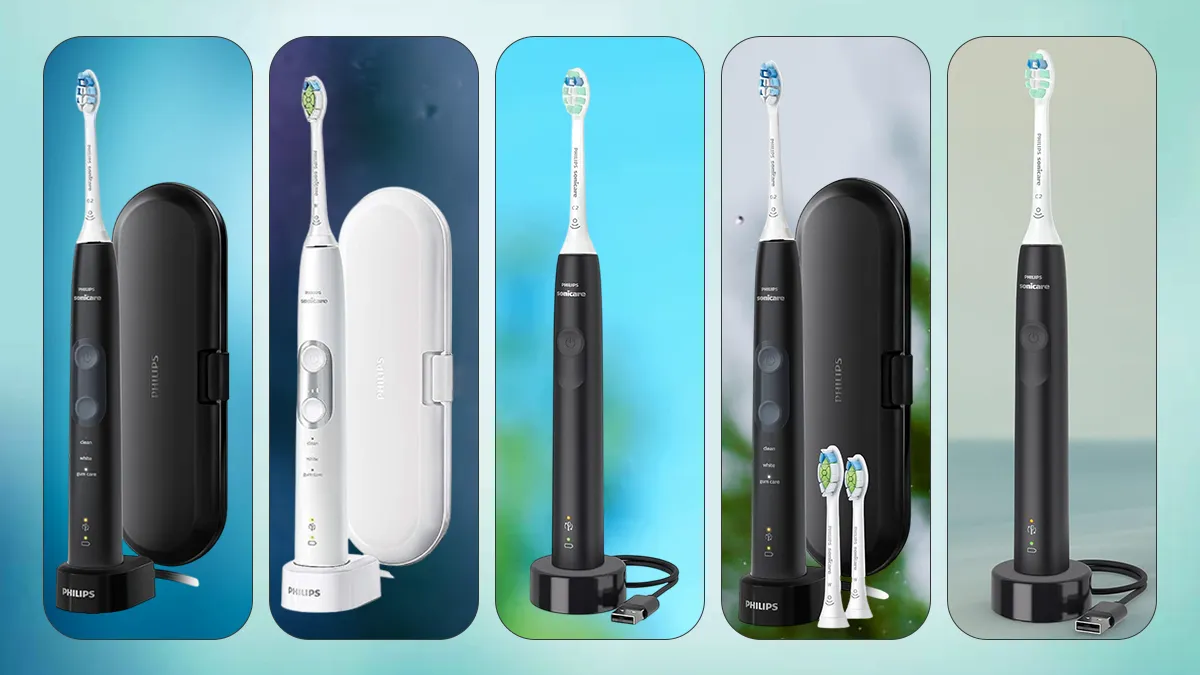
Quick answer: who should buy what
The Philips Sonicare 4100 is the best electric toothbrush for most people: it uses the same motor as higher models, costs less, and delivers clinically proven cleaning with a two-minute timer and pressure sensor. The Sonicare 6100 is the only meaningful upgrade, and only if you have sensitive gums, because it is the sole model with adjustable intensity settings. The 5100 and 5300 are the same handle in different packaging; buy whichever is cheaper.
- Sonicare 4100: Best for Most People
Same motor as every higher model. Best value. Buy this unless you have a specific reason not to. - Sonicare 6100: Best for Sensitive Gums
The only model with adjustable intensity (Low/Medium/High). Essential if your dentist has mentioned gum sensitivity or recession. - Sonicare 5100: Best for Frequent Travelers
Adds Clean, White, and Gum Care modes plus a travel case. Same handle as the 5300. - Sonicare 5300: Best Bundle Deal
Identical to 5100. Usually includes 3 brush heads. Buy if the bundle price works out cheaper per unit.
Why the Philips Sonicare Electric Lineup Is Deliberately Confusing
When I first unboxed all four Philips Sonicare handles – the 4100, 5100, 5300 and 6100 – and placed them on my bathroom shelf, my wife thought I’d bought the same electric toothbrush for everyone at home. This confusion arises because Philips uses nearly identical industrial design across the ProtectiveClean range. This deliberate similarity in design removes visual appeal and creates a customer confusion.
Here is the structural fact that underlies all the decisions below: all four of these toothbrushes use the same core sonic motor, running at 31,000 brush strokes per minute. You are not buying a more powerful brush when you move up the range. You are buying additional software modes and, for the 6100, the ability to run that motor at a lower setting. Everything else, the build, the battery, the head compatibility, is identical.
The single most important thing to know: Brushing effectiveness is determined by technique and consistency, not by which Sonicare model you own. Any of these four brushes, used twice daily for two minutes with proper technique, will remove significantly more plaque than a manual toothbrush. The choice between models is about comfort, convenience, and cost, not clinical outcomes.
Philips Sonicare Electric Toothbrush Comparison: 4100 vs 5100 vs 5300 vs 6100
| Highlights | Philips Sonicare 4100 | Philips Sonicare 5100 | Philips Sonicare 5300 | Philips Sonicare 6100 |
| Cleaning Modes | 1–2 (Clean, Sensitive)* | 3 (Clean, White, Gum) | 3 (Clean, White, Gum) | 3 (Clean, White, Gum) |
| Intensity Settings | Fixed (1 level) | Fixed (1 level) | Fixed (1 level) | 3 Levels (Low / Medium / High) |
| Pressure Sensor | ✓ Yes | ✓ Yes | ✓ Yes | ✓ Yes |
| 2-Minute SmarTimer | ✓ Yes | ✓ Yes | ✓ Yes | ✓ Yes |
| 30-Second QuadPacer | ✓ Yes | ✓ Yes | ✓ Yes | ✓ Yes |
| BrushSync Pairing | ✗ No | ✗ No | ✗ No | ✓ Yes |
| Brush Heads in Box | 1 | 1 | 3 (bundle) | 1 |
| Travel Case | ✗ None | ✓ Standard | ✓ Standard | ✓ Premium |
| Battery Life | ~14 days | ~14 days | ~14 days | ~14 days |
| Handle Difference from 5100 | Different | — | Identical to 5100 | Different |
| Best For | Most users | Travellers, multi-mode | Bundle value | Sensitive gums |
What All Four Models Share
Before the differences, the common ground is knowing that this prevents you from overpaying for something you already have on a cheaper model.
Every model in this comparison includes:
- SmarTimer: A two-minute countdown aligned with dental guidelines for brushing duration. The handle turns off automatically after two minutes.
- QuadPacer: A brief vibration pulse every 30 seconds, signaling you to move to the next quadrant of your mouth: upper left, upper right, lower left, lower right.
- Pressure Sensor: If you press too hard against your gum line (the most common brushing error and a leading cause of gum recession), the handle vibrates to warn you. This is not a gimmick; it is one of the most practically valuable features in any electric toothbrush.
- Brush Head Replacement Reminder: An LED on the handle illuminates when your brush head has worn past its optimal cleaning efficiency (roughly three months of twice-daily use).
- 14-Day Battery Life: A full charge provides approximately 14 days of use with twice-daily, two-minute sessions. All four charge on the same inductive base.
- Universal Sonicare Brush Head Compatibility: All four accept the full range of Sonicare replacement heads: C1, C2, C3, G2, G3, W3, and others.
If that list gives you everything you need, the 4100 is your answer. Read on to understand whether the upgrades on higher models are worth the premium.
Philips Sonicare 4100 – Best for Most People
Overall Rating (⭐): 9 out 10
Daily Cleaning
Ease of Use
Value for Money
Travel Suitability
Sensitive Gums
Pros
- Same cleaning power as the 4100 and 6100
- Travel case included (genuinely useful).
- White mode adds a 30-second polishing step.
- Gum Care mode is helpful after dental procedures.
9.5
10
9.8
5.2
6.5
Cons
- 1 brush head only (vs 3 in the 5300)
- Fixed motor intensity (no adjustment)
- Modes are software additions, not hardware upgrades.
- The price premium over 4100 is often hard to justify purely on the basis of modes.
I’ll be direct: this is the brush I recommend to most people who ask me. Not because it is the cheapest, but because it does the important things well, without the feature additions that inflate cost without improving your teeth.
The 4100 is Philips’ entry point to the ProtectiveClean series, and it shows the discipline of good engineering. The handle is slim, the controls are a single power button, and the result is a brush that a first-time electric user or a veteran will immediately feel at ease with. There’s no mode cycling, no LED matrix to decode, no cognitive overhead. You press the button and brush.
On the newer 4100 variants (what you’ll find in current 2025 and 2026 stock), Philips added a Sensitive mode alongside the standard Clean mode. Sensitive mode runs the same timer cycle but with a slightly modified vibration pattern better suited to inflamed or newly treated gum tissue. This is a meaningful addition for post-dental-work recovery periods.
3. No travel case in the box is a real inconvenience if you travel with your toothbrush more than occasionally. The brush head sits unprotected in your bag, which both damages the bristles and raises hygiene concerns. If you travel with it regularly, pay the 5100 premium and get the case.
I’ve used the 4100 as a daily driver for extended stretches, and at the end of each dental checkup during those periods, my hygienist’s assessment was identical to periods when I used the 6100. The motor is the motor. What matters is the two-minute timer and whether you actually use it.

2. Philips Sonicare 5100 Electric Toothbrush- Best for Frequent Travelers
Overall Rating (⭐): 7.5 out 10
Daily Cleaning
Ease of Use
Value for Money
Travel Suitability
Sensitive Gums
Pros
- Travel case included
- White mode adds 30-second polishing step
- Gum Care mode is helpful after dental procedures
- Same cleaning power as the 4100 and 6100
9.5
8.4
7
9
6.8
Cons
- Fixed motor intensity, no adjustment
- Modes are software additions, not hardware upgrades
- Price premium over 4100 often hard to justify purely on modes
- 1 brush head only (vs 3 in the 5300)
The 5100 is a good toothbrush. I want to be clear about that before being critical, because my criticism is about value positioning rather than product quality.
The step up from the 4100 comes in three forms: Clean mode (same as the 4100), White mode (Clean’s two minutes plus an additional 30-second polishing phase for front teeth surfaces), and Gum Care mode (Clean’s two minutes plus an extra minute at a reduced rhythm intended to stimulate gum tissue). All three are legitimate brushing protocols, and your dentist may recommend the latter two in specific situations.
The travel case is the 5100’s most practically useful addition over the 4100. It is a hard-shell case that protects both the handle and the brush head during transit. If you travel with your toothbrush more than twice a month (weekend trips, work travel, holidays), the case alone justifies a modest premium. If you travel rarely, it does not.
In real-world use over many months, I found myself defaulting to Clean mode roughly 90% of the time. White mode is something I’d use before a photo shoot or a big meeting. Gum Care is something I’d reach for during a period of gum inflammation. Neither is a reason to pay significantly more for a brush if you don’t have those specific needs. The modes work as advertised; they are just more situational than Philips’ marketing implies.
White mode does not whiten teeth in the cosmetic sense. It creates a slightly longer, more varied-brush motion that removes more surface staining than the standard Clean mode. Clinical whitening requires a peroxide-based product. Managing this expectation prevents the disappointment I’ve seen in readers who bought the 5100 expecting it to replace a whitening treatment.
3. Philips Sonicare 5300 – Best Bundle Value
Overall Rating (⭐): 7.5 out 10
Daily Cleaning
Ease of Use
Value for Money
Travel Suitability
Sensitive Gums
Pros
- Three brush heads means lower per-head cost
- Travel case included
- All the same modes as the 5100
9.5
8.4
7
9
6.8
Cons
- No hardware difference from the 5100
- The number “5300” implies an upgrade that doesn’t exist
- Bundle value depends entirely on current pricing
The Sonicare 5100 and Sonicare 5300 are the same toothbrush. Open both boxes, put both handles side by side, and you cannot tell them apart without reading the model number on the base. The internals are identical. The motor is identical. The cleaning modes are identical. The software is identical.
The 5300 is what happens when Philips negotiates different package configurations for different retail partners. Some chains wanted a bundle with multiple brush heads. The 5300 is that bundle. The 5100 is the standard single-head version. There is no engineering difference.
Look at the current Amazon India price for the 5100. Look at the 5300. A Philips Sonicare C2 or G2 replacement head costs approximately ₹800–1,000. If the 5300 costs less than the 5100 plus two heads, buy the 5300. If it costs more, buy the 5100. That is the entire decision tree. Do not spend another minute weighing these two models on any other dimension.
4. Philips Sonicare 6100 Electric Toothbrush – Best for Sensitive Gums
Overall Rating (⭐): 8.5 out 10
Daily Cleaning
Ease of Use
Value for Money
Travel Suitability
Sensitive Gums
Pros
- Low intensity setting is genuinely transformative for sensitive users.
- Three full intensity levels across all modes
- BrushSync pairing is convenient (if not essential)
- Premium travel case in the box
- All three cleaning modes are included.
9.5
8.4
6.4
9
9.7
Cons
- No cleaning benefit over lower models for users with healthy gums
- BrushSync is a feature looking for a problem.
- Significant price premium over the 4100
- Only 1 brush head in the box at the higher price
The 6100 is where the ProtectiveClean range genuinely earns its premium, and it does so through a feature that sounds simple but changes the daily experience for a significant subset of users: three adjustable intensity levels.
On every other model in this comparison, the motor runs at a fixed power level. You can’t change it. For most people with healthy gums, that fixed level is exactly right. But for people with exposed tooth roots, receding gum lines, active gum disease treatment, post-surgical sensitivity, or simply a lower tolerance for vibration intensity, that fixed power is a daily problem. You end up either brushing less thoroughly to reduce discomfort or brushing less frequently because it is unpleasant. Both outcomes are bad for your dental health.
The 6100 solves this. The Low setting is noticeably gentler. I’ve measured this subjectively over extended use, and the difference between Low and High is not trivial. During a period when I had post-deep-cleaning sensitivity, dropping to Low made the difference between brushing properly and dreading it. That experience is worth more than any mode variation.
BrushSync mode pairing is the 6100’s other exclusive feature. Compatible brush heads contain a microchip that communicates with the handle; snap in a Whitening head, and the brush automatically switches to White mode. It is a clever engineering solution to the problem of forgetting to switch modes. My assessment after using it: convenient, not essential. You can switch modes manually in under a second. But if you’re the kind of person who creates systems to reduce friction in daily routines, BrushSync is a genuine quality-of-life improvement.
Who should buy the 6100: If your dentist has mentioned receding gums, gum sensitivity, or tooth root exposure; if you’re recovering from a dental procedure; if you’ve found electric toothbrushes uncomfortable in the past; or if you’ve tried a standard Sonicare and found the sensation too aggressive. For these users, the 6100 is not a luxury, it is the correct tool.
Who should buy the 6100: If your dentist has mentioned receding gums, gum sensitivity, or tooth root exposure; if you’re recovering from a dental procedure; if you’ve found electric toothbrushes uncomfortable in the past; or if you’ve tried a standard Sonicare and found the sensation too aggressive. For these users, the 6100 is not a luxury it is the correct tool.
Who Should Buy Which Model — The Decision Tree
Buy the Sonicare 4100 if:
- You are switching from a manual toothbrush for the first time.
- You brush at home most of the time and rarely travel with your toothbrush.
- You want the simplest possible interface with no cognitive overhead.
- Your dentist has not mentioned gum recession, sensitivity, or specific brushing protocols.
- Budget is a consideration — this is the best value in the range.
Buy the Sonicare 5100 if:
- You travel with your toothbrush more than twice a month and want a proper case.
- Your dentist has specifically suggested a Gum Care or Whitening brushing mode as part of your routine.
- The price premium over the 4100 is modest at the time you’re buying.
- You would not find it burdensome to pay extra purely for the travel case and mode options.
Buy the Sonicare 5300 if:
- The 5300 bundle price, after accounting for the extra brush heads, comes out cheaper than buying the 5100 and purchasing heads separately.
- There is no other reason to prefer the 5300 over the 5100. They are the same handle.
Buy the Sonicare 6100 if:
- Your dentist has mentioned receding gums, gum sensitivity, or exposed tooth roots.
- You’ve found other electric toothbrushes too aggressive or uncomfortable.
- You are recovering from a dental procedure that has left your gums sensitive.
- You have a low tolerance for vibration intensity and need the ability to run the motor at reduced power.
- You want BrushSync to automatically select the mode for convenience.
Final Verdict
The 4100 is the answer for most people. The 6100 is the only meaningful upgrade.
After testing all four models across multiple months, the conclusion I keep arriving at is this: Philips has built an excellent entry-level product in the 4100 and a genuinely differentiated product in the 6100. Everything in between occupies a value-for-money grey zone that is hard to justify unless travel accessories and specific cleaning modes are relevant to your actual routine.
The jump from a manual toothbrush to any of these four models will do more for your dental health than the difference between the 4100 and the 6100. Spend your money on the brush that fits your needs, then use it consistently. Twice a day. Two minutes. Every day.
If you’re in doubt, buy the 4100. If you have sensitive gums, buy the 6100. If neither of those applies to you, you’ve already found your answer.

Frequently Asked Questions
Q: What is the difference between Philips Sonicare 4100 and 5100?
A: The Sonicare 4100 has one cleaning mode (Clean, with newer models adding a Sensitive mode) and does not include a travel case. The Sonicare 5100 adds two additional modes — White (Clean plus 30-second polishing) and Gum Care (Clean plus one-minute gum massage) — and includes a travel case. Critically, both models use the same motor and deliver identical cleaning power. For most users with healthy gums who brush primarily at home, the 4100 is sufficient and a better value.
Q: Are the Sonicare 5100 and 5300 the same toothbrush?
A:Yes, the Sonicare 5100 and 5300 are identical toothbrush handles with the same motor, modes, battery, and build. Philips packages them differently for different retail arrangements. The 5300 typically comes bundled with three brush heads instead of one. The decision between them is purely arithmetic: add the cost of two extra replacement heads to the 5100 price, and buy whichever version is cheaper in total.
Q: Is the Sonicare 6100 worth the extra money over the 4100?
A: Only if you have sensitive teeth or gums. The 6100’s meaningful upgrade is three adjustable intensity settings (Low, Medium, High). This allows you to reduce the motor’s power — a critical feature for users with gum recession, sensitivity, or post-dental-work soreness. For users with healthy gums and no sensitivity issues, the 4100 delivers the same cleaning effectiveness, and the 6100’s premium is hard to justify.
Q: Which Philips Sonicare should I buy in India in 2026?
For most Indian buyers in 2026, the Sonicare 4100 is the best value. It has the same motor as higher models and includes all essential features — a 2-minute timer, a pressure sensor, and a brush head reminder. If you have sensitive gums or your dentist has mentioned gum recession, the 6100 is the correct upgrade. The 5100 is worth considering if you travel frequently and want a bundled travel case. Check sale pricing on Amazon India, as gaps between models can narrow significantly during Prime Day and major sale events.
Q: Do all Sonicare models have a pressure sensor?
Yes. All four models i.e. the 4100, 5100, 5300, and 6100 include a pressure sensor. When you press too hard against your gum line (the most common brushing error, and a significant cause of gum recession over time), the handle vibrates to alert you. This is one of the most genuinely useful protective features in any electric toothbrush.
Q: What does adjustable intensity on the Sonicare 6100 actually mean?
The 6100’s intensity setting controls the sonic motor’s power level. On Low, the motor runs at reduced power — the vibration is noticeably gentler, and the brushing sensation is less aggressive. Medium is an intermediate level. High is the standard full power used by all other models in this range. The 4100, 5100, and 5300 run exclusively at full power with no option to reduce them. For users with sensitivity, this distinction is significant.
Q: Can I use the same brush heads on all four Sonicare models?
Yes. All four models are compatible with the full range of standard Sonicare replacement heads — C1, C2, C3, G2, G3, W3, and others. On the 6100, brush heads with a BrushSync microchip will automatically trigger mode selection on the handle. On the 4100, 5100, and 5300, the same heads fit and function normally; the chip is simply not read.
Q: What is BrushSync mode pairing on the 6100?
BrushSync mode pairing means the 6100 handle reads a small microchip embedded in compatible brush heads. When you attach a Whitening brush head, the handle automatically switches to White mode. When you attach a Gum Care head, it switches to Gum Care mode. It reduces one step in your routine. It is a convenience feature, not a cleaning upgrade, and should not be the primary reason to choose the 6100 over the 4100.
Q: How often should Sonicare brush heads be replaced?
Every three months, consistent with dental guidelines for electric toothbrush heads. All four models include a brush head replacement reminder LED that activates when the bristles have worn past their optimal performance threshold. With twice-daily brushing, the correct replacement interval is 3 months. Worn bristles clean less effectively and can damage gum tissue.
Q: Does the Sonicare 4100 work with Indian power (220V)?
Yes. The Sonicare charging base for all four models is a universal 100–240V inductive charger. It works on a 220V Indian supply without a voltage converter. A plug adapter for Indian three-pin sockets may be needed, but no voltage conversion is required. This also means the charger works internationally without modification.
Q: Is the Sonicare 4100 good enough, or should I always buy a higher model?+
The 4100 is good enough for most users. The motor, sonic frequency, and core cleaning mechanics are identical to those of the 5100, 5300, and 6100. Higher models add software modes and accessories — not cleaning power. The only exception is the 6100’s adjustable intensity, which is a genuine hardware-level upgrade for users with sensitive gums. For everyone else, the 4100 delivers equivalent dental outcomes.
Q: What is the Philips Sonicare warranty in India?
Philips India offers a 2-year warranty on Sonicare toothbrushes purchased through authorized channels. Purchase from the Philips official storefront on Amazon India or from authorized brick-and-mortar retailers to ensure warranty validity. Grey imports and unauthorized resellers may not carry Indian warranty support.
You can follow Smartprix on Twitter, Facebook, Instagram, and Google News. Visit smartprix.com for the latest tech and auto news, reviews, and guides.