

For close to three decades, Nvidia was the company you added to a PC. With RTX Spark laptops, it wants to be the PC, and I think that is the most interesting thing to happen to Windows laptops in a long time.
The price is as bold as the hardware. In India, RTX Spark starts at Rs 2,99,399. This first generation is not for everyone. I tried the machines at Nvidia’s New Delhi showcase and came away impressed with the direction.
Nvidia is no longer just the extra chip.
Here is how it used to work. I would buy an Intel or AMD computer, and if I wanted to play games, render video, or run machine learning, I would add a GeForce chip next to the processor. Nvidia mattered, but the PC still ran fine without it.
RTX Spark flips the script. Now Nvidia supplies both the main processor and the graphics. Nvidia tried this before with Tegra in the Windows RT era, but that never caught on. This time, Asus, Dell, HP, Lenovo, and MSI are all building serious, high-end machines around Nvidia silicon.
What is RTX Spark?
RTX Spark puts all the main computing parts into one package. The Nvidia N1X processor combines a Grace CPU, based on Arm designs, with a Blackwell RTX GPU. MediaTek worked on the CPU design. The chip is built on TSMC’s 3nm process and can hit up to 1 petaflop of FP4 AI performance, which is a peak number for a specific type of AI math.
The top version packs 20 CPU cores and 6,144 CUDA cores, which matches the GPU core count of a desktop GeForce RTX 5070. The smaller version has 18 CPU cores and 5,120 CUDA cores. But matching core counts does not mean matching speed. Thin laptops have far less power and cooling to work with.

Memory is the main story here. Unified memory changes what you can do on a laptop.
Most gaming laptops split system RAM for the processor and video memory for the graphics chip. If you have an RTX 5070 laptop with 8GB of video memory, you hit a wall fast if your AI model needs more. RTX Spark gives both the CPU and GPU a single shared pool of fast LPDDR5X memory, up to 128GB.
In simple terms, you can load much bigger models now. Windows does not give the entire pool to graphics, and reviewers say you get about 96GB usable on a 128GB machine. That is still a huge amount of memory for a laptop you can carry around.
There is a catch if you want 128GB unified memory. The cheaper laptops in India use the 18-core chip and start with 24GB or 32GB of memory. The Rs 2.99 lakh machine gets you started, but you will need to pay more to join the 128GB club.
ALSO READ: Vivo X500 vs. Oppo Find X10: Two Camera Flagships, But Which One Comes Out on Top?
RTX Spark is not just another gaming laptop
When I see RTX on the box, I think about frame rates first. But at the showcase, Nvidia focused on local AI and creator work: agents editing footage in DaVinci Resolve, Nvidia Broadcast doing more than just cleaning up a webcam feed, and Unreal Engine 5 projects running smoothly on thin laptops. These jobs are not new for Nvidia GPUs. The difference now is fitting them into a laptop with this much memory.
Most AI PCs just use small helper chips for things like background blur and live captions. RTX Spark aims much higher. I see it as a portable AI and creator workstation that also happens to play games well, especially for AI development on Windows.
Local AI agents without the command line
Agents are the most forward-looking part of the pitch. Nvidia offers guided setup for GitHub Copilot, Hermes, OpenClaw, Perplexity, Pi and WorkBuddy. You do not need to type commands into a black window to get started. You can run local AI models on laptop hardware and put them to work writing code, organizing files, or generating assets.
When the model runs fully on your device, your data stays there too. That matters if you are a developer protecting private code or a production house handling client footage. Always check each agent’s settings. Some can send work to the cloud. Never assume local means local by default.
Can RTX Spark laptops back up the promise?
I have not stress-tested one yet, so treat the numbers in two buckets. Nvidia’s figures for the compact desktops show a 35-billion-parameter Qwen model running at about 100 tokens per second in llama.cpp, and a denser 27B model at about 34. Nvidia also says a small 4-bit QLoRA fine-tuning job on a 32B model takes about 14 minutes in Unsloth.
Independent laptop tests are a useful reality check. StorageReview measured 89.5 tokens per second on a Qwen 35B model using a 128GB HP laptop. Micro Center saw about 14.5 tokens per second on a Qwen 27B model on Microsoft’s Surface Laptop Ultra, well below Nvidia’s desktop figure, though the two tests aren’t like-for-like.
If you want an AI laptop for video editing, Nvidia claims strong PugetBench scores in DaVinci Resolve and Premiere Pro, 4K ProRes 422 HQ exports above 100 fps, and faster ComfyUI image generation with its NVFP4 format. On the demo floor, timelines moved smoothly and AI effects applied without the stalls I usually expect from thin laptops. But a demo floor is always friendly. The real test will come when I can use one for longer.
ALSO READ: EXCLUSIVE: JSW Combat (Jetour T2) Spotted Testing Days Before India Launch, All You Need To Know
Is RTX Spark good for gaming?
Yes, RTX Spark can handle games, but gaming alone is not a good reason to pay this much. Nvidia says Cyberpunk 2077 at 1440p gets close to 100fps with 2x frame generation and about 168fps with 4x. Apex Legends runs around 165fps without frame generation. Frame generation adds AI-made frames between real ones, so a higher number does not always feel faster.
Micro Center’s Surface test adds some context. Cyberpunk 2077 at 1440p Ultra averaged about 49fps natively, 65fps with DLSS Balanced, and 151fps with 4x frame generation. That is plenty of fun after work, but you are not getting a bargain.
Windows on Arm laptops have finally grown up, mostly.
The big question is RTX Spark compatibility with Windows apps, since software was the main reason to avoid Arm machines for years. Microsoft’s list of verified Arm-ready apps and games has now passed 7,000, and its Prism layer translates most older Intel and AMD software. Easy Anti-Cheat and BattlEye support now open the door to more competitive games.
Nvidia has worked with studios like Remedy on native versions, and Call of Duty support is expected in 2027. Specialist work software, hardware dongles, and anything that needs its own low-level driver still need checking. Always check before you spend Rs 3 lakh, not after.
RTX Spark vs MacBook Pro
The natural rival is a MacBook Pro with an M-series Max chip, long a favourite for running local AI models. Apple has the faster memory on paper: up to 614GB per second on the M5 Max, against about 300GB per second for RTX Spark. The new touchscreen MacBook Pro with M5 Max starts at Rs 5,49,900.
Nvidia’s answer is CUDA, the software foundation much of the AI world uses. Windows laptops with large shared memory existed before, like AMD’s Ryzen AI Max machines, but they did not have CUDA. That pairing is why I think RTX Spark can go head-to-head with the MacBook Pro.
RTX Spark laptops price in India and availability
Here are the announced starting prices. The Lenovo Yoga Pro 9n costs Rs 2,99,399 and the Yoga 9n 2-in-1 costs Rs 3,32,801, both due in November. The Asus ProArt P14 starts at Rs 3,19,990 and the ProArt P16, with 64GB, at Rs 4,89,990.
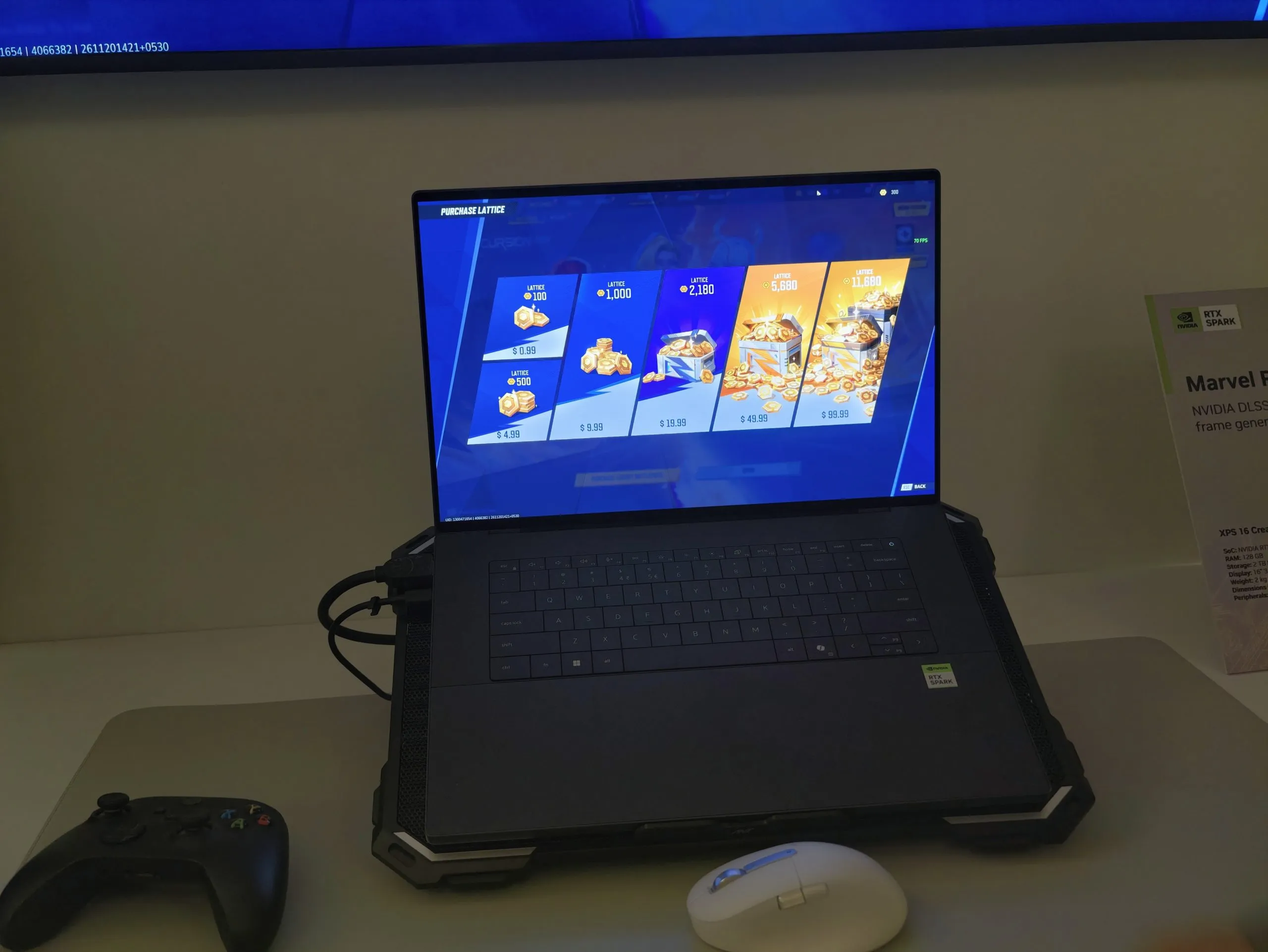
The Dell XPS 16 Creator Edition went on sale on November 20 at Rs 4,49,990 with 32GB and 1TB. HP’s OmniBook Ultra starts at Rs 5,49,999 with 64GB, with pre-bookings slated to open from November 24. MSI’s Prestige N16 Flip AI+ is priced at Rs 4,99,990 with 64GB and 1TB, but arrives in the first quarter of 2027.
Among desktops, the MSI EdgeMesa N AI+ costs Rs 3,89,999 plus GST for 64GB, or roughly Rs 4.6 lakh at 18 percent tax. The Gigabyte AI TOP Aero is due in December at Rs 7,35,499 with 128GB and a 2TB SSD. The Asus ProArt GR1X costs Rs 9,00,000 with 64GB.
Oddly, a desktop is not always the cheaper way to get maximum memory. Asus lists a 128GB ProArt P16 laptop at Rs 6,49,990, which is less than the 128GB Gigabyte desktop. Always compare the exact memory, storage, and tax before you buy.
Why RTX Spark matters in India
India has plenty of people who need this: developers building AI tools, editors handling client footage, game makers, and small studios. A local machine can cut down on recurring cloud costs and keep sensitive work in the office. It will not replace the cloud for everyone, especially when a job gets too big for one box.
The math has to work. Compare the machine’s price with your monthly cloud spend. Then weigh the value of privacy and offline work. If your AI bill is small, a Rs 5 lakh laptop is an expensive way to save it.
Should you buy an RTX Spark laptop?
Buy one now if memory is what is stopping your work. The best laptop for local AI in India is the one that fits your model, your software, and your budget. If you are an engineer prototyping with 30B to 70B models, an editor who wants Resolve’s AI tools without a tower under the desk, or a developer carrying Unreal Engine around, you have a clear use for it. For bigger models and heavier jobs, go for 64GB or 128GB.
If you need a 64GB machine to park on your desk, the MSI EdgeMesa makes sense. I’d also take a look at the ProArt P16 at Rs 4,89,990, since it’s close in price and specs. For teams that need a 128GB desktop, Gigabyte is worth checking out. If gaming is your main goal, stick with regular RTX laptops to save cash.
Reviewers abroad have flagged fan noise, heat, and battery life on some models, and results swing a lot between machines. I’d wait for tests of the exact laptop you want. A portable workstation isn’t really portable if you’re always hunting for a charger.
Prices need to drop
Early adopters pay a premium right now, and this year’s memory shortage is driving laptop prices up even more. Nvidia’s smaller N1 chip is on the way for cheaper models. Arm software support keeps improving, and partner designs should drop in price as production scales. Nvidia has done this before. Ray tracing started on expensive RTX cards in 2018, then quickly landed in much cheaper ones.
I expect some of what I saw in New Delhi to show up in cheaper laptops sooner than most people think. That’s my forecast, not a guarantee. The first generation just needs to prove the idea works.

Final Thoughts
RTX Spark shows that a Windows laptop can be a real AI workstation without turning into a desktop replacement. The price is high, testing is still ongoing, and you need to check compatibility carefully. But the idea is strong, partner support is wide, and the direction is clear.
For almost thirty years, Nvidia was the part you added to a PC for extra power. Now, it might be the reason you buy the whole machine. As a first shot at reinventing the Windows laptop, this is a promising start.
You can follow Smartprix on Twitter, Facebook, Instagram, and Google News. Visit smartprix.com for the latest tech and auto news, reviews, and guides.