


The realme P Series began as an “India-first” experiment. Four years later, it has grown into one of the brand’s most successful lineups, crossing 3 million units sold globally. With the launch of the realme P4 Pro and P4, the company wants to prove that its midrange phones can compete on specs, performance, and — more importantly — user trust.
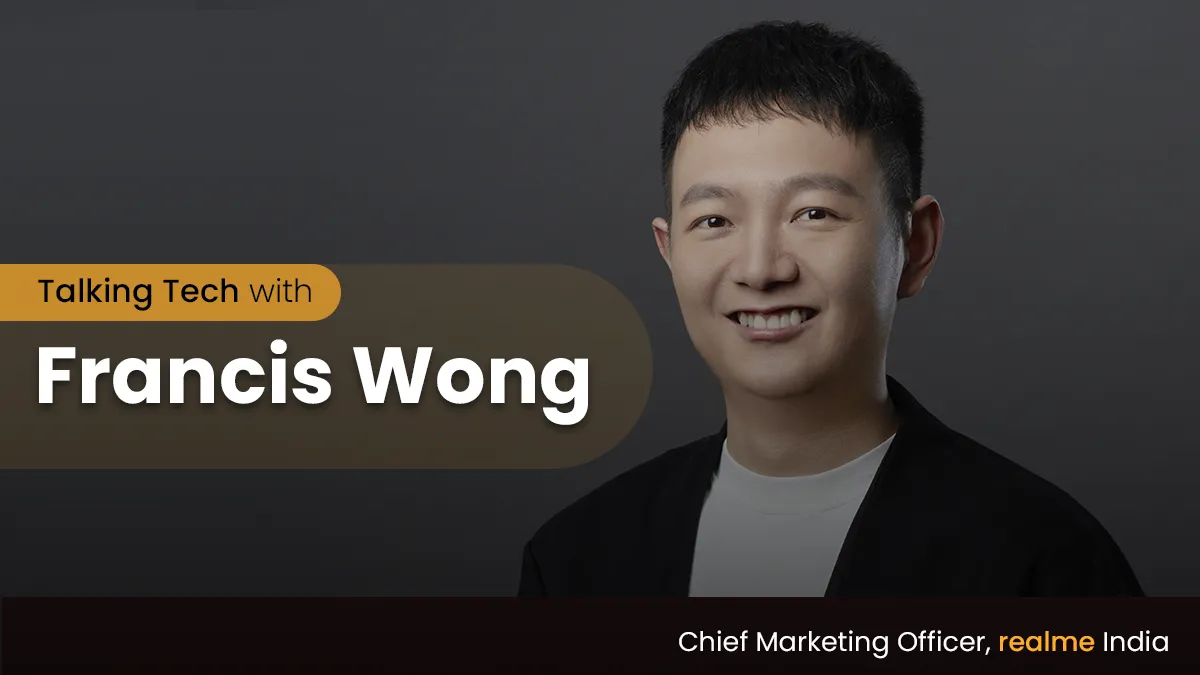
But realme’s story in India is complicated. Growth has slowed. Its ecosystem ambitions with TVs and laptops have been quietly shelved. And users still complain about performance drops and camera degradation after a year of updates. Against this backdrop, Francis Wong, Chief Marketing Officer, realme India, told Smartprix that the P4 Series is designed to be a turning point.
Why the P Series clicked with India?
Francis explained that the P Series carries realme’s founding philosophy of “Power Meets Style”. The company prioritized processors, batteries, and fast charging, while also experimenting with bold design. From the glow-in-the-dark back of the P3 Ultra to the wood-textured finish of the P4 Pro, the lineup has consistently aimed to stand out visually.
The bigger win, he added, has been aggressive online pricing. “I’m still not satisfied with P Series performance. It could achieve better market share from online channels. That’s why we priced the P4 Series very aggressively. So far, the P4 sold 240% more than the P3 during its first sale,” Francis told Smartprix.
Dual-chip setup and the BGMI play
The P4 Pro introduces a dual-chip architecture. Qualcomm’s Snapdragon 7 Gen 4 paired with realme’s Hyper Vision AI chip. According to Francis, this setup isn’t just about marketing hype.
“It delivers Always-On HDR in video and gaming. It makes your games stable at 144FPS and consumes less power compared to high FPS driven by the main processor. The key is the visual experience, it’s like watching Netflix Prime content versus free online content,” he said.
realme is also extending its BGMI partnership, first established with the GT7 Pro. “Yeah, we are still official partner of BGMI in India. We co-developed a lot on driving higher FPS. realme P4 Series got a guaranteed 144FPS with BGMI, and this is only possible on realme P4 Series and only with the HyperVision AI chip,” Francis said.
He also pointed to the addition of AI Gaming Coach, which gives players smart alerts. “You get danger alerts with AI’s help to identify risks such as enemy footsteps or approaching attacks. It also reminds you about teammate statuses and equipment durability,” he noted.
AI Edit and AI Genie backlash
The P4 Series also ships with 18 AI features, including AI Glare Removal and the much-discussed AI Edit Genie. The latter recently sparked controversy after it wrongly generated a creator’s photo. Francis acknowledged the issue but positioned it as part of the growing pains of AI adoption.
“To keep realme among the T1 AI smartphone brands, we have to be fast and smart enough to put many ‘industry first’ features. Because AI Edit Genie was based on cloud calculating with big models, wrong generation can happen occasionally. Mistakes can happen even with ChatGPT and DeepSeek. But overall customers are very happy about this feature,” he told Smartprix.
He even drew an analogy: “Many years ago when the car was invented, people laughed at cars which couldn’t run on grass like horses. But look at where cars are now.”
Addressing the update problem head-on
Perhaps the biggest criticism realme faces in India is that its phones lose performance and camera quality after a year of updates. Francis did not shy away from the issue.
“Word of mouth is the key for brand’s health in the long run, that is why I am now very active on X to talk with users and check what they are talking about. First of all, we have refreshed our update policy to 3+4 years — three OS updates and four years of security. Long-term commitment makes sure we continue to get users’ feedback and make changes accordingly,” he said.
He further explained that realme will rebuild its user community to provide a direct line to its R&D team. “I want a monthly updated thread in the community where every user can post their problems, and the R&D team will be required to reply and solve them. It will also be easier for me to understand users’ complaints better, and I’m determined to solve them.”
That approach, if executed, could help realme rebuild long-term trust in a way similar to Samsung and Google’s software strategies.
Why TVs and laptops are off the table
realme once experimented with TVs and laptops but has quietly scaled back. Francis was candid about the reason. “realme used to launch TV and laptops as well, but the reason we stopped is that those are volume-driven industries with low margin. We’ve decided to slow down, focus on audio and wearable products, and expand step by step. After all, customer satisfaction matters more than short-term success,” he told Smartprix.
The software update problem
realme has long faced criticism that its phones slow down or lose camera quality after a year of updates. Wong acknowledges the issue and outlines a new policy: 3 years of OS updates and 4 years of security patches for midrange phones, with 4+5 years for flagships like the GT series.
He also wants to rebuild realme’s once-thriving community. “I want a monthly thread where users post problems and our R&D team is required to reply and solve them,” he says.
This shift mirrors what Samsung and Google have already made central to their brand promise — a clear sign realme knows it can’t win on flashy specs alone.
Big batteries over extreme charging
realme pioneered ultra-fast charging with 240W phones, but Francis suggested priorities have shifted. “Now there is another big trend — big battery. In 2025, 8 of 20 big-battery phones launched are from realme. We now have 7000mAh battery phones across budget and flagship GT series. Brands need to balance the speed of charging and the size of the battery. If we launch a 150W phone with a big battery, the phone won’t sell due to its unacceptable size,” he said.
What’s next
realme plans to roll out ColorOS 16 internal beta in September, followed by an open beta in October. The Narzo series will continue as an Amazon-exclusive lineup, while the flagship GT series will push big batteries and extended update policies.
Francis added that realme’s long-term strategy is clear: strengthen offline retail presence while maintaining dominance in online sales. “Our strategy for the long run is determined, which is to be strong on both online and offline channels and have a healthy and sustainable profit,” he told Smartprix.
The bigger picture
With this conversation with Francis, one thing is clear: realme is quietly realigning itself to market realities, trying to reset the conversation around trust and innovation. Francis is betting big on AI flourishes, dual-chip gaming optimizations, and mega-batteries. Yet he concedes that Realme must rebuild long-term confidence, especially when users complain of performance dips and camera degradation after a year of updates.
That level of candidness is refreshing, but it also reveals the company’s position: realme is no longer the fast-rising disruptor it once was. It grew quickly on flashy features and aggressive pricing, but now it must prove it can play the long game.
The P4 Series won’t silence every critic, but it’s a marker that realme understands the stakes. In a market where Samsung, OPPO, and vivo are doubling down on reliability and extended software support, realme can’t afford to remain just the “specs-first” brand. The P Series is its shot at proving that style, power, and staying power can finally coexist.
You can follow Smartprix on Twitter, Facebook, Instagram, and Google News. Visit smartprix.com for the latest tech and auto news, reviews, and guides.