



TL; DR
- Hyundai Bayon launches October 26, slotting between the Venue and Creta with a 4.2-meter length.
- It gets a 1.5L petrol engine producing 115 PS, paired with manual and IVT automatic options.
- Expected pricing of ₹10–16 lakh will determine whether it undercuts the Creta while offering more than the Venue.
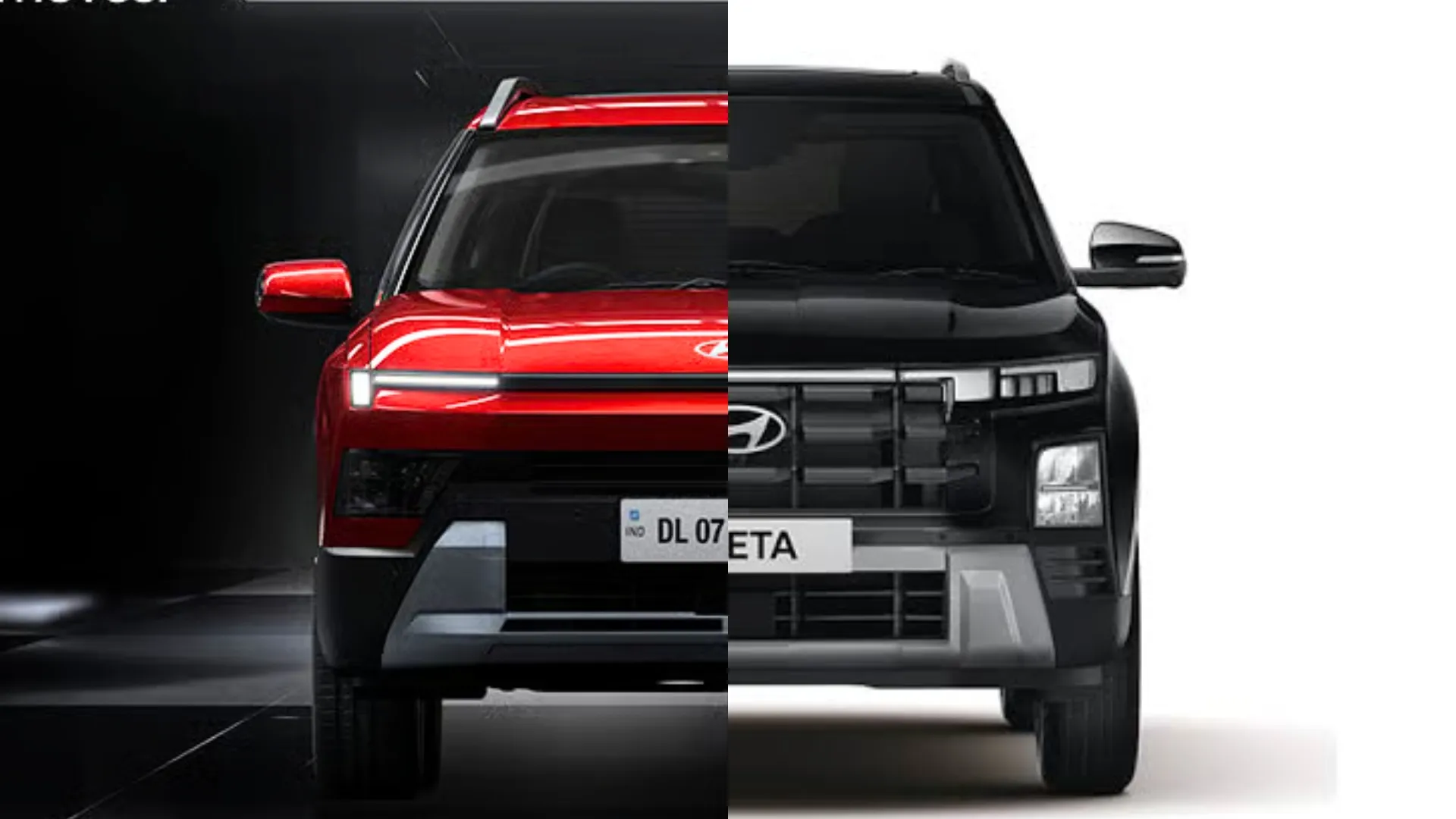
If there’s one car currently dominating the conversation in the Indian automotive space, it’s the Hyundai Bayon. Set to launch on October 26, the Bayon has generated more pre-launch buzz than most new nameplates in recent memory. Ahead of the anticipated launch, here’s a preview of how the Bayon compares to the new-generation Venue and the mighty Creta.
This should give you a clear idea of where the Bayon sits, what it might offer in terms of interior space, and how to plan your expenses when you buy it. Bookings opened weeks ago at ₹11,000, and its size, features, and pricing have kept the Bayon firmly in the spotlight.

Also Read: MINI Cooper Oxford Edition Debuts In India As A CBU: Check Price & Other Details Here
Venue vs. Bayon vs. Creta: Tech Specifications
| Venue (India) | Bayon (India-spec – most likely) | Creta (India) | |
| Body type | Compact SUV (sub-4 m) | Compact / mid-size crossover SUV | Mid-size SUV |
| Length | 3,995 mm | ~4,200–4,245 mm (Most likely / Euro proxy; Hyundai has said ~4.2 m) | 4,330 mm |
| Width | 1,800 mm | 1,810 mm (Euro-spec, widely used as proxy) | 1,790 mm |
| Height | 1,665 mm | 1,565–1,570 mm (Euro-spec proxy) | 1,635 mm |
| Wheelbase | 2,520 mm | 2,600 mm (Euro-spec proxy) | 2,610 mm |
| Ground clearance | 190 mm | 180–185 mm (Euro-spec proxy) | 190 mm |
| Boot / Cargo capacity | 375 liters | ~440 liters (Euro-spec ICE proxy; most commonly cited) | 433 liters |
| Engine | 1.2L NA petrol / 1.0L turbo petrol / 1.5L diesel | 1.5L NA petrol (Confirmed for India) | 1.5L NA petrol / 1.5L turbo petrol / 1.5L diesel |
| Displacement | 1,197 cc / 998 cc / 1,493 cc | 1,497 cc (Confirmed engine family) | 1,497 cc / 1,482 cc / 1,493 cc |
| Power | 83 PS / 120 PS / 116 PS | 115 PS (Confirmed) | 115 PS / 160 PS / 116 PS |
| Torque | 115 Nm / 172 Nm / 250 Nm | 144 Nm (Confirmed) | 144 Nm / 253 Nm / 250 Nm |
| Transmission | 5MT / 6MT / 7DCT / 6AT | 6MT / IVT (CVT) (Confirmed) | 6MT / IVT / 7DCT / 6AT |
| Drivetrain | FWD | FWD | FWD |
| Fuel type | Petrol / Diesel | Petrol only (at launch) | Petrol / Diesel |
| Claimed mileage (ARAI) | ~17.9–20.99 kmpl (varies by engine/gearbox) | Expected ~16–18 kmpl range (similar to Creta 1.5 NA) | 17.4–21.8 kmpl |
| Fuel tank | 45 liters | Expected ~45–50 liters (not yet confirmed) | 50 liters |
| Tyre size | Up to 215/60 R16 (varies by trim) | Expected 17-inch alloys (215-section common in reports) | 205/65 R16 to 215/55 R18 |
| Turning radius | ~5.1 m (typical reported) | Not yet confirmed | ~5.3 m (typical reported) |
| Seating capacity | 5 | 5 | 5 |
| Kerb weight (approx.) | ~1,050–1,250 kg | Expected ~1,200–1,350 kg range | ~1,200–1,400 kg |
Also Read: Relax, The Flying Tesla Roadster Is Never Coming On Roads, History Pattern Shows

Venue vs. Bayon vs. Creta: Key Takeaways
There’s some sort of confusion in the market about the Bayon’s length and width. One of those has already been confirmed by the brand. For the other, we have solid literature to refer to. As mentioned in an official blog post, the India-bound Hyundai Bayon will measure 4.2 meters in length, right between the current-generation Venue (3,995 mm) and Creta (4,330 mm).
While Hyundai India has only confirmed the length, the automaker recently unveiled the India-bound Bayon in Europe. That’s where we can get a clearer idea of its dimensions and specifications. For instance, the Euro-spec Bayon is 1,810 mm wide, making it 10 mm wider than the Venue and 20 mm wider than the Creta (yes, that’s right), a difference that should translate into better shoulder room for both front and rear passengers.


When it comes to headroom, though, it features the shortest roofline in the comparison – sitting at around 1,565–1,570 mm versus the Venue’s 1,665 mm and Creta’s 1,635 mm – which could trouble a specific set of buyers (those who’re taller than average, wear caps, or feel claustrophobic in cars with a relatively lower roofline).
Also Read: Honda Amaze Review: Better Than The Maruti Suzuki Dzire, Despite Its Quirks
As expected, the wheelbase is longer than the Venue’s, at a projected 2,600 mm, 80 mm more than the Venue and just 10 mm short of the Creta, which should mean more legroom and interior space.
Bayon’s ground clearance could be a bit lower than the Venue and the Creta; Euro-spec figures sit at 180–185 mm against 190 mm on both rivals, so keep that in mind. The boot space, on the other hand, could be bigger than both, with a claimed 440 liters in the European ICE version, edging past the Venue’s 375 liters and the Creta’s 433 liters.

However, keep in mind that Hyundai India hasn’t confirmed anything except the length, and the rest is based on the European version.
Talking about the powertrain, the Bayon is confirmed to feature Creta’s 1.5L NA engine (115 PS and 144 Nm). One of the country’s most reliable petrol units, the oil-burner is mated to a six-speed manual or Hyundai’s IVT (CVT) transmission.
Also Read: BMW X3 30i Driven: The Bridge Between Older BMWs and The Neue Klasse
And yes, for now, the Bayon is confirmed to launch with a petrol-only powertrain: no diesel or turbo option has been announced yet.

One interesting tidbit here is around Bayon’s weight. With the car’s expected weight slightly lower than the Creta, the 1.5L engine might feel a bit more responsive. However, this is speculation, not a claim based on first-hand experience. The fuel tank’s capacity should be around 45L. Finally, the car could come with 16-inch steel wheels or 18-inch alloy wheels.
Also Read: A Cheaper Jeep Is Coming To India: What Stellantis’ FaSTLAne 2030 Plan Confirms
Venue vs. Bayon vs. Creta: Smartprix’s Take
Strengths
Here’s something that I’d say upfront: the Bayon isn’t trying to be a “mini-Creta.” Its lower roofline, wider track, and slightly more crossover proportions give it a distinctly different personality: more urban and planted than the upright Creta. In my opinion, the Bayon could appeal to buyers who want SUV practicality without the bulk or higher seating position.

Hyundai seems to have focused on maximizing the usable cabin and luggage space in a slightly smaller footprint. This should help in city traffic and tighter parking situations while still offering family-friendly practicality.
Feature expectations are high; dual 12.3-inch screens, Level-2 ADAS, a 360-degree camera, and Hyundai’s new generative AI voice assistant have all been strongly linked to the model.
Also Read: XUV 3XO ZNG Takes On Nexon CNG and Brezza CNG From ₹9.99 Lakh While Retaining The Power Figures
Weakness
The biggest unknowns that will decide its success are: exact Indian ground clearance, final boot figure, real-world ride quality over broken roads, and how the lower roofline feels for rear passengers.
Opportunities
However, if I set everything aside, pricing will be the single biggest make-or-break factor for the Hyundai Bayon. We’ve already established that the car sits between the Venue and the Creta, and its pricing should reflect that.
I genuinely hope that the company prices the entry-level trim under ₹10 lakh (ex-showroom) so that more buyers can get a feel for the new-age Hyundai.
The top model could stretch up to ₹15-16 lakh (ex-showroom). Consider it a premium alternative to the Venue while undercutting the mid-to-top Creta trims.
Also Read: Jaguar Type 01 Revealed With 1,016 bhp And 720 km Range, With An India Launch Expected In 2027
Threat
What could work against it is the petrol-only powertrain in a market that still values diesel for high-mileage users, the lower roofline that may alienate buyers who prioritize headroom and a commanding driving position, and the risk that a higher-than-expected starting price forces it into direct competition with the Creta’s more affordable variants.

You can follow Smartprix on Twitter, Facebook, Instagram, and Google News. Visit smartprix.com for the latest tech and auto news, reviews, and guides.