




Quick answer
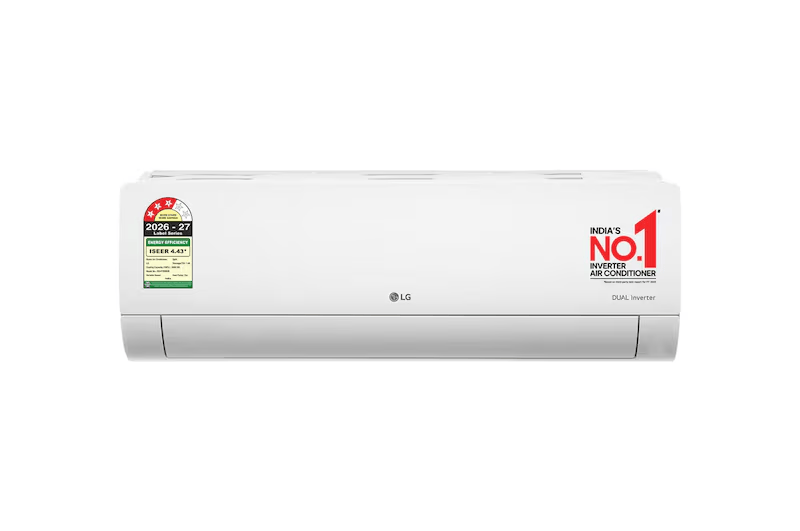
A hot-and-cold AC doesn’t make heat the way a heater does. It pulls warmth from the outside air and pumps it indoors, the same idea as a fridge working in reverse. Because of this, it can produce far more heat than the electricity it uses. LG’s AS-H19BNXE, for example, uses 1,290 W of power to produce 4.16 kW of heat, about 3.2 times more heat than the power it draws. That’s why it can cost roughly a third as much as a plug-in heater like an oil-filled radiator (OFR) for the same warmth. On Delhi’s coldest nights, this gap shrinks a little, but the AC still works out cheaper.
Two winters ago, I picked up an oil heater (also known as an OFR, or oil-filled radiator) to handle Delhi’s December and January cold. I was done with the hot blower that barely warmed anything beyond half a meter and left the room dry. The Oil Heater was a real upgrade: steady heat, no burning-dust smell, no noise. But it showed up on my electricity bill every month, since a resistive heater draws nearly its full rated wattage whenever the thermostat kicks in. Last year, I switched to a hot-and-cold AC. It works for both seasons, instead of gathering dust in a cupboard for nine months.
What is an AC with a heater?
Not every split AC heats a room. Only hot-and-cold models, built as heat pumps, can reverse their refrigeration cycle to pull warmth from outside and release it indoors. A cooling-only AC lacks this reversing valve. So if you’re asking, “does AC have a heater?” the answer is yes, but only if it’s sold as a hot-and-cold, all-weather, or heat-pump model.
In India, you’ll see this kind of AC sold under a few different names: hot-and-cold AC, all-weather AC, heat pump AC, or reverse-cycle AC. They all mean the same thing: one AC that both cools and heats, instead of buying a separate AC and a separate heater, which is what my oil-heater-plus-cooling-only-AC setup was, for two years.
How the two heat a room
A conventional room heater, whether it’s a fan heater, an oil-heater, or a ceramic unit, converts electricity directly into heat with nothing wasted. Every watt drawn from the socket becomes a watt of warmth in the room. That’s simple, but it caps efficiency at 1:1, regardless of design.
In my experience, the oil heater kept a Delhi bedroom’s temperature more even than the fan heater it replaced. The oil holds heat and keeps radiating after the element shuts off. But at its core, it’s still a resistive heater that draws nearly full rated wattage whenever the thermostat calls for heat, like any hot blower.
A hot-and-cold AC works differently. It doesn’t generate heat. Instead, it moves heat from the outdoor air into the room, using the compressor and refrigerant to pump it across the temperature gradient. This is the same physics as a refrigerator running in reverse. Because it moves heat instead of creating it, it can deliver more heat energy than the electricity it uses.
There’s a number for this: how many units of heat you get out for every one unit of electricity you put in. A heater always scores 1 on this. A hot-and-cold AC usually scores 3 or more, meaning three units of heat for one unit of power. This number isn’t fixed, though. It depends on the weather. The colder it is outside, the less warmth the AC has to pull from the air, so it delivers less heat and its score drops on colder nights. That’s why comparing a hot-and-cold AC to a heater isn’t as simple as comparing two numbers on a spec sheet, it changes with the weather.
The cost formula
Here’s the simple version, with both appliances compared the same way.
- Room heater, daily cost = heater’s wattage ÷ 1,000 × hours used × how often it actually switches on × your electricity rate (₹ per unit)
- Hot-and-cold AC, daily cost = heat needed (kW) ÷ its heat-output score × hours used × your electricity rate (₹ per unit)
One thing that’s easy to miss: a heater with a thermostat, including most oil heaters, doesn’t run nonstop. Once the room reaches the set temperature, it switches off and on to hold it there, so over an hour it typically draws 60 to 80 percent of its full power, not 100 percent. For your electricity rate, check your latest electricity bill for the per-unit charge that applies to you. In Delhi, this rate changes depending on how much power you use each month. This is what decides your actual cost in rupees, not just how many units you use.
Worked example
The table below uses LG’s own numbers for the AS-H19BNXE: 4,160 W (4.16 kW) of heat from 1,290 W of power, a heat-output score of about 3.2. For the heater, we’ve used a common 3,000 W oil heater, close to the one I used for two Delhi winters. Swap in your own appliance’s wattage and electricity rate to get your own numbers.
| Input | Oil-filled radiator (illustrative) | Hot and cold AC (LG-verified heating specs) |
| Rated wattage / heating output | 3,000 W | 4,160 W heating output |
| Rated electrical input | 3,000 W | 1,290 W |
| Hours used per day | 6 | 6 |
| Thermostat duty cycle | 70% | n/a (modulates via inverter) |
| Effective heat delivered | 1.4 kW average | 1.4 kW (matched for comparison) |
| COP | 1.0 | ~3.2 |
| Tariff | ₹10/unit | ₹7/unit |
| Daily cost | ≈ ₹100.80 | ≈ ₹31.50 |
| Monthly cost (30 days) | ≈ ₹3,024 | ≈ ₹945 |
In this moderate-winter case, the AC costs about a third as much as the oil heater for the same warmth. That matches my own experience: the radiator’s power draw pushed me to switch.
Now the colder-weather case, where the AC’s score drops. Heat pumps lose efficiency as outdoor temperatures approach freezing, since there’s less ambient heat to extract. If score falls to around 2.2 to 2.5 on a cold North Indian night, the same 2.1 kW of delivered heat costs about ₹42.85 a day, or roughly ₹1,286 a month. That’s still well under half the heater’s cost, but the margin shrinks a lot on Delhi’s coldest, foggiest January mornings. This is the honest version of the comparison, not just the best-case.
Benefits of a hot-and-cold AC over a room heater
Cost is the biggest one, and it’s covered above: because the AC moves more heat than the electricity it uses, it typically costs a third to half as much as an oil heater for the same warmth, even on colder nights.
Room coverage is the second. The AS-H19BNXE is a 1.5-ton unit (see the sizing guide below for what that means for your room), and like any split AC, it pushes warm air around the room using its fan, rather than just radiating heat outward from one spot the way an oil heater does. Sized correctly, it can comfortably warm a larger living room, not just the area right around the unit.
The AC genuinely also has an edge on safety is that it has no exposed heating element or hot casing the way a fan heater or an oil heater does, so there’s less risk of accidental burns, which matters more in homes with kids or pets.
When a room heater is still the better choice
A hot-and-cold AC isn’t always the right choice for every winter. I still reach for a small heater over the AC in a few specific situations.
Short heating sessions, like warming a bathroom for 15 minutes before a bath, favor a heater’s instant, no-installation convenience. An AC heats the whole room’s air volume, even if you only need it briefly. A very small room or a single person at a desk is also better served by a compact heater placed close by. On the coldest nights in hill states or the Kashmir valley, when outdoor temperatures approach or drop below freezing, a heat pump AC’s output and COP both fall sharply.
A resistive heater’s fixed 1:1 efficiency becomes more competitive. If you don’t want to pay for an AC’s upfront price, installation, and outdoor unit, a heater that costs a few thousand rupees and plugs in anywhere makes more sense. That’s exactly why the OFR worked for me two winters ago, before I needed a new AC.
Upfront cost and payback
The LG AS-H19BNXE sells online for ₹43,000 to ₹46,000. AC prices change often. A cooling-only 1.5-ton, 3-star split AC from the same segment usually costs a few thousand rupees less. The hot-and-cold premium is usually modest compared to the AC’s total price and isn’t the main cost.
Formula: payback period (months) = extra upfront cost ÷ monthly heating savings. If the hot-and-cold version costs ₹4,000 more than an equivalent cooling-only AC and saves roughly ₹1,200 a month over an OFR across a typical Delhi winter (November to February, about four months of real use), the extra cost pays for itself in that single season.
That math drove my decision this year: I was due for an AC upgrade anyway, and paying a small premium for a unit that replaces both the old cooling-only AC and the radiator made more sense than running two separate appliances through two separate seasons.
Which room and size suits what
Tonnage should match room size, not just winter heating needs, since the same unit works for both seasons. As a rough guide for Indian homes: a small bedroom up to 120 sq ft needs a 1-ton unit. A medium bedroom or living area of 120 to 180 sq ft needs 1.5 tons (like the AS-H19BNXE). Larger living rooms over 180 sq ft need 2 tons.
FAQs
Does an AC have a heater?
Only if it’s specifically a hot-and-cold, all-weather, or heat pump AC mentioned in the product name. A standard cooling-only split or window AC has no reversing valve and cannot produce heat, regardless of brand or price point.
Is a hot and cold AC cheaper than a room heater?
Usually yes, often by half or more, because it moves more heat than the electricity it consumes. The savings narrow in very cold weather, but the AC rarely costs more than a plug-in heater or oil heater.
How much electricity does heating mode use?
It depends on your tariff and the AC’s rated heating input. For the LG AS-H19BNXE, rated input is 1,290 W; running it six hours a night at a ₹7/unit tariff costs roughly ₹18 to ₹27 a day depending on outdoor temperature.
Can a hot and cold AC replace a room heater in North India?
For most of Delhi NCR, Punjab, and UP, yes, since outdoor lows rarely stay near freezing for long. In hill regions or on the coldest nights, a heater or a secondary heat source may still be useful as backup.
Does heating work when it is very cold outside?
It still works, but output and efficiency both fall as outdoor temperature drops because the compressor has less ambient heat to extract. This is standard heat pump behavior and isn’t specific to any one brand.
What is COP?
COP, or coefficient of performance, is heating output divided by electrical input. A COP of 3 means the AC delivers three units of heat for every one unit of electricity it draws, versus a room heater’s or OFR’s fixed COP of 1.
Is a hot-and-cold AC worth it if I only use it in winter?
Rarely, since you’re paying the full AC price for heating-only use, the economics work best when the AC also handles summer cooling, which is why the switch was worthwhile for me this year.
Bottomline
The formula is simple. A room heater’s or oil heater’s cost scales directly with its wattage, while a hot-and-cold AC’s cost scales with the heat needed divided by how much heat it gets back per unit of power, a number always above 1 but shrinking as the weather gets colder. For a Delhi winter, that math favoured giving up my oil heater for a hot and cold AC, and it’ll likely favour the same move for most North Indian households running both an AC and a separate heater today.
Disclaimer: The calculations presented in the article are based on official appliance specifications and established principles of thermodynamics and electrical engineering. The worked example uses LG’s published heating output and power consumption specifications for the specific AC model. Therefore, the calculation methodology does not need to be attributed to a single website, as it is derived from these technical specifications and standard engineering principles.
This document is for informational purposes only and compares winter heating costs of a hot-and-cold AC and a room heater in India. It explains that room heaters convert electricity directly into heat, while hot-and-cold ACs work as heat pumps and may deliver more heat per unit of electricity, depending on outdoor temperature, usage hours, tariff and room size. The article includes cost formulas, an illustrative example using LG AS-H19BNXE specifications, suitability guidance, benefits, limitations, payback and FAQs.
Product features, availability, suitability, calculations and performance may vary by model, usage conditions, room insulation, climate and electricity tariff. Any model-specific output, COP, savings or performance claim should be inspected, verified and confirmed with official product specifications, the user manual or an authorized LG representative before purchase or use.