

Galaxy Z TriFold vs. Galaxy Z Fold 7: Table of Contents
Samsung’s foldable lineup just took a major leap forward, and a sharp turn into the future. The new Galaxy Z TriFold sits alongside the refined Galaxy Z Fold 7, but the two devices couldn’t be more different in how they approach mobility, productivity, and pure tech ambition.
One is a polished, reliable evolution of a proven formula. At the same time, the other is Samsung’s most daring experiment yet: a phone that unfolds not once, but twice, into a full-fledged tablet. Here’s how these two premium foldables stack up when you look closely at what really matters.
Also Read: Galaxy Z TriFold vs. Huawei Mate XTs Ultimate: Battle Of Two Tri-Foldable Smartphones
Galaxy Z TriFold vs. Galaxy Z Fold 7: Design
| Samsung Galaxy Z TriFold | Galaxy Z Fold 7 | |
| Dimensions: Unfolded | 159.2 x 214.1 x 3.9-4.2 mm | 158.4 x 143.2 x 4.2 mm |
| Dimensions: Folded | 159.2 x 75 x 12.9 mm | 158.4 x 72.8 x 8.9 mm |
| Weight | 309 grams | 215 grams |
| Hinge | Armor FlexHinge, titanium housing | Armor FlexHinge, titanium housing |
| Frame | Advanced armor aluminum frame | Advanced armor aluminum frame |
| IP Rating | IP48 (dust > 1mm, depth < 1.5m for 30 minutes) | IP48 (dust > 1mm, depth < 1.5m for 30 minutes) |
| Dedicated Cover Screen | Yes, Corning Gorilla Glass Ceramic 2 | Yes, Corning Gorilla Glass Ceramic 2 |
| Back Material | Ceramic glass fiber polymer | Gorilla Glass Victus 2 |
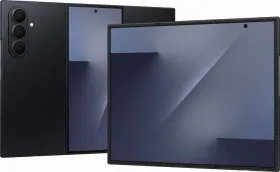
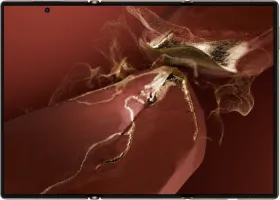
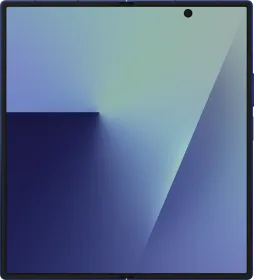
The Galaxy Z TriFold and the Galaxy Z Fold 7 are two distinct foldables. While the former opens twice (has two hinges) and carries three nearly symmetrical panes that rest on top of one another when folded, the Fold 7 opens once (has one hinge) and features two symmetrical folding panes.
Unfolding the Galaxy Z TriFold should be a new experience for buyers accustomed to the Fold 7’s (or any other foldable’s) intuitive fold. The phone uses an “inward-folding” G-shaped mechanism, i.e., it unfolds twice to the right or folds twice to the left. Of the three panes, the central one (when unfolded) has a cover screen on its back (it faces away from you when unfolded and toward you when folded).

To prevent you from folding the phone in the wrong order, Samsung has equipped the user interface with quite aggressive on-screen and haptic alerts. The Fold 7, on the other hand, keeps things simple by allowing you to fold and unfold the phone in a single, natural motion. The Fold 7 also has a cover screen, behind the left foldable pane.
It is commendable that the Galaxy Z TriFold is almost as thin as the Galaxy Z Fold 7 when unfolded. However, when folded, the three panes are 12.9 mm thick, making the phone thicker than the Fold 7. Due to the additional hinge material, the TriFold weighs much more than the Fold 7 (309 grams vs. 215 grams).


Both phones have a similar IP water- and dust-resistance rating (IP48). In terms of materials, both share the Advanced Armor aluminum frame and Gorilla Glass Ceramic 2 protection for the cover screen, but the Fold 7 uses Victus 2 for its back panel.
Moreover, the TriFold borrows many of its design and material cues from the Fold 7, but given that the latter is a tested and improved form factor, I’m inclined to believe it should be the more durable daily driver for most users, at least for a couple of years.
Galaxy Z TriFold vs. Galaxy Z Fold 7: Display
| Samsung Galaxy Z TriFold | Samsung Galaxy Z Fold 7 | |
| Cover Screen | 6.5-inch Dynamic LTPO AMOLED 2x, 1-120Hz, 2600 nits (peak), HDR | 6.5-inch Dynamic LTPO AMOLED 2x, 1-120Hz, 2600 nits (peak), HDR |
| 422 ppi | 422 ppi | |
| Inner Screen | 10.0-inch Dynamic LTPO AMOLED 2x, 1-120Hz, 1600 nits (peak), HDR | 8.0-inch Dynamic LTPO AMOLED 2x, 1-120Hz, 2600 nits (HDR) |
| 269 ppi | 368 ppi |
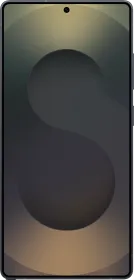
At least on paper, Samsung seems to have borrowed the cover screen on the Galaxy Z TriFold from the Galaxy Z Fold 7. Both use the same display technology and have the same size, peak brightness, refresh rate, and pixel density. Hence, expect the TriFold cover display to provide a very familiar experience.

However, it is when you unfold the TriFold that the true potential of a tri-folding form factor shows up. With all three panes extended, the TriFold provides a 10-inch screen that can refresh at up to 120Hz, achieves a peak brightness of 1600 nits, and supports HDR content. This is the phone’s true novelty: a tablet-sized screen that folds and fits in your pocket.
The Fold 7, on the other hand, offers an 8.0-inch Dynamic LTPO AMOLED 2x screen that isn’t small by any means (especially when you compare it with a traditional non-foldable smartphone). Furthermore, it has higher peak brightness (2600 nits vs. 1600 nits) and pixel density (368 ppi vs. 269 ppi) than the TriFold, while supporting a similar refresh rate.

Regarding display, it is a size vs. refinement trade-off. Buyers should choose according to their preference.
Also Read: Find X9 vs. OnePlus 15 vs. Pixel 10: Which Android Flagship Is Right For You?
Galaxy Z TriFold vs. Galaxy Z Fold 7: Performance
| Samsung Galaxy Z TriFold | Samsung Galaxy Z Fold 7 | |
| Processor | Snapdragon 8 Elite for Galaxy (3nm) | Snapdragon 8 Elite for Galaxy (3nm) |
| CPU | 8-core CPU: 2 x 4.47 GHz + 6 x 3.53 GHz | 8-core CPU: 2 x 4.47 GHz + 6 x 3.53 GHz |
| GPU | Adreno 830 (1.2 GHz) | Adreno 830 (1.2 GHz) |
| NPU | Qualcomm Hexagon NPU | Qualcomm Hexagon NPU |
| Memory + Storage | 16GB (LPDDR5X) RAM / 512GB or 1TB (UFS 4.0) storage | Up to 16GB (LPDDR5X) RAM / 256GB, 512GB, 1TB (UFS 4.0) storage |
Despite arriving a couple of months after the Snapdragon 8 Elite Gen 5 announcement, Samsung’s first tri-folding phone still features the Snapdragon 8 Elite (3nm) chipset, which looks more like a strategic decision than an oversight. Samsung has spent more time with the SD 8 Elite chip, using it in smartphones like the Galaxy S25 Ultra and the Fold 7, making it the most optimized and cost-effective option for the company.
Alongside the chipset, the TriFold offers 16GB of LPDDR5X RAM and two storage options: 512GB and 1TB (both UFS 4.0). The Fold 7 is available with 12GB of LPDDR5X RAM and three storage variants: 256GB, 512GB, and 1TB (all UFS 4.0). There’s a 16GB + 1TB version as well.

Given that the TriFold and the Fold 7 use the same chipset, buyers should expect similar performance from both. We’ve already reviewed the Fold 7, which performs well for multitasking and high-end gaming, and the Galaxy S25 Ultra does as well. In our Fold 7 test, the handset scored 2,545 and 8,612 points in the single- and multi-core GeekBench 6 CPU tests, and the TriFold should score similarly.
Whether you need raw power to run games at the highest settings, excellent RAM management to keep your apps alive in the background, or more storage, the TriFold and the Fold 7 should deliver an equally good experience. Both phones also offer dedicated multitasking features, such as a split-screen view.
Also Read: realme GT 8 Pro vs. OnePlus 15 vs. iQOO 15: Camera Comparison
Galaxy Z TriFold vs. Galaxy Z Fold 7: Operating System
| Samsung Galaxy Z TriFold | Samsung Galaxy Z Fold 7 | |
| User Interface | One UI 8 | One UI 8 |
| Operating System | Android 16 | Android 16 |
| App Availability | Google Play Store | Google Play Store |
| Desktop Mode | Samsung DeX | Samsung DeX |
| AI Features | Galaxy AI | Galaxy AI |
| Voice Assistant | Google Gemini / Samsung Bixby | Google Gemini / Samsung Bixby |
Both the Galaxy Z TriFold and the Galaxy Z Fold 7 feature Samsung’s One UI 8 skin atop Android 16. Both phones offer the popular Galaxy AI features integrated across the user interface, along with those like Now Bar and Now Brief for personalized updates relevant to the time of the day, and enhanced multitasking capabilities via the split-screen view (including the 90:10 view), a better and improved Quick Share, and a myriad of customization features.
Both the foldables offer multimodal Gemini AI (with deeper integration across the system). Further, they’ll get seven years of major Android and security updates from their launch date. The Galaxy Z TriFold has arrived with a couple of new features, though.

It offers a new, standalone Dex experience that doesn’t require an external monitor. You can use it on the device’s 10-inch foldable screen. You can enable the desktop mode, which lets you use the device as a desktop and offers four workspaces, each of which can run up to five apps. With three screen panes, you get a split-screen view that can fit one app in each pane in portrait mode.
Also Read: ColorOS 16 vs. iOS 26: Who Did Lock Screen Customization Better?
Galaxy Z TriFold vs. Galaxy Z Fold 7: Cameras
| Samsung Galaxy Z TriFold | Samsung Galaxy Z Fold 7 | |
| Primary Camera | 200MP (f/1.7, 1/1.3″, OIS) | 200MP (f/1.7, 1/1.3″, OIS) |
| Secondary Camera | 12MP (f/2.2, 1/2.55″, PDAF) | 12MP (f/2.2, 1/2.55″, PDAF) |
| Tertiary Camera | 10MP (f/2.4, 1/3.94″, OIS) 3x optical zoom | 10MP (f/2.4, 1/3.94″, OIS) 3x optical zoom |
| Inner-Screen Camera | 10MP (f/2.2, 1/3.0″) | 10MP (f/2.2, 1/3.0″) |
| Outer-Screen Camera | 10MP (f/2.2, 1/3.0″) | 10MP (f/2.2, 1/3.0″) |
Like the cover screen, the Galaxy Z TriFold has borrowed its camera setup, and I mean all of it (five sensors), from the Galaxy Z Fold 7. It doesn’t matter which foldable you choose. You will get a 200MP primary camera, a 12MP ultrawide camera with autofocus, a 10MP 3x optical-zoom camera (with a very small sensor), and two 10MP selfie cameras, one on the cover screen and another on the foldable screen.
Interestingly, the 10MP shooter on the inner screen has a slightly wider field of view than the one on the cover screen. Both foldables can record 8K30 and 4K60 video, but Samsung doesn’t allow users to record 4K120 video on the TriFold (as that is technically possible with the Snapdragon 8 Elite chipset). The Fold 7 can record 4K120 videos; both phones can record HDR10+ videos. The front cameras can also record 4K60 videos.

Additional camera features include up to 30x zoom, manual camera controls, improved Portrait Studio, refreshed filters, and the new Audio Eraser feature. Further, you also get log video support on the Fold 7, though I am not sure about the Galaxy Z TriFold. Overall, expect a similar camera experience on Samsung’s tri-folding and bi-folding phones.
Also Read: Xiaomi 17 Pro Max vs. iPhone 17 Pro Max: Battle of the Ultimate Flagships in 2025
Galaxy Z TriFold vs. Galaxy Z Fold 7: Battery Capacity & Charging Rate
| Samsung Galaxy Z TriFold | Samsung Galaxy Z Fold 7 | |
| Battery Capacity | 5,600 mAh | 4,400 mAh |
| Wired Charging Speed | 45W, QC2.0, 50% in 30 minutes | 25W wired, QC 2.0, 50% in 30 minutes |
| Wireless Charging Speed | 15W | 15W |
| Reverse Wireless Charging | 4.5W | 4.5W |
Leveraging the additional internal volume, Samsung has equipped the Galaxy Z TriFold with a larger 5,600 mAh battery. The foldable features three battery cells, each in a separate pane, for higher overall battery capacity. Furthermore, the phone supports 45W wired charging. However, given the phone’s larger screen, it should offer either comparable or slightly better battery life than the Fold 7.

Both the TriFold’s battery capacity and charging speed exceed those of the Fold 7. The Fold 7 still has a respectable (though it could be better) 4,400 mAh battery that supports 25W wired charging. In our review of the device, we achieved approximately 6 hours and 16 minutes of screen-on time.
Connectivity options on the handsets are pretty similar. Both offer Wi-Fi 7 and Bluetooth v5.4, GPS, NFC, and a USB Type-C 3.2 port.
Also Read: Galaxy S25 FE vs. Galaxy S24 (Snapdragon 8 Gen 3): Which One Should You Purchase?
Galaxy Z TriFold vs. Galaxy Z Fold 7: Pricing & Availability
| Samsung Galaxy Z TriFold | Galaxy Z Fold 7 | |
| Launch Date | December 12, 2025 | July 2025 |
| Launch Availability | South Korea | Worldwide |
| Pricing | 16GB RAM/512GB: 3,594,000 KRW (approximately $2,450 USD or ₹2,20,000 INR) | 12GB/256GB: Rs. 1,74,999 12GB/512GB: Rs. 1,86,999 16GB/1TB: Rs. 2,16,999 |
| Expanded Availability | Late December: China, Taiwan, Singapore, and the UAE Early 2026: United States (first quarter) | – |
For now, the Galaxy Z TriFold is only available in South Korea. However, Samsung plans to expand its availability beyond its home market to Taiwan and China by the end of December. In 2026, the company could also launch the phone in the United States. However, its availability in India remains unclear.
The Fold 7, on the other hand, is already available in every major smartphone market worldwide, including India, where it costs Rs. 1,74,999 for the baseline variant with 256GB of storage.
Also Read: iPhone 17 Pro Max vs. iPhone Air: All The Differences Explained In One Place
Galaxy Z TriFold vs. Galaxy Z Fold 7: Verdict
The Galaxy Z TriFold is a bold step into the future, offering unmatched screen real estate, enhanced multitasking, and a massive battery in a still-pocketable form. Its 10-inch display and standalone DeX mode make it ideal for productivity-heavy users.
However, its added weight, thicker folded profile, limited availability, and untested long-term durability make it a better option for early adopters than mainstream buyers. Most users may want to wait until Samsung refines the tri-folding form factor.

The Galaxy Z Fold 7 remains Samsung’s most polished and reliable foldable for everyday use. It offers brighter displays, lighter weight, proven durability, excellent camera performance, and widespread availability.
Its one-step folding mechanism is intuitive, and the software is already well-optimized for its form factor. While it lacks the TriFold’s expansive 10-inch canvas and bigger battery, its refinement, practicality, and lower price make it the smarter choice for most users seeking a dependable premium foldable today.

You can follow Smartprix on Twitter, Facebook, Instagram, and Google News. Visit smartprix.com for the latest tech and auto news, reviews, and guides.