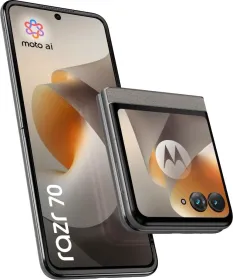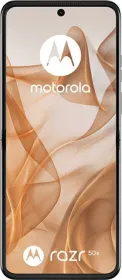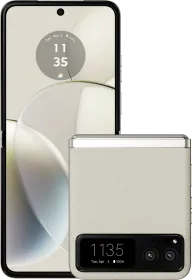


The Lenovo-owned smartphone brand Motorola just launched a new foldable: the Moto Razr 50. Unlike popular flip-style models, the Razr 50 doesn’t cost as much. By striking a balance between affordability and functionality, Motorola aims to increase the adoption rate of foldable smartphones with the Razr 50. It looks like the newly launched foldable ticks a lot of boxes, but how does it compare to the Moto’s Razr 40? Are there any differences worth considering between the two? Let’s find out.
Moto Razr 40 vs. Moto Razr 50: Design

The Razr 40 follows a similar design language as the Galaxy Z Flip. When open, the smartphone measures 73.95 x 170.82 x 7.35mm, while when closed, it measures 73.95 x 88.24 x 15.8mm. While Corning’s Gorilla Glass Victus protects the external display, the foldable has a 7000 series aluminum frame with a Vegan leather back finish. The smartphone weighs 188.6 grams and is IP52 dust and water resistance.
Motorola Razr 40 is available in Sage Green, Summar Lilac, and Vanilla Cream colors (with a vegan leather finish).

Strangely, the Razr 50 is slightly thinner than the Razr 40 when unfolded, with its dimensions being 73.99 x 171.30 x 7.25mm, but when closed, it measures 73.99 x 88.08 x 15.85mm, making it thicker than its predecessor. There’s no change in the weight or the Gorilla Glass protection on the front screen, except that the phone has lost its dust protection: it is now IPX8 water-resistant.
What’s good is that the Razr 50 is certified to last for 400,000 folds. Motorola Razr 50 comes in Koala Gray, Beach Sand, and Spritz Orange. While the first variant ships with a vegan suede finish, the others ship with a vegan leather finish.
ALSO SEE: Mediatek Dimensity 6300 Mobile Phones Price List 2024
Moto Razr 40 vs. Moto Razr 50: Display

The Razr 40 features a 1.5-inch OLED cover screen with a pixel density of 282 ppi and a peak brightness of 1000 nits. Further, it supports a refresh rate 60Hz and a touch sampling rate 120Hz.
Inside, the flip-style foldable features a 6.9-inch FHD+ pOLED screen with 413 ppi and a peak brightness of 1,400 nits. The main screen supports LTPO technology for a variable refresh rate of up to 144Hz, HDR10+ content, and a touch sampling rate 240Hz (up to 360Hz in game mode).

The new Razr 50, on the other hand, features a 3.63-inch OLED screen, which is about two times bigger than the one on the Razr 40. Further, it has a higher refresh rate of 90Hz (and a similar touch sampling rate as 120Hz) and can achieve a peak brightness of 1,700 nits.
Unfolding the smartphone reveals a 6.9-inch pOLED FHD+ pOLED screen with 412 ppi and a peak brightness of 3,000 nits. Like the predecessor, the Razr 50’s main screen supports LTPO technology, but surprisingly, the maximum refresh rate is only 120Hz, which is a downgrade. The screen also supports HDR10+ and a touch sampling rate of up to 220Hz (up to 300Hz in game mode).
Moto Razr 40 vs. Moto Razr 50: Processor

Under the hood, the Razr 40 features a Snapdragon 7 Gen 1 SoC. The chipset features one 2.4GHz prime core, three 2.36GHz balanced cores, and four 1.8GHz efficiency cores. Paired with 8GB of LPDDR4X RAM and 256GB of UFS 2.2 storage, the chipset provides a mid-range performance.
For comparison, the Snapdragon 7 Gen 1 scores about 960 points on the single-core score and 2,761 points on the multi-core score.

The Razr 50, on the other hand, features a new MediaTek Dimensity 7300X (4nm) octa-core chipset with four cores clocked at 2.5GHz and four balanced cores clocked at 2.0GHz. Users also get 8GB of RAM with RAM Boost 3.0 technology and 256GB of storage.
According to Notebookcheck, the Dimensity 7300X scores 1,047 points in the single-core score and 2,973 points in the multi-core score.
ALSO SEE: Electric SUV Cars Price List
Moto Razr 40 vs. Moto Razr 50: Camera

The Razr 40 features a 64MP (f/1.7) primary camera with optical image stabilization, laser autofocus, and a 13MP (f/2.2) ultrawide camera that doubles as a macro shooter. The front camera on the foldable is a 32MP (f/2.4) sensor. With the sensors, users can record 4K videos at 30 fps and 1080p videos at 60 fps.

On the Razr 50, users get a 50MP (f/1.7) primary sensor with optical image stabilization and a 13MP (f/2.2) ultrawide/macro shooter. Like the refresh rate of the inner screen, the primary camera on the Razr 50 is a downgrade from the predecessor. Nonetheless, the 32MP (f/2.4) selfie shooter is intact on the smartphone. The video recording abilities remain the same as well.
Moto Razr 40 vs. Moto Razr 50: Battery

Regarding battery, both foldables feature a 4,200 mAh battery cell that supports 33W wired charging. What’s good is that the company provides a charger in the box.
Moto Razr 40 vs. Moto Razr 50: Software

Out of the box, the Razr 40 shipped with Android 13. The phone was recently upgraded to Android 14 (in August 2024). It will still get another two years of Android and three security updates.
The Razr 50, on the other hand, ships with Android 14. Motorola has also promised to provide three years of operating system upgrades and four years of security updates. In addition, the smartphone also supports a couple of GenAI features, including AI Magic Canvas, AI Generative Theming, AI Adaptive Stabilization, Smart Color Segmentation, and Screenshots with Auto Blur. You can also access Google’s Gemini voice assistant.
Moto Razr 40 vs. Moto Razr 50: Connectivity
Connectivity options on Razr 40 include 5G, Wi-Fi 6e, Bluetooth v5.3, NFC, and Type-C USB 2.0.
The Razr features an upgraded Bluetooth v5.4 version, but the other connectivity options are similar to the Razr 40.
ALSO SEE: Cruiser Bikes Price List
Moto Razr 40 vs. Moto Razr 50: Price And Availability
Moreover, the Razr 50 is the Razr 40 with a couple of new features. The foldable gets a bigger cover screen and access to Google’s Gemini chatbot, but it makes a lot of compromises, too, starting from the inferior IP rating, lesser resolution on the primary camera, and a primary screen that isn’t as smooth in terms of refresh rate.
The Razr 40 is currently available on Flipkart for Rs. 44,995, while the Razr 50 is available for Rs. 49,999 on Amazon (including all the pre-order benefits and discounts. If you’re looking for an affordable foldable, you can definitely consider the Razr 50, primarily due to a confidence-instilling 400,000 fold claim. Otherwise, both phones offer a pretty similar set of features and specifications.
You can follow Smartprix on Twitter, Facebook, Instagram, and Google News. Visit smartprix.com for the latest tech and auto news, reviews, and guides.