

Quick Verdict — Score: 8.5 / 10 · Recommended
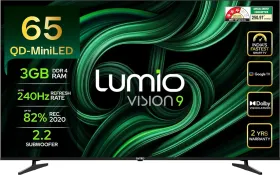
The 2026 Lumio Vision 9 65-inch TV is the most complete television available in India under Rs 1 lakh, delivering legitimate gaming-grade specs, surprisingly cinematic built-in audio, and a clean Google TV experience that rivals panels costing significantly more with a few honest asterisks.
Buy it if:
- you want the most complete package under Rs 1 lakh in India particularly for gaming at 4K/144Hz.
- If you want TV’s built-in audio that genuinely replaces a budget soundbar.
- If you want a clean fast Google TV experience.
- Also buy it if the value gap versus Sony Bravia 5 or Samsung QN70F pricing is relevant to your decision.
Skip it if:
- If you want to own a TV with maximum dimming zones in the segement.
- If you regularly watch from extreme off-axis angles past 40 degrees.
- If you need OLED-grade per-pixel contrast uniformity across the entire screen.
| Last year, Circuit House, a startup founded by former Xiaomi and Flipkart team members, launched the Lumio Vision series in India and quickly made a mark in the premium TV segment. Their 2026 model features an EVA QD-MiniLED panel with 7,000:1 native contrast, 4K 144Hz refresh rate, a 50-watt dual-subwoofer audio system, and Android 14 running on the MediaTek Pentonic 700 with 64GB of storage. For any new brand, what really matters is how the product performs in everyday use, not just its specifications. I tested this TV for 21 days to see how it holds up. After ten days, my parents came over. My father, who is particular about his LG TV, watched an IPL cricket match on the Vision 9. After about fifteen minutes, he asked, “The sound is coming from the TV?” I told him there was no soundbar, just the TV itself. He was genuinely surprised. Later, we watched Dune: Part Two in Dolby Vision. The sandworm scenes felt massive, with deep bass and impressive visuals. Would I recommend this TV? Yes. You will ask why? Well, let me tell you my thoughts on the Lumio Vision 9 65-inch tv in detail. |
HOW I TESTED
| Reviewed By: Deepak Singh Rajawat, Expert in Smartphones, TVs, Laptops, Audio Gear, AI and more (10 years experience, 500+ reviews). Test Unit: Lumio Vision 9 2026 65-inch (Model: EPIC2-ADSI). Unit provided by Circuit House for review purpose. No commercial arrangement. They have no involvement in the review process. Duration and Environment: This review is based on 21 continuous days of daily-use viewing, dedicated reference testing sessions, and extended gaming across a normally-lit living room and a controlled dark-room environment. Tests: Testing included productivity workloads, gaming benchmarks (Cyberpunk 2077, Battlefield 6, Street Fighter 6, Arc Raiders, Marvel Rivals), battery run-down at adaptive and maximum brightness, and display assessment. Competitors: TCL 65C72K, Haier M92 Mini LED TV, Sony Bravia 3 K-65S30, Sony Bravia 5 KD-65XR70, Samsung Neo QLED 65QN80HAU and LG 65QNED85BLA. |
2026 Lumio Vision 9 TV (65-inch)Price & Availability
The 2026 Lumio Vision 9 TV (65-inch) is priced at ₹72,999 in India. You can purchase it via Amazon, Flipkart or Urban Ladder Stores.
2026 Lumio Vision 9 TV (65-inch) Pros & Cons
Pros
- Buttery Smooth
- Gaming Beast
- Good HDR and SDR performance
- Robust Audio
- Clean software
- Excellent Connectivity Options
Cons
- Off-Axis Viewing Angles are limted
- Dimming Zones downgraded from the 55-inch model
- Ethernet port is capped at 100 Mbps rather than 1 Gbps
- Aggressive local dimming crushes some details shadows
Lumio Vision 9 65-inch (2026) Specifications
| Category | Specifications |
|---|---|
| Model | Lumio Vision 9 (2026) |
| Screen Size | 65-inch (1.65m) |
| Resolution | 3840 × 2160 (4K UHD) |
| Display Technology | QD-MiniLED |
| Panel Type | EVA (Enhanced VA) Panel |
| Refresh Rate | Native 144Hz at 4K, 240Hz at 1080p |
| Brightness | 450 nits Typical, 800 nits Peak |
| Contrast Ratio | 7000:1 Native, 1,00,000:1 Dynamic |
| Dimming Zones | 128 Local Dimming Zones |
| HDR Support | Dolby Vision, HDR10, HLG |
| Gaming Features | VRR (48–144Hz), ALLM, 9.7ms Input Lag |
| Processor | MediaTek Pentonic 700 |
| RAM | 3GB DDR4 |
| Storage | 64GB |
| Operating System | Google TV (Android 14) |
| Casting | Google Cast Built-in |
| Audio Output | 50W |
| Speaker Setup | 2 Subwoofers, 2 Full-Range Drivers, 2 Tweeters |
| Audio Features | Dolby Atmos, DGS Audio 2.2 |
| Wi-Fi | Dual-band Wi-Fi 5 (802.11a/b/g/n/ac) |
| Bluetooth | Bluetooth 5.0 |
| HDMI Ports | 3 × HDMI 2.1 |
| eARC Support | Yes (HDMI 2) |
| USB Ports | 2 × USB 2.0, 1 × USB 3.0 |
| Ethernet | RJ45 LAN Port |
| Audio Out | Optical + 3.5mm |
| Dimensions (Without Stand) | 1.44m × 7.8cm × 83cm |
| Dimensions (With Stand) | 1.44m × 33.1cm × 88.5cm |
| Weight | 18.1kg |
| Power Consumption | 260W |
| Warranty | 2-Year Comprehensive Warranty |
| Country of Origin | India |
2026 Lumio Vision 9 TV Review (65-inch): Picture Quality
The Vision 9 ships with a manufacturer-specified colour deltaE of 2.99 sitting right at the threshold where colour errors become borderline visible to most viewers. In practice, in Movie Mode SDR out of the box, I noticed a slight cool blue push in near-white tones, particularly in skin tones under daylight scenes. The picture is good on day one. It is better after calibration.
Vibrant Colors for Animation and Casual Streaming
The Vision 9 covers 95% of the DCI-P3 and 70% of the Rec. 2020 color spaces, thanks to its QD-MiniLED panel. This means it shows colors that most TVs in this price range simply can’t match.

When watching animated movies or casual streams, Disney and Pixar films like Coco, Moana, and Turning Red look vibrant and accurate in DCI-P3. The Vision 9 produces rich, lifelike images where other TVs fall short.

Streaming in SDR on Netflix, Prime Video, and JioHotstar looks great after a few small picture adjustments. Skin tones look natural, colors are vivid but not too strong, and the display gives balanced, accurate visuals with good shadow detail.

For standard-definition DTH broadcasts, the Vision 9’s upscaling makes news and regular TV shows look clear without fake sharpening effects. I’ll talk more about upscaling later.
The 1,00,000:1 dynamic contrast ratio adds real depth to SDR content, especially in scenes with mixed lighting. Try adjusting this setting in the Advanced Picture menu.
Best SDR Picture Settings for Indian Content
Out of the box, the Vision 9 has a color delta E of 2.99, which means color errors are just barely noticeable. Near-whites look a bit cool and blue. Using the official calibrated settings is important to get the best picture from this panel.

Adjusting the hue in Standard SDR mode helps skin tones look better in Indian content. The brightness setting in Movie Mode is meant for low-light viewing, so avoid using it in bright rooms.


The Vision 9’s Advanced Settings menu has Local Dimming, Adaptive Luma Control, Dynamic Color Booster, and 11-point white balance correction. These features are uncommon at this price and let you customize the picture more deeply.Indian broadcast content, use Standard Mode with calibrated settings daily. Movie Mode is best for dedicated viewing.
Recommended SDR settings
| Setting | Out of Box | Recommended Value |
| Standard Mode: Brightness | 50 | 44 |
| Standard Mode: Hue | 0 | 4 |
| Movie Mode: Brightness | 50 | 41 |
| Movie Mode: Sharpness | 8 | 10 |
Dark Room Performance
The EVA (Enhanced VA) panel is where the Vision 9 really stands out from other TVs in its price range. The ‘Enhanced’ part is real: its paired-crystal design absorbs extra backlight better than standard VA panels, giving it a native contrast ratio of 7,000:1. That’s about 40% higher than the usual 5,000:1. In a dark room, you can see the difference right away.
With local dimming turned on, the Vision 9 really does achieve nearly zero nits black levels. In a dark room, unlit parts of the screen are basically invisible. The 128 full-array local dimming zones control the backlight well enough that most content shows a clear difference between dark and bright areas. Having said that, there is negligible halo around the subtitles of bright lights. I must say I am impressed with the blooming control as I have seen TVs with higher dimming zones struggle to control blooming around subtitles.


The Batman (2022) is the go-to movie for testing how TVs handle dark scenes. I use it because director Matt Reeves and cinematographer Greig Fraser shot the whole film with only practical lighting no fill lights or artificial exposure. Most scenes are lit by just one light source in almost complete darkness. On most LED TVs at this price, big parts of the movie turn into a gray blur.

On the Vision 9, shadows stay well separated. In the Riddler’s apartment scenes, the monitor glow in a dark room showed controlled zone behavior with very little blooming around the light source when viewed straight on.

The darkest areas stay close to zero, and the known VA-family weakness in near-black gradients is present but managed. In very dark water passages in streaming content and in deliberate test patterns, a slight banding step is visible to a viewer looking for it, but it’s not present in typical dark-room viewing of narrative content. The EVA panel has better viewing angles than standard VA panels, but there are still limits.
If you sit about 35 to 40 degrees off-center, black levels get lighter, a blue-grey tint appears, and you can see blooming around bright objects on dark backgrounds. From the main seat, dark room performance is excellent. But if you’re sharing a wide sofa, these limits might matter.relevant.
HDR and Dolby Vision Performance

With a peak HDR brightness of 800 nits, as specified by the manufacturer, the Vision 9 delivers real high dynamic range instead of just looking like a brighter SDR. Highlights like sunlight on water, fire, or lights in dark rooms stand out with real intensity.


The Las Vegas scene in Blade Runner 2049 is designed to test how well a TV handles highlights and shadows at the same time. The Vision 9 managed the bright orange haze outside and the almost total darkness inside Deckard’s candlelit room with real skill. The local dimming followed the candle as a point source accurately. You might see a faint halo at the edge of the zone if you pause and look closely, but during normal viewing, it’s not noticeable. Having said that, you tend to lose some details in some complex HDR scenes due to agressive control of backlights.

Avatar: The Way of Water is one of the toughest tests for color volume as I played it from my home server. The glowing coral scenes need both very bright highlights and deep, saturated blues and greens at the same time. With 95% DCI-P3 color coverage, the Vision 9 shows these scenes with real brightness and depth.

This level of color accuracy means you’re seeing almost exactly what the colorist intended.

The Harkonnen Arena scene in Dune: Part Two was shot in near-infrared, so everything appears in high-contrast black, white, and silver with no color. It’s the toughest test for greyscale and contrast uniformity in recent movies.

Skin textures still looked three-dimensional, the black sand floor stayed very dark, and the strong backlighting around Feyd-Rautha’s silhouette caused only minimal blooming. This scene really shows off what a 7,000:1 native contrast ratio can do.
One HDR limitation to mention: in the night sequence of 1917 (2019) at Écoust-Saint-Mein, the movie quickly shifts from bright fire and flares to pitch-black doorways. The Vision 9’s 128 dimming zones made a brief adjustment that was just noticeable on a careful first viewing. In normal watching, you probably won’t see it. TVs with more dimming zones handle this even better.
Dolby Vision Bright, Dark, and Vivid modes are available for content-specific optimisation. Dolby Vision Dark is the most immediately useful for JioHotstar content, which is frequently graded darker than the reference.

Changing the gamma from Middle to Dark in both HDR10 modes makes the biggest difference out of all the calibration settings. It adds depth to shadows and improves midtone accuracy, which the default settings don’t show well. Make this change first; the other settings are just fine-tuning.
For Dolby Vision, use Dolby Vision Dark mode as your default. If a stream looks too dark or lacks highlight detail, switch to Dolby Vision Bright. The Advanced Settings menu offers an 11-point white balance control for even more precision, but the settings above will be enough for most people.
Recommended HDR10 Settings
For 4K HDR movies and high-end console gaming. Dropping the gamma from Middle to Dark is the single most important tweak you can make on this TV. It instantly restores the depth to shadows that the default algorithm aggressively crushes.
| Setting | Out of Box | Recommended Value |
| Standard Mode: Gamma | Middle | Dark |
| Standard Mode: Hue | 0 | 4 |
| Standard Mode: Saturation | 50 | 45 |
| Movie Mode: Gamma | Middle | Dark |
| Movie Mode: Brightness | 50 | 47 |
| Movie Mode: Sharpness | 8 | 10 |
Upscaling
Standard-definition content like DTH broadcasts, older streaming shows, and YouTube is where any 4K TV’s upscaling is tested daily. The Vision 9’s DOPE Display 2 processor does a good job here. Upscaling is clean, not too aggressive. SD content looks decent and more detailed without the fake edges or plastic-looking skin that some other TVs at this price create.
HD content upscaled to 4K is the most common situation for Indian streaming, since much of it is still in 1080p. The Vision 9 handles this well, and it’s 11-point white balance correction keeps colors accurate as the resolution goes up, so the picture doesn’t look too warm or cool.
The Vision 9 doesn’t work miracles with standard definition DTH like some high-end Sony or Samsung TVs with special AI upscaling chips. But it does honest, clean upscaling that looks good for this price. At ₹72,999, that’s exactly what you should expect, and the Vision 9 delivers.
ALSO READ: Sony Bravia 9 Mini-LED Review (Long-term): The OLED Killer?
2026 Lumio Vision 9 TV Review (65-inch): Gaming Performance
The Vision 9 has two full-bandwidth HDMI 2.1 ports (ports 2 and 3) at 48 Gbps. It supports native 4K at 144Hz and 1080p at 240Hz for PC gamers. VRR works from 48 to 144Hz on ports 2 and 3. You also get ALLM and the new QMS (Quick Media Switching). These aren’t just minor upgrades—at ₹72,999, this is a gaming TV spec list that other brands charge Rs 20,000–30,000 more for.
The most important thing to know before connecting your console is that VRR only works on HDMI ports 2 and 3. HDMI port 1 doesn’t support VRR. So, plug your PS5, Xbox Series X, or RTX 4070 gaming PC into port 2 or 3. This isn’t clearly shown on the box, and missing it can lead to confusion and support calls.
I connected a PS5 via HDMI port 2 and an RTX 4070 gaming PC via HDMI port 3. Both were running 4K/120Hz with VRR and ALLM active simultaneously without any manual mode switching.
Playing Spider-Man 2 at 4K/120Hz with VRR active is so smooth that going back to 60Hz feels dull by comparison. The difference isn’t just a number; you notice it right away during fast movement, combat, and camera pans. VRR remained stable even as frame rates fluctuated in demanding PC games, with no black flashes, flicker, or other issues. The feature works well. Alan Wake 2 is a serious test for gaming local dimming. The game alternates between near-total darkness lit only by Alan’s flashlight, which demands tight zone tracking around a fast-moving point of light, and the neon-saturated Bright Falls diner interiors that push color volume and peak brightness. The flashlight sequences revealed Vision 9’s most visible gaming weakness: the local dimming zone around the moving light cone produced a rectangular halo that trailed it with a slight delay. This happens because 128 zones are managing a fast-moving isolated light source on a dark background. In Alan Wake 2, it’s sometimes visible because the gameplay is built around this scenario. In every other title I tested—Ghost of Yotei, Elden Ring, Spider-Man 2—the artifact was negligible or absent.
Valorant at 1080p/240Hz via the RTX 4070 is the current benchmark title used by competitive player communities to evaluate display responsiveness. The 240Hz output was smooth and consistent across extended sessions. ALLM engaged automatically on the RTX 4070 PC without manual mode switching.
Gaming felt quick and responsive on both the PS5 and PC. I didn’t have a Leo Bodnar input lag tester, so I can’t give you an exact number. But in practice, fast-paced games felt snappy and natural on both systems. If you’re used to a dedicated gaming monitor with sub-2ms response, you might notice a limit in the most demanding situations. For most living-room gamers, though, the experience will feel excellent and immediate. The TV also delivered what it promised: 4K, 144Hz, 10-bit HDR, and VRR all worked together without chroma subsampling artifacts or bandwidth issues.
ALSO READ: LG OLED Evo AI G5 vs. Sony Bravia 9: Which Flagship Television Should You Choose?
2026 Lumio Vision 9 TV Review (65-inch): Software & Hardware
The MediaTek Pentonic 700 processor, paired with 3GB DDR4 RAM and 64GB of storage, delivers 210 Mbps read speed, powering what Lumio calls “India’s Fastest Google TV.” After using it daily for 21 days, I found the TV to be more responsive and snappy than TVs that cost twice as much. The TV consistently boots to the home screen in 29 seconds. Switching between Netflix, Prime Video, YouTube, and JioHotstar is almost instant. Over three weeks, I never saw a reload loop, stutter, or any lag while navigating.

Android 14 comes without any extra apps or bloatware from the manufacturer. This is important because many mid-range and even premium TVs add their own software, which can slow things down, clutter the interface, and show unwanted ads. The Vision 9 avoids all of that. You get access to over 10,000 Google Play apps, plus built-in Google Cast, Google Photos for the big screen, and Gemini readiness.

With a storage read speed of 210 Mbps, apps not only open quickly but also install fast. The WiFi 5 chip allows for smooth video streaming from OTT apps, avoiding the frame drops that often happen with slower chipsets in this price range.

The TLDR 2.0 app, which is Lumio’s content discovery layer built on Google TV, solves a real problem without making things complicated. Here is what each tab includes:movies aggregated from Netflix, Prime Video, JioHotstar, SonyLIV, Apple TV, Zee5, Aha, Hoichoi, and Fancode in one unified row. Language-based collections (with specific focus on South Indian languages). Genre-based browsing. Franchise and collection rows. OTT platform collection rows. Critic and influencer curated collections.

Shows Tab: Language filtering across eight languages. Genre-based discovery. Franchise and popular show collections. Platform-wise rows across OTT partners.

Sports Tab: Live match cards show OTT partner details and links you can click. Upcoming matches display fixture times. There are cards for results, and highlights are organized by tournament and by individual match. Clicking a highlight opens a details page for that match. Sports covered include Cricket, Football, Tennis, Badminton, Kabaddi, Hockey, NFL, Motorsports, Esports, and MMA.

There are dedicated pages for IPL, WPL, and other major tournaments. For cricket, football, and tennis, you also get standings and ranking tables. Other sports show only highlight videos.
Music Tab: Latest releases from YouTube Music. Top 10 Songs. Trending Artists. Daily Top Songs on Shorts. Influencer music collections. Curated playlists are refreshed daily or weekly. Upcoming Artists spotlight. Top Weekly Videos. Top Global Music Videos.

Search Tab: One search across movies, shows, sports, and music simultaneously. Filterable by 10 genres, 8 languages, and content type (Movie, Show, Sport, Music).
Settings Tab: Account sign-in for consistency with preferences. Warranty information displayed on-screen. Terms of Usage and Privacy Policy in TV-readable format.

The Sports tab stopped me from reaching for a second device within the first week of testing. Everything you need what’s live, where to watch, and the score is on one screen, so you don’t have to open another app or browser.

Project Neo, Lumio’s upcoming AI feature that connects WhatsApp and Instagram to the TV for natural language content searches, Reel-to-watchlist, photo casting, and couple movie-matching, is not available to the public yet.
The demo was convincing. I will review it when it launches. For now, this review focuses on what comes in the box.


There is one firmware issue to note: two different remote buttons currently open the same Live TV app. Lumio says this will make more sense after Google adds deeper Live TV OS support. A firmware update will fix it, but for now, it may confuse non-technical users.
ALSO READ: Sony BRAVIA Theater Bar 9 Review with Rear Speakers and Bass Module: Is It Worth the Price?
2026 Lumio Vision 9 TV Review (65-inch): Design, Build, and Connectivity
Build Quality

From the front, the Vision 9 looks like a premium TV with slim bezels, clean lines, and no extra surface details. The back uses hard polycarbonate, which is a realistic choice for the ₹72,999 price. It is not soft-touch magnesium alloy, and it does not try to be. Compared to the 2025 model, the back panel now flexes less and the build feels more solid. A metallic strip along the bottom edge adds a thoughtful design touch, catching the light in a way that feels intentional.

The bottom part of the TV is thicker than the slim top because Lumio included a real audio system with a 1.4-litre cavity and six drivers. This extra thickness is a good trade-off for better sound. The metal stand feels sturdy. The feet are 1.17 metres apart, so you will need a large table if you are not wall-mounting. Be sure to measure your furniture before the TV arrives, as this often surprises people when they unbox it.

Ports and Connectivity
All the ports are on the side of the rear panel, which makes cable management much easier if you wall-mount the TV. Each port is clearly labelled, fixing a common complaint from the 2025 model.

- HDMI: There are three HDMI ports. Ports 2 and 3 are full-bandwidth 48 Gbps HDMI 2.1, supporting 4K at 144Hz, VRR (48–144Hz), ALLM, QMS, and eARC. Port 1 does not support VRR.USB 3.0 port supports exFAT — plug in high-capacity external drives without reformatting.
- Satellite: There is a dedicated DD Free Dish satellite port. You can connect a standard antenna directly to the TV and get hundreds of free live channels without needing a separate set-top box. This is the first time Lumio has offered this feature, and it is especially helpful for households that use a set-top box only for free-to-air channels.
- Other ports include 100 Mbps Ethernet, Optical Audio Out, a 3.5mm headphone jack, and a Mini AV port for older standard-definition devices.
Remote Control
The remote, which Lumio calls the Minion, has dedicated hotkeys for Netflix, YouTube, Prime Video, and TLDR. It also features a Google Assistant button, a profile-switching key, and an (i) Information button that shows real-time playback bitrate and resolution on the screen.

The Information button is one of the most useful features I have seen on any TV remote, as it lets you instantly check if your Netflix stream or PS5 game is actually running at 4K. However, it currently doesn’t work on Jio Hotstar or Prime Video. Also, the button spacing near the bottom of the remote is a bit tight, leading to some accidental presses during my first two weeks of use.
2026 Lumio Vision 9 TV Review (65-inch): Audio
The 50W Hexa-Driver DGS 2.2 system uses six dedicated drivers: two subwoofers, two mid-range woofers, and two tweeters, each tuned for a specific frequency range. All of this fits into a 1.4-litre internal cavity. The dual subwoofers can reach a peak bass of 38Hz, which is about the same frequency as a cinema explosion, a heavy bass drop, or a thunderclap.
In real use, the bass feels physically present in the room. It is not just about loudness, but about the sense of weight. When watching an action film with real explosions or listening to bass-heavy music, the low-frequency output vibrates through the stand and can be felt in the room. The mid-range is also very clear, so dialogue stays easy to understand at any volume without needing a Dialogue Enhancer mode. DGS 2.2 audio tuning uses Lumio’s own EQ layer on top of the hardware. Stadium Mode adds extra width for sports and live music. Dolby Atmos is supported through the built-in drivers and also via eARC pass-through to external audio hardware.
What does all this mean in practice? If you are thinking about buying a soundbar with this TV, try the built-in system first. You will probably save the money you would have spent on a soundbar under Rs 10,000.
2026 Lumio Vision 9 TV (65-inch) vs. Competition
Lumio Vision 9 vs. TCL C6K & C72K
TCL wins on raw brightness and dimming zones; Lumio wins on software speed and user experience.
TCL is a strong competitor in this segment. Both the Vision 9 and TCL C6K use the MediaTek Pentonic 700 processor and 3GB RAM, resulting in fast, responsive performance. TCL distinguishes itself with higher peak brightness and more local dimming zones, which help manage blooming and improve HDR in bright rooms. Lumio, on the other hand, offers a clean, ad-free Android 14 interface and robust 50W built-in audio. For users prioritizing a seamless software experience and strong audio, Lumio is a solid choice. If your focus is on achieving the highest HDR brightness and deeper black levels, TCL is the better fit.
Lumio Vision 9 vs. Samsung Neo QLED QN80H
Lumio matches Samsung’s gaming specifications and adds Dolby Vision support, all at a significantly lower price point.
Samsung’s QN80H offers a wide service network, a stable Tizen OS, and four HDMI 2.1 ports, which are valuable for users with multiple high-bandwidth devices. However, the absence of Dolby Vision limits its appeal for streaming content from platforms like Netflix and JioHotstar in India. The Vision 9 matches the 144Hz refresh rate, includes Dolby Vision, and delivers similar gaming performance at a much lower cost.
Lumio Vision 9 vs. LG QNED85BLA
Vision 9 provides more advanced display hardware at a lower price, making it a stronger value proposition.
The LG QNED85BLA is priced higher but uses a standard LED panel instead of MiniLED, resulting in less precise backlighting. It does not support Dolby Vision or Dolby Atmos and is limited to a 120Hz refresh rate. For most users, unless there is a specific need for LG’s WebOS ecosystem, Vision 9 offers stronger specifications and better overall value.
Lumio Vision 9 vs. Haier M92
Lumio remains the practical choice unless your setup requires four HDMI 2.1 ports.
Haier’s M92 offers four HDMI 2.1 ports and slightly broader color coverage, which may benefit users with multiple next-gen devices. However, it is affected by dirty-screen effect consistency issues and needs significant color calibration out of the box. With a ₹33,000 higher price, it is less practical for most buyers compared to the Vision 9.
Lumio Vision 9 vs. Sony Bravia 3 & Bravia 5
Sony’s models command a premium for their image processing capabilities and brand reputation, rather than hardware specifications alone.
Vision 9 surpasses the Bravia 3 in gaming features and display technology, while being more affordable. The Bravia 5 stands out for its advanced picture processing and accurate color reproduction in dark environments, which may appeal to dedicated cinephiles. For users focused on value and hardware performance, Lumio provides a stronger return on investment.
Review Verdict: Should You Buy the 2026 Lumio Vision 9 TV (65-inch)?

Smartprix Rating (⭐): 8.5/10
The 2026 Lumio Vision 9 65-inch TV earns an 8.5 out of 10 by delivering on the specs that matter most. Priced at ₹72,999, it stands out as both affordable and highly capable in its class, with strong panel technology, a fast refresh rate, solid gaming features, and impressive built-in audio.
The EVA QD-MiniLED panel offers a 7,000:1 native contrast ratio and 95% DCI-P3 colour coverage, resulting in picture quality that lives up to its technical claims. With native 4K at 144Hz and dual HDMI 2.1 ports, it matches gaming specs that usually cost Rs 20,000 more. The 50W dual-subwoofer audio system is the best built-in TV sound I’ve heard at this price. Android 14 runs on the MediaTek Pentonic 700 with 64GB of fast storage, making it the fastest and cleanest Google TV experience in this segment.
There are a few drawbacks. Calibration is necessary, local dimming struggles in some challenging scenes, VRR only works on certain ports, and although viewing angles are better, they still have some physical limitations.
None of these is a deal-breaker. At ₹72,999, while competing with TVs priced between ₹91,990 and ₹1,50,990, the Vision 9 doesn’t have to be perfect. It’s a smart pick for anyone looking for flagship performance at a mid-tier price. Infact, the Lumio Vision 9 (2026) is the best all-rounder TV available right now under ₹75,000.
First reviewed in May 2026.
Frequently Asked Questions
Is the 2026 Lumio Vision 9 65-inch the best TV under Rs 1 lakh in India?
For those seeking a value-for-money product, the Lumio Vision 9 at ₹72,999 is an excellent choice, especially if you enjoy gaming, watch a diverse range of content, and desire built-in audio that eliminates the need for a separate soundbar.
How does the Lumio Vision 9 compare to the Sony Bravia 5?
The Vision 9 is better for refresh rate, gaming features, and sound. The Bravia 5 stands out for Sony’s brand support and usually has better color right out of the box.
Does the Lumio Vision 9 support 4K 144Hz on PS5 and Xbox Series X?
Yes, it does. HDMI ports 2 and 3 are full-bandwidth HDMI 2.1 (48 Gbps), so you get 4K at up to 144Hz with VRR and ALLM both working at the same time.
Which HDMI ports support VRR on the Lumio Vision 9?
Only HDMI ports 2 and 3 support VRR, covering a 48 to 144Hz range. HDMI port 1 doesn’t support VRR, so connect your PS5 or gaming PC to port 2 or 3.
Does the Lumio Vision 9 support Dolby Atmos?
Yes, it works with the built-in speakers and also through eARC for external soundbars or AV receivers.
Is the Lumio Vision 9 good for a bright living room?
It does a decent job. With a peak brightness of 800 nits, it handles most ambient light well. However, the semi-glossy screen can reflect strong light sources, especially if there’s a window behind you.
Does the Lumio Vision 9 have a satellite port?
Yes, it has a dedicated DD Free Dish satellite port. You can connect a regular antenna directly to the TV for free live channels, so you don’t need a separate set-top box.
Does the Lumio Vision 9 support Dolby Vision and Dolby Atmos?
Yes, the panel fully supports Dolby Vision, HDR10, and HLG. It also supports Dolby Atmos for sound.
You can follow Smartprix on Twitter, Facebook, Instagram, and Google News. Visit smartprix.com for the latest tech and auto news, reviews, and guides.