


Quick Verdict
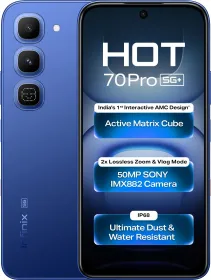
The Infinix HOT 70 Pro 5G is built to stand out. The Active Matrix Cube and Dynamic Shine finishes give it a look that’s quite different from most phones around ₹25,000, while XOS 16 packs in a huge number of features and useful AI tools. The 45W charging also does a good job of keeping the 6,000mAh battery topped up without making you wait around for too long.
The phone has its share of compromises. The 144Hz refresh rate rarely gets used, outdoor visibility could be better, and the camera misses some hardware you’d expect at this price. There’s no OIS or ultrawide camera, video recording stops at 2K, and the haptic motor feels weaker than the software tuning suggests. I also ran into occasional app crashes and animation hiccups during testing.
Buy it if:
- You want a phone that looks different from everything else around this price.
- You like having lots of software features and useful AI tools to play with.
- Fast charging matters to you, and you’re fine with an LCD display even if the 144Hz mode isn’t used very often.
Skip it if:
- You want OIS, an ultrawide camera, or 4K video recording.
- You want excellent outdoor visibility or a stronger haptic experience.
The HOT 70 Pro 5G is Infinix’s attempt to make the HOT series more than a straightforward value-focused lineup. The Active Matrix Cube, Dynamic Shine finishes, Sony main camera sensor, IP68 rating, and feature-heavy software give it several things to talk about at ₹25,000. I’ve used the phone for about a week to see how these features hold up in everyday use and where the usual mid-range compromises start showing up. Here’s how it went.
HOW I TESTED
| Test Unit: Infinix provided the review unit of the HOT 70 Pro 5G, although the company had no involvement in the editorial process of this review. Duration and Environment: The phone was used for about a week during testing on Jio’s network in India, running XOS 16 based on Android 16. Tests: I tested the camera in daylight, low-light, and other real-world situations. I also tested the Active Matrix Cube, checked the display at different refresh rates and in outdoor conditions, and tracked charging speed and screen-on time during mixed daily usage. Competitor: POCO M8 Power |
Infinix HOT 70 Pro 5G Price & Availability
The Infinix HOT 70 Pro 5G starts at ₹24,999 for the 6GB + 128GB variant. The 8GB + 128GB model costs ₹27,999, and there’s no 256GB option.
The phone is available in Mirage Green, Dive Blue, Silk Glow Purple, and Thermo Orange.
Pros
- Active Matrix Cube
- Slim, solid build with a fingerprint-resistant back
- Feature-rich XOS 16 with plenty of useful features
- Fast charging, with 0 to 50% taking around 30 minutes
- NFC support
- Charger and color-matched case included in the box
- Decent daylight camera performance
- 3 + 5 years of update policy
- Stereo speakers
Cons
- 144Hz was usable only in Clash Royale during testing; most of the time, the display stays at 90Hz or 120Hz
- Outdoor visibility isn’t great
- No OIS, no ultrawide camera, and video is capped at 2K30
- Ads appear in the lock screen magazine and on the Zero screen, although both can be turned off
- Occasional app crashes and animation hiccups
- The haptic motor is weak
Infinix HOT 70 Pro 5G Specifications
| Display | 6.76-inch LCD, FHD+ (1080 x 2344), punch-hole cutout, 144Hz adaptive refresh rate (60/90/120/144Hz), 240Hz touch sampling, up to 950 nits HBM brightness |
| Processor | MediaTek Dimensity 7100 |
| RAM | 6GB / 8GB LPDDR5X |
| Storage | 128GB, UFS 2.2 |
| Main Camera | 50MP Sony IMX882, 1/1.95-inch sensor, f/1.8, 26mm, no OIS, 2K@30fps video |
| Depth Camera | 2MP |
| Front Camera | 13MP GalaxyCore GC13A0, 1/3.1-inch sensor, f/2.2, 24mm, fixed focus, 2K@30fps video |
| Battery | 6,000mAh, 45W wired fast charging, Bypass Charging support |
| Build | Plastic frame and back, fingerprint-resistant finish, 7.85mm thickness, 204 grams |
| Audio | Stereo speakers |
| Special Features | Active Matrix Cube, Dynamic Shine finish on select colors, One Tap Button, UltraLink for calling and messaging up to 1.5km without a network, three-mode noise cancellation |
| Biometrics | Side-mounted fingerprint scanner |
| Durability | IP68 dust and water resistance |
| Software | XOS 16 based on Android 16; three years of OS upgrades, five years of security patches |
| SIM | Hybrid dual Nano-SIM or single Nano-SIM + microSD |
| Colors | Mirage Green, Dive Blue, Silk Glow Purple, Thermo Orange |
Infinix HOT 70 Pro 5G Review: Unboxing
Inside the box, you get the phone, a 45W charger, USB cable, SIM ejector tool, and documentation. Infinix also includes a case, which is a nice touch. The sides are color-matched to the phone, while the back is transparent.

Infinix HOT 70 Pro 5G Review: Design and Build
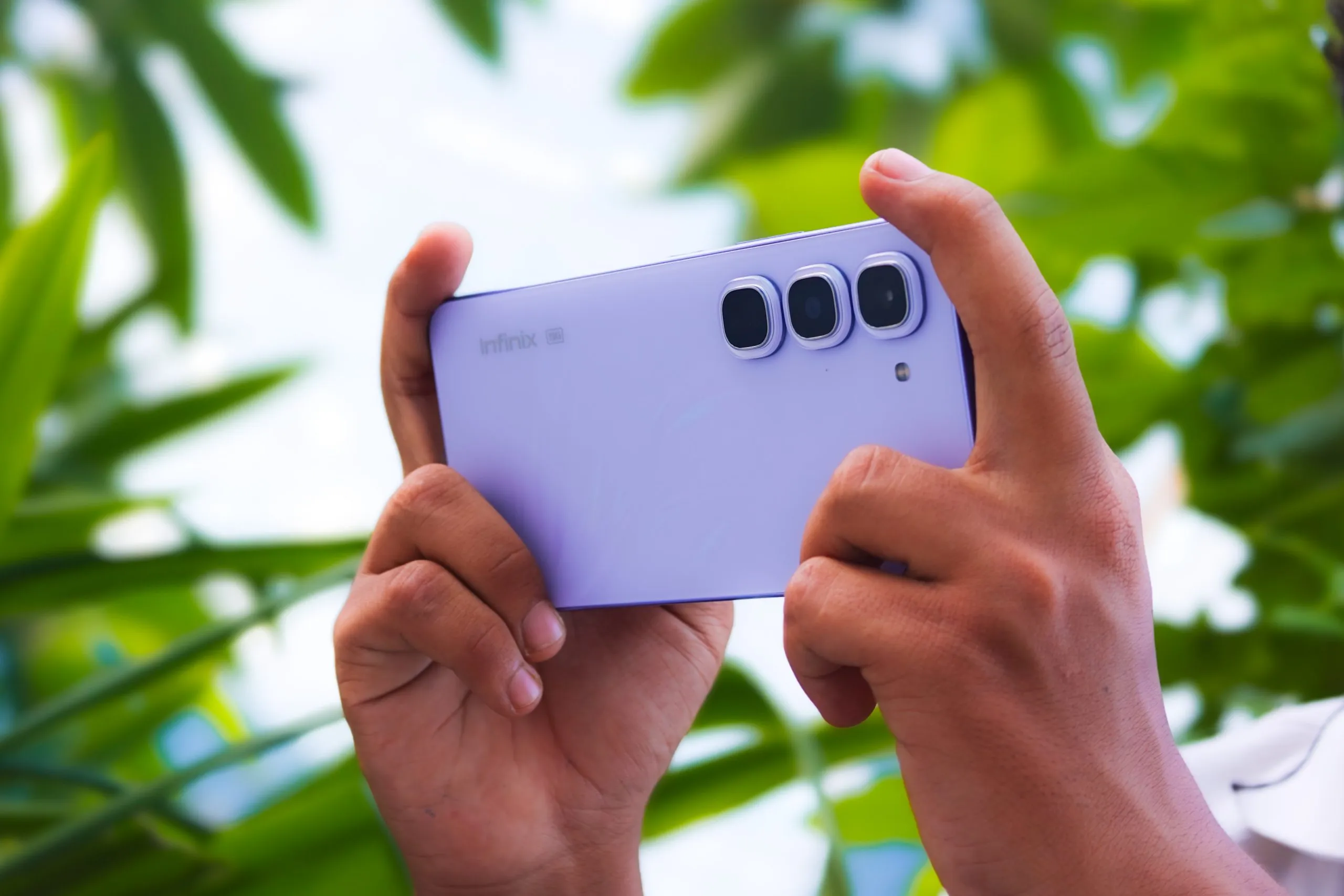
Design is one of the biggest reasons to consider the HOT 70 Pro 5G. I tested the Silk Glow Purple version, and it looks excellent in person. The light purple shade gives the phone an eye-catching appearance, especially in daylight.

The Active Matrix Cube is the other feature that immediately grabs your attention. It works well for glanceable notifications and call alerts, while Matrix Studio lets you create your own light patterns. The built-in mini-games are more of a gimmick. They’re fun for showing the feature to someone, but I don’t see myself using them regularly.

It’s also noticeably smaller than the Active Matrix display on the Note 60 Pro. The effect doesn’t have the same visual presence, but it remains a fun feature that you can actually interact with.
Build quality is solid. The phone feels larger in the hand than its specifications might suggest, although it remains quite slim at 7.85mm. The rear finish also does a good job of resisting fingerprints. There is a slight wobble when the phone is placed flat on a table, probably because of the camera module.

The layout is fairly standard. The bottom has the USB-C port, primary speaker, and microphone, while the earpiece sits at the top. The left side houses the SIM tray, which supports either a hybrid dual Nano-SIM setup or one Nano-SIM and a microSD card.

On the right are the power button with the fingerprint scanner built in, volume buttons, and the One Tap Button. It ships configured for mute/unmute rather than the smart on-screen capture function Infinix highlights in its marketing. You’ll need to reassign it yourself if you want that functionality.

The front uses a punch-hole display. The bezels and chin are noticeably thick, which makes the phone feel larger than its 6.76-inch display size suggests.
Infinix HOT 70 Pro 5G Review: Display
The HOT 70 Pro 5G uses a 6.76-inch FHD+ LCD panel with a 144Hz adaptive refresh rate. In actual use, 144Hz is rarely available. During testing, Clash Royale was the only app that actually ran at 144Hz. Everything else regularly dropped to 90Hz or 120Hz.

Outdoor visibility is another weak point. Infinix quotes close to 950 nits of peak brightness, but the display isn’t particularly easy to read under direct sunlight.
Indoors, the panel is much better. Viewing angles are decent and colors look good for everyday use. Since this is an LCD panel, blacks aren’t as deep as they would be on an AMOLED screen.

Motion Sickness Relief is one feature that works as advertised. It puts small moving dots on the display to make using the phone in a moving vehicle easier on the eyes. It’s a useful addition that I could see some people actually using.
Infinix HOT 70 Pro 5G Review: Speakers and Haptics
The HOT 70 Pro 5G uses stereo speakers, which is a welcome inclusion at this price. The speaker setup gets reasonably loud and works well for watching videos and casual gaming. It doesn’t have the same level of tuning you get from some of Infinix’s more premium Note-series phones, but the stereo setup itself is useful.

The haptic experience is better from the software side. Typing and UI interactions are reasonably well tuned, although the vibration motor itself feels weak and doesn’t provide particularly satisfying feedback.

Infinix HOT 70 Pro 5G Review: Software
The HOT 70 Pro 5G runs XOS 16 based on Android 16, and this is one of my favorite XOS versions so far. The feature list is huge, but more importantly, many of those features have an actual use.

The AI suite includes Folax AI for on-device assistant tasks, with the option to switch to Gemini. You also get Circle to Search, an AI call assistant for summaries and translation, automatic call answering, AI captions for live transcription and translation across apps including YouTube, recording summarization, a translation assistant, AI writing tools for rewriting and grammar correction, an AI theme generator, and AI Notes.

There’s also Dynamic Port, Infinix’s Dynamic Island-style feature. It appears for calls, charging, NFC, music, timers, hotspot status, screen recording, flash, and even WhatsApp calls.


Personalization options are extensive. Depth effects are available on both the lock screen and home screen, and there are plenty of first-party widgets. Always-on display supports proper lock screen transitions, but it lasts only 10 seconds. The widget selection is decent, although it still doesn’t match ColorOS.

There is bloatware and app recommendations, although much of it is disabled by default during setup. That’s something I appreciate because it’s not common to see on phones in this segment.
The default keyboard looks like Gboard but isn’t Gboard, so I’d switch it out immediately if you want a proper typing experience.

The lock screen magazine contains ads, although it can be turned off. The Zero screen uses XOS’s own feed instead of Google Discover (you can’t switch to Google Discover), and ads are present there as well.

I also ran into occasional app crashes and animations breaking during app launches. The overall day-to-day experience remained reasonably smooth, though. Considering the Dimensity 7100 and UFS 2.2 storage underneath, this is probably close to the limit of what the hardware can realistically deliver.
Overall, I think XOS 16 is a really good software experience, packed with plenty of useful features that you rarely see at this price.
Infinix HOT 70 Pro 5G Review: Biometrics
The side-mounted fingerprint scanner is built into the power button, as you’d expect with an LCD panel that doesn’t have an in-display fingerprint sensor. It’s fast and reliable in daily use. I had no issues unlocking the phone during testing.
Infinix HOT 70 Pro 5G Review: Performance
The HOT 70 Pro 5G uses the MediaTek Dimensity 7100 with UFS 2.2 storage. This puts it in the lower mid-range category. Day-to-day experience is mostly lag-free and you are unlikely to notice any major issues with regular use. However, the UFS 2.2 storage isn’t particularly fast, and it might start showing its age sooner than expected.
| Benchmark | Infinix HOT 70 Pro 5G (Dimensity 7100) |
| AnTuTu Score | 719073 |
| Storage (Score, Sequential Read Speed, Write Speed) | Score: 38459; Sequential Read: 1076 MB/s; Sequential Write: 779 MB/s |
| Geekbench 6 CPU (Single-Core, Multi-Core) | Single-Core: 831; Multi-Core: 2824 |
| Geekbench 6 GPU (OpenCL, Vulkan) | OpenCL: 2038; Vulkan: 1764 |
| 3DMark Wildlife Extreme (Score, Avg FPS) | Score: 693; Avg FPS: 4.15 |
| 3DMark Wildlife Extreme Stress Test (Best Loop, Lowest Loop, Stability) | Best Loop: 695; Lowest Loop: 689; Stability: 99.1% |


The MediaTek Dimensity 7100 handles everyday gaming fairly well. In BGMI, the phone supports 60fps and delivers a playable experience with relatively few frame drops. Heavier scenes can still cause some drops, but they aren’t frequent enough to affect the overall experience.

For gaming, I’d call the HOT 70 Pro 5G a decent device for its segment. Just don’t expect it to handle much heavier games like Genshin Impact particularly well.
Infinix HOT 70 Pro 5G Review: Cameras
The HOT 70 Pro 5G uses a 50MP Sony IMX882 1/1.95-inch main camera with a 2MP depth sensor. There is no ultrawide camera.

Daylight photography is good overall. HDR isn’t particularly strong, and autofocus can sometimes take a little longer to lock onto a subject. The phone advertises 2X lossless zoom, but the 2X crops I took showed some oversharpening and loss of detail. I’d call the results usable rather than genuinely lossless.
Zoom goes up to 15X on paper, although I’d keep it around 5X or below if you want results that remain genuinely usable. Live Photo is available and works as expected, capturing a short 3 second clip around the image.


Low-light photography can introduce some flaring. Manually lowering the exposure compensation helps produce better results.
Portrait mode offers 24mm, 35mm, and 50mm focal lengths. There’s also Sky Shop, which lets you replace the sky with different colors and moods depending on the filter.


The AIGC Portrait mode uses generative AI to create styled portraits across categories including occupational roles, workplace IDs, hairstyles, weddings, graduation, childhood, and art photos. Each category has several style options.
Video recording tops out at 2K30, with no option for 4K. Stabilization is available at 1080p60 and 1080p30, while the front camera is limited to 30fps. Portrait video works at 1080p30.

Exposure handling during movement can be a little inconsistent, although the results are generally fine for casual shooting. There’s also a dedicated Vlog Mode for quickly combining clips into an edited video.
Overall, the camera system on the HOT 70 Pro is just decent. It handles daylight photography well enough for everyday use, while the AI features give you some additional things to play around with.
Infinix HOT 70 Pro 5G Review: Battery Life and Charging
The HOT 70 Pro 5G packs a 6,000 mAh battery with 45W wired charging. Charging is reasonably quick. The phone went from 5% to 50% in around 30 minutes, while a full charge took approximately 1 hour and 25 minutes.

Battery life is decent. I got around 7 to 8 hours of screen-on time with mixed daily usage. That’s good, although it’s not particularly impressive considering the 6,000 mAh capacity.

The 45W charger is included in the box, which is still worth mentioning since chargers aren’t included with every phone at this price.
Review Verdict: Should You Buy the Infinix HOT 70 Pro 5G?
The HOT 70 Pro 5G works best when you’re interested in the things that make it different. The Active Matrix Cube is fun, the phone has a slim and solid build, and XOS 16 is one of the most feature-packed software experiences I’ve used from Infinix.nThere are plenty of AI tools, personalization options, fast charging, NFC, and a long software update promise. The phone clearly isn’t trying to win purely on specifications.
Still, there are a few shortcomings. The 144Hz display rarely runs at 144Hz, outdoor visibility isn’t great, and the camera hardware leaves out OIS and an ultrawide lens. The camera system is fairly ordinary for the segment.
At ₹24,999, the HOT 70 Pro 5G makes the most sense if you care about design and features more than having the strongest camera or display in the segment. The Active Matrix Cube gives it something unique, and XOS 16 has enough useful features to make the software worth exploring.

Smartprix ⭐ Rating: 7.8/10
- Design and Build: 8/10
- Display: 7/10
- Speakers: 7.5/10
- Software: 8.5/10
- Haptics: 7/10
- Biometrics: 8/10
- Performance: 8.1/10
- Cameras: 7.6/10
- Battery Life & Charging: 8.5/10
First reviewed in February 2026.