

Buying a phone under ₹30,000 in 2026 has become surprisingly complicated. There are plenty of phones with big batteries, fast charging, and high refresh rate displays, but finding one that also comes with useful AI features narrows the field considerably. Some brands are adding AI almost everywhere, while others are sticking to the basics. The result is a market where two phones with similar hardware can end up offering completely different experiences.
For this list, we’ve picked seven phones that bring a good mix of AI features and solid hardware. Some focus on productivity, some lean heavily into photography, while others try to make day-to-day tasks through on-device intelligence and cloud AI tools. Just as importantly, these are also good phones even if you ignore the AI side completely.
One thing worth mentioning before we begin is that this list is not ranked in any particular order. The best option for you depends entirely on whether you care more about cameras, gaming, battery life, software experience, or AI features. Let’s get into it.
Best AI Phones to Buy Under ₹30,000
- Motorola Edge 70 Fusion
- Motorola Edge 60 Pro
- Motorola Edge 70
- realme P4 Pro
- OnePlus Nord CE6
- realme P4 Power
- realme GT 7T
1. Motorola Edge 70 Fusion

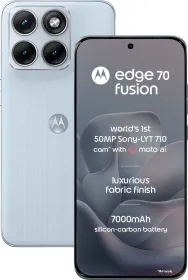
The Motorola Edge 70 Fusion is one of the more interesting options in this segment because it tries to do a little bit of everything. It is powered by the Snapdragon 7s Gen 4 chipset, which is a decent platform for gaming and multitasking.
Motorola has also given the phone IP68 and IP69 dust and water resistance ratings, something that’s always appreciated. The phone weighs around 193 grams and measures roughly 8mm thick.

On the front, Motorola ships a 144Hz AMOLED panel with a 1.5K resolution and up to 5,200 nits of peak brightness. The company promises three major Android updates alongside five years of security updates, although Motorola’s software rollout speeds have historically been slower than some competitors.

The camera hardware is one of the better parts of the package. The main camera uses a 50MP 1/1.56-inch sensor with autofocus and OIS, which is a fairly large sensor for this segment. Motorola has also avoided using a low-end ultrawide camera and instead includes a 13MP ultrawide sensor with AF support, doubling as a macro camera as well. A 32MP front is there for selfies, and all cameras support 4K video recording.
The rest of the hardware is well-rounded too. You get stereo speakers, an optical in-display fingerprint scanner, NFC support, a 7,000 mAh battery, and 68W wired charging with the charger included in the box.

Motorola’s AI implementation is quite decent. The company includes a dedicated Moto AI hub that brings together several features under one roof. Image Studio can generate avatars, stickers, wallpapers, and images using text prompts.
Playlist Studio works with Amazon Music and can create playlists based on prompts and moods. The Remember This feature acts as a memory layer for the phone, allowing users to save information and retrieve it later through natural language searches.
Moto AI also integrates deeply with productivity features. AI Notes can record conversations, generate transcripts, summarize meetings, and save everything directly inside the Moto Notes application. Screenshots can be stored as searchable memories with tags attached to them, making them easier to find later.

Motorola also includes an Update Me feature that summarizes notifications and messages so users can quickly catch up on what they missed. Alongside Moto AI, the phone also supports Google Gemini and Circle to Search, both of which extend the AI experience even further.
All in all, the Motorola Edge 70 Fusion is a strong option under ₹30,000. It combines capable hardware, a large camera sensor, extensive AI features, good durability, and enough performance for gaming, making it one of the more complete AI smartphones currently available in this price segment.
2. Motorola Edge 60 Pro

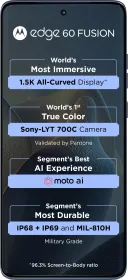
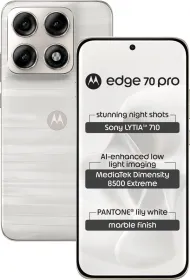
Next up is the Motorola Edge 60 Pro. It launched back in April last year, but it holds up surprisingly well in 2026 (reason: RAM hikes), especially considering you can now pick up the 8GB + 256GB variant for around ₹30,000. At that price, it continues to be one of the better value options in this segment.
The phone comes with a 6.7-inch 1.5K OLED display with a 120Hz refresh rate. PWM dimming sits at 720Hz, which is something worth keeping in mind if you’re sensitive to display flicker.

Powering the device is the MediaTek Dimensity 8350 Extreme, paired with UFS 4.0 storage. Motorola promised three major Android updates, although the phone launched with Android 15, which means there are effectively two major OS upgrades still remaining.
You get a 50MP primary camera, a 50MP ultra-wide camera, and a 10MP 3X telephoto camera, which is something that’s becoming increasingly rare under ₹30,000. Video recording tops out at 4K 30fps, while selfies are handled by a 50MP front camera.

The rest of the package is equally solid. Motorola includes stereo speakers, NFC support, a 6,000 mAh battery, 90W wired charging, and 15W wireless charging, making it one of the very few phones in this segment to offer wireless charging at all.

On the AI side, the Edge 60 Pro gets the same Moto AI suite available on the Edge 70 Fusion. That means you get Image Studio for generating wallpapers, stickers, avatars, and images, Playlist Studio for creating Amazon Music playlists through prompts, and Remember This, which allows Moto AI to store information and recall it later when needed.

The phone also supports AI Notes for recording, transcribing, and summarizing conversations and meetings, while screenshots can be saved as searchable memories with tags attached to them.
Motorola also includes the Update Me feature, which summarizes notifications and updates, alongside support for Google Gemini and Circle to Search.

The Edge 60 Pro also gets an additional hardware shortcut in the form of a dedicated Moto AI button, giving users quicker access to these features without needing to dig through menus or launch apps manually.
Even a year after launch, the Motorola Edge 60 Pro remains a very easy phone to recommend if your priorities include cameras, battery life, wireless charging, and AI features in the same package. Just keep in mind that Motorola’s software update rollout is slow.
3. Motorola Edge 70

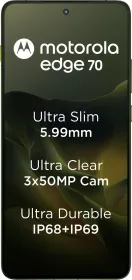
The Motorola Edge 70 is another strong option if you’re looking for a phone that balances hardware with useful AI features. Compared to the Edge 60 Pro, this one takes a slightly different approach and focuses more on design and portability.
The phone comes with a 6.7-inch 1.5K display with a 120Hz refresh rate, alongside IP68 and IP69 dust and water resistance. Motorola ships the device with Android 16 out of the box and promises three years of major Android updates and four years of security patches.

Under the hood, you get the Snapdragon 7 Gen 4, paired with UFS 3.1 storage. The chipset is more than capable for this price segment and handles everyday use, multitasking, and gaming comfortably.
For cameras, Motorola includes a 50MP primary camera alongside a 50MP ultrawide camera. Both rear cameras support 4K recording at 30fps and 60fps, while the front uses a 13MP selfie camera with support for 4K 30fps recording.
The phone also includes stereo speakers, 68W wired charging, and 15W wireless charging.

One thing to keep in mind is the battery size. The Edge 70 comes with a 4,800 mAh battery, which is smaller than what most phones in this segment offer today. Motorola has clearly made that tradeoff to keep the phone slim, as the device measures just 6mm thick.
If you want a thinner and lighter phone without giving up AI features, this is probably one of the better options available under ₹30,000. The smaller battery is simply something you’ll want to keep in mind before making a decision.


On the AI side, the Edge 70 gets the same Moto AI experience as the Edge 70 Fusion and Edge 60 Pro. You get Image Studio for creating wallpapers, stickers, avatars, and AI-generated images, Playlist Studio for generating playlists through prompts inside Amazon Music, and Remember This, which lets Moto AI save information and retrieve it later using natural language queries.
The phone also supports AI Notes for recording, transcribing, and summarizing conversations and meetings, while screenshots can be stored as searchable memories and organized with tags. Motorola also includes the Update Me feature for summarizing notifications and updates, alongside support for Google Gemini and Circle to Search.
4. realme P4 Pro

The realme P4 Pro is probably one of the most AI-heavy phones you can buy under ₹30,000 right now. If your main reason for upgrading is to get access to as many AI features as possible without spending flagship money, this one deserves a serious look.
The AI feature list alone is massive. You get AI Edit Genie, AI Eraser, AI Unblur, AI Recording, AI Summary, AI HyperClarity, AI Smart Loop, AI Portrait Glow, AI Perfect Shot, AI Recompose, and AI Remove Reflections.
realme has also integrated AI into its Notes app for summaries and organization, while Chrome can generate summaries for webpages as well. There are plenty of smaller AI tools scattered throughout the system too, making this one of the more feature-packed AI experiences in this segment.

The hardware holds up well too. The phone comes with a 144Hz display with 1.5K resolution and 1,800 nits of HBM brightness. realme promises three major Android updates, and since the phone launched with Android 15, users still have two major OS upgrades left.

Powering the device is the Snapdragon 7 Gen 4, which is a capable chipset for this price segment. You also get UFS 3.1 storage, which helps with app loading times and overall responsiveness.
The camera setup includes a 50MP 1/1.56-inch primary camera, an 8MP ultrawide camera, and a 50MP selfie camera on the front. Both the front and rear cameras support 4K 60fps video recording, which is still relatively uncommon in this price bracket.

Battery life is another strong point. realme includes a 7,000 mAh battery alongside 80W wired charging, and the charger comes bundled in the box. You also get stereo speakers, rounding out what is already a fairly complete package.
The ultrawide camera isn’t particularly impressive compared to some other phones on this list, but apart from that, there aren’t many obvious compromises here. If AI features sit at the top of your priority list and you also want a large battery, a capable chipset, and good camera hardware, the realme P4 Pro is easily one of the strongest contenders under ₹30,000 right now.
5. OnePlus Nord CE6

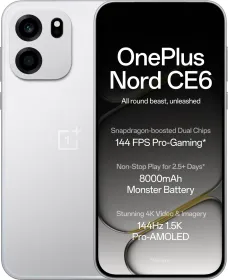
The OnePlus Nord CE6 is another easy recommendation in this segment, especially if AI features sit high on your priority list. In fact, if you’re looking purely at the number of AI tools available under ₹30,000, this is probably one of the most feature-packed options you can buy right now.
The phone comes with a 6.78-inch 1.5K display with a 144Hz refresh rate and up to 1800 nits HBM brightness. Powering the device is the Snapdragon 7 Gen 4, paired with UFS 3.1 storage, which makes for a capable setup for everyday use, multitasking, and gaming.

For cameras, the Nord CE6 packs a 50MP primary camera alongside a 32MP selfie camera, with both front and rear cameras supporting 4K 30fps video recording.

Battery life is one of the highlights here. OnePlus includes a massive 8,000 mAh battery along with 80W SUPERVOOC wired charging and 27W reverse wired charging, which is still quite rare in this price segment.

The phone also gets stereo speakers and one of the strongest durability packages in the category with IP66, IP68, IP69, and IP69K certifications.
Software support is one area where the phone falls slightly behind some rivals. OnePlus promises only two major Android updates and four years of security updates, which isn’t terrible, but several competitors have started offering longer support windows.

On the AI side, however, the Nord CE6 pulls ahead quickly. The phone includes AI Eraser, AI Reflection Eraser, AI Recompose, AI Perfect Shot, AI Detail Boost, AI Portrait Glow, and AI Unblur for photo editing and image enhancement.


The AI VoiceScribe feature can record conversations and generate transcripts and summaries automatically through the Recorder app. Inside the Notes app, OnePlus includes AI formatting tools, summaries, and even mind map generation.
The phone also supports AI Speak, which can read articles and webpages aloud, while AI Writer helps generate, rewrite, or refine text directly inside supported applications.

There’s also an AI Summary feature for webpages and articles, an AI Translate app for translations, along with Google Gemini and Circle to Search integration.
The camera setup isn’t as versatile as some rivals that offer telephoto cameras or autofocus ultrawides, and software support could certainly be better. Outside of those areas, though, the Nord CE6 gets a lot right.
6. realme P4 Power

If your priorities are simple and you want the biggest battery possible alongside a healthy dose of AI features, then the realme P4 Power is worth considering.
The phone does make a few compromises compared to some of the other devices on this list, starting with the chipset. realme uses the Dimensity 7400 Ultra here, which isn’t quite as capable as the Snapdragon 7 Gen 4 or Dimensity 8350 Extreme found elsewhere in this segment.
The display is one of the stronger parts of the package. You get a 144Hz panel with 1.5K resolution and up to 1,800 nits of brightness. realme also promises three major Android updates, and since the phone launched with Android 16, all three of those updates are still ahead of it.

For cameras, the P4 Power comes with a 50MP 1/1.95-inch primary camera, an 8MP ultrawide camera, and a 16MP front camera. Video recording tops out at 4K 30fps from the rear camera.
Battery life is very clearly the main selling point here. The phone packs a massive 10,000mAh battery alongside 80W wired charging and 27W reverse wired charging, making it one of the easiest recommendations for users who simply don’t want to think about charging their phone every evening.
On the AI side, you get the same feature set available on the realme P4 Pro. That includes AI Edit Genie, AI Eraser, AI Recording, AI Summary, AI HyperClarity, AI Smart Loop, AI Portrait Glow, AI Perfect Shot, AI Recompose, AI Unblur, and AI Remove Reflections.


The phone isn’t without compromises. It uses a single speaker instead of stereo speakers, the curved display may be a little too aggressive for some users, and the cameras are not the strongest in this category.

Still, if battery life sits above everything else on your priority list and you still want access to a large collection of AI features, the realme P4 Power makes a lot of sense under ₹30,000.
7. realme GT 7T

If software support matters more to you than anything else, and you’re okay picking up a slightly older phone, then the realme GT 7T deserves serious consideration. It has already been around for a while, which means prices have settled nicely, and you’ll regularly find it selling for around ₹27,000 to ₹28,000.
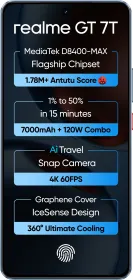
The phone comes with a 1.5K display that reaches up to 1,800 nits of HBM brightness. realme launched the device with Android 15, and the company promises four major Android updates and six years of security updates, which is comfortably the longest software commitment among the phones we’ve discussed so far.
Performance is another area where the GT 7T pulls ahead. It uses the MediaTek Dimensity 8400 Max, which is the most powerful chipset among all the devices on this list so far. Pair that with UFS 4.0 storage, and you have one of the faster phones available under ₹30,000.

The camera hardware is solid as well. The main camera uses a 50MP 1/1.56-inch sensor, which remains one of the larger sensors in this segment. You also get an 8MP ultra-wide camera and a 32MP front camera. Both the front and rear cameras support 4K 60fps video recording, which is still uncommon at this price.
The rest of the package is equally strong. You get stereo speakers, a large 7,000 mAh battery, and 120W wired charging, making this the fastest charging phone among all the devices we’ve covered so far.
On the AI side, the GT 7T gets almost the entire realme AI suite. You get AI Eraser, AI AI Recording, AI Summary, AI HyperClarity, AI Smart Loop, AI Portrait Glow, AI Perfect Shot, AI Recompose, AI Unblur, AI Remove Reflections, AI tools inside the Notes app, and Chrome webpage summaries. The only notable omission compared to the realme P4 Pro is AI Edit Genie.

If you want the fastest chipset, the fastest charging, the longest software support, and one of the biggest batteries available under ₹30,000, the realme GT 7T is very easy to recommend.

You can follow Smartprix on Twitter, Facebook, Instagram, and Google News. Visit smartprix.com for the latest tech and auto news, reviews, and guides.