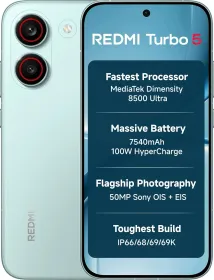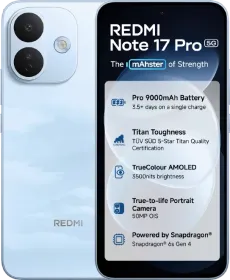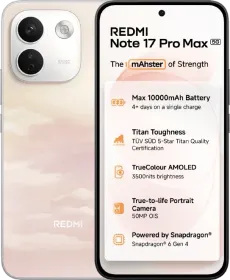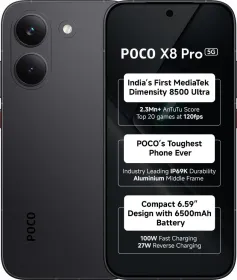


Quick Verdict
The Redmi Note 17 is a phone built around one strength, and it delivers on that strength convincingly. The 8,000mAh battery genuinely eliminates charging anxiety, the AMOLED display is vibrant and immersive for its size, and four years of OS updates plus six years of security patches make this a phone you can hold onto.
But the performance downgrade from the Snapdragon 4 Gen 4 is real and measurable, the camera has been stripped down to a single lens, and the display’s brightness has taken a noticeable step back from last year.
Buy it if:
- You want a phone that survives 1.5-2 days easily
- Screen size matters more than resolution or peak brightness
- You plan to keep this phone for several years
- Long software support outweighs raw performance for you
Skip it if:
- You play demanding games regularly or want 90 fps gaming
- Camera versatility and 4K video matter to you
- You want the brightest screen at this price
- You’re upgrading from the Redmi Note 15 for speed
Xiaomi’s Redmi Note series built its reputation on balance. Solid specs across the board without a glaring weak spot. The Redmi Note 17 breaks from that formula entirely. At ₹27,999 onward, it leans almost entirely on one pillar: an 8,000mAh battery, the largest ever fitted to a Note phone. The battery is backed by a bigger 6.9-inch AMOLED display and genuinely strong software support.
To get there, though, Xiaomi has cut deep elsewhere. The phones comes with a simplified single camera, a noticeably weaker chipset than its own predecessor, and a dimmer screen. After three weeks of daily use, I wanted to know if the battery alone is enough to carry this phone, or whether the Note series has lost what made it special in the first place.

HOW I TESTED
| Reviewed By: Shikhar Mehrotra (Consumer Tech, Auto, and AI Expert with 6+ years of experience) Test Unit: Xiaomi provided the review unit of the Redmi Note 17 5G, with no involvement in the editorial process. Duration and Environment: I used the device for over two weeks, on a mix of home Wi-Fi and mobile data in Northern India. The unit tested was the Starlight Purple variant with 8GB RAM and 128GB storage. Tests: Daily usage including calls, social media, streaming, navigation, multitasking, and photography. I also ran synthetic benchmarks (AnTuTu, Geekbench 6, 3DMark Wildlife Extreme) and tested gaming performance in BGMI and COD: Mobile, along with battery drain tests under both light and heavy usage conditions. Competitors: vivo T5x, Motorola Edge 70 Fusion, Samsung Galaxy F70 Pro 5G, Nothing Phone 3a |
Redmi Turbo 5: Price & Availability
The Redmi Note 17 5G is available in India in two memory and storage configurations.
- Redmi Note 17 5G (6GB + 128GB): Rs. 27,999
- Redmi Note 17 5G (8GB + 128GB): Rs. 30,999
The phone is available via Amazon.in, Mi.com/in, Xiaomi Retail Stores, and authorized offline partners across India. Color options include Starlight Purple, Dark Night, and Arctic Blue.
Redmi Note 17 5G: Tech Specs
| Specification | Details |
| Display | 6.9-inch AMOLED, FHD+ (1080 x 2396 pixels, 375 ppi), 120Hz AdaptiveSync refresh rate, 240Hz touch sampling rate, 1,800 nits peak brightness, DCI-P3 color gamut, Widevine L1, 960Hz PWM dimming, TÜV Rheinland Eye Care certified, HydroTouch 2.0, Corning Gorilla Glass 7i, no HDR support |
| Processor | Qualcomm Snapdragon 4 Gen 4 (4nm), octa-core, up to 2.3GHz, Adreno 613 GPU |
| RAM & Storage | 6GB / 8GB LPDDR4X RAM, 128GB UFS 2.2 storage, microSD expandable via hybrid SIM slot |
| Main Camera | 50MP, f/1.8, 5P lens, no ultrawide, no depth sensor, 1080p@30fps video, no OIS |
| Front Camera | 8MP, f/2.0, 1080p@30fps video |
| Battery & Charging | 8,000mAh silicon-carbon battery, Xiaomi Surge G1 battery management chip, Battery Health 4.0, 45W wired charging (charger included), 22.5W reverse wired charging |
| Audio | Single bottom-firing speaker, no 3.5mm headphone jack |
| Biometrics | Optical in-display fingerprint sensor |
| Build & Durability | Plastic frame and back, Gorilla Glass 7i front, IP65 rating |
| Software | HyperOS 3 based on Android 16, 4 years OS updates + 6 years security patches |
| Connectivity | 5G, dual-band Wi-Fi (802.11 a/b/g/n/ac), Bluetooth 5.1, no NFC, IR blaster, USB Type-C |
| Dimensions & Weight | 169.70 x 79.14 x 8.4mm, 225 grams |
| Colors | Starlight Purple, Dark Night, Arctic Blue |
| Price | Rs. 27,999 (6GB+128GB) / Rs. 30,999 (8GB+128GB) |
Redmi Note 17 5G Review: Design & Build
I’ve been using the Starlight Purple variant for over three weeks now, and it’s one of the more striking finishes I’ve seen on a Redmi phone, or an affordable smartphone in a while. Depending on the angle at which light hits the rear panel, it shifts its color between light pink and purple.

While the back panel looks entirely plain from certain angles, you tilt the phone in front of a light source, and it will reveal the concealed design that looks like a sky full of shooting stars. Despite this, the back panel has a matte finish and doesn’t pick up fingerprints whatsoever. The phone is also available in Dark Night and Arctic Blue are the other two options.
The camera module has also moved: it now sits in the top-left corner, housed in a squared-off, pill-shaped element with two circular cutouts (one for the camera sensor and another for the flash).

I’d say that It has a distinct, almost retro charm to it. It immediately reminded me of Xiaomi phones from a long time ago (I’ve been a Redmi Note 8 user back in the day).
The design itself marks a clean break from the Note 15 (which was the last generation, as Redmi skipped the Note 16 entirely). While the corners are round, the plastic frame around the phone is flat, and so is the back, with a slightly curvature toward the edges though, which gives a comfortable in-hand feel.

That said, I never once managed to comfortably use this phone one-handed. The nearly 7-inch display simply demands both hands for anything beyond basic scrolling. If you’re coming from a more compact phone, that adjustment period is real.
I wouldn’t use the word “premium” for the phone’s build quality, but rather “solid.” At 169.70 x 79.14 x 8.4mm and 225 grams, this is a genuinely large phone.


What I appreciate is that the phone isn’t pretending to be an exceptional thin or light phone, and the context matters here, especially since the phone packs an 8,000mAh battery. The weight distribution never felt lopsided in my hand.

The front is protected by Corning Gorilla Glass 7i, and the phone comes with a screen protector pre-applied. It carries an IP65 rating for dust and splash resistance. I’ll be honest, though, there are phones in the segment that ship with triple IP ratings, though even one with better water ingress protection would have done well.
The power button and volume rocker sit on the right edge with a satisfying, clicky feedback, and the bottom houses the USB-C port, speaker grille, and SIM tray that also accepts a microSD card.

The box itself is genuinely generous: you get the phone, a 45W charger, a USB-C cable, a protective case, a pre-applied screen protector, a SIM ejector tool, and the manual.
Redmi Note 17 5G Review: Display
This is one of the strongest suits of the handset. Redmi’s latest Note series handset features a 6.9-inch AMOLED panel with Full HD+ resolution (1080 x 2396; 375 ppi), a 120Hz AdaptiveSync refresh rate and a 240Hz touch sampling rate.

It is genuinely a good quality AMOLED display. Everything from Instagram photos to YouTube thumbnails looked punchy and accurate. The colors are vibrant, the blacks are inky, and the contrast is good enough, even for viewing the display under bright sunlight.
The rated peak brightness has gone down from 3,200 nits to 1,800 nits. So, it isn’t the brightest AMOLED panel in the segment.

However, I appreciate how the company has taken cuts on the brightness figures rather than swapping out the AMOLED panel for an equally bright IPS LCD display. The panel is Widevine L1 certified, which means Netflix and other DRM-protected apps stream in full HD rather than getting capped to standard definition.
That said, there’s no HDR support anywhere on this phone. YouTube caps out at standard playback with no HDR toggle, and there’s no support for HDR video beyond 1080p in general.

I also have to mention the bottom chin, which is noticeably thicker than the bezels along the sides and top. It feels like an area Xiaomi could have tightened up.
Additional niceties include 960Hz PWM dimming, DC dimming, a TUV Rheinland Eye Care certification, and HydroTouch 2.0, which keeps the screen responsive even when I tested it with wet fingers. Coming to the speaker, it isn’t the best one I’ve heard in this segment, especially since other phones offer a stereo speaker setup.

It gets loud, which is great for casual video consumption, but not great for gaming or watching something more immersive. Further, it lacks the low-end, something that is very common in smartphone speakers in the entry-level or affordable mid-range segment.
Rounding out this section, biometrics are handled by an optical in-display fingerprint sensor. It’s not the fastest scanner I’ve used, but it got the job done reliably throughout my review period.
Redmi Note 17 5G Review: Performance
From one of the most impressive aspects of the Redmi Note 17, we’re now entering into one of the most underwhelming ones: performance.

Chipset
Under the hood, the Redmi Note 17 runs on the Snapdragon 4 Gen 4, a 4nm chipset with an octa-core CPU (clocked up to 2.3GHz) and an Adreno 613 GPU. Right off the bat, it’s a noticeable downgrade from the Snapdragon 6 Gen 3 used on the Redmi Note 15. However, I wouldn’t blame Redmi for it.
That’s just how the smartphone market has progressed (read “regressed”) over time. Memory, storage, and chip prices have skyrocketed to a level that manufacturers have to cut corners where possible to keep costs under a certain level.

RAM, Storage, Day-To-Day Performance
Anyways, enough on the industry commentary. My review unit came with 8GB of LPDDR4X RAM and 128GB of UFS 2.2 storage. Both of them are just enough to get the job done, I’d say.
The 8GB of RAM is enough to keep seven to eight apps alive in the background (light ones), while the UFS 2.2 is quick enough for everyday use, but then again, you have plenty of UFS 3 storage phones in the segment.
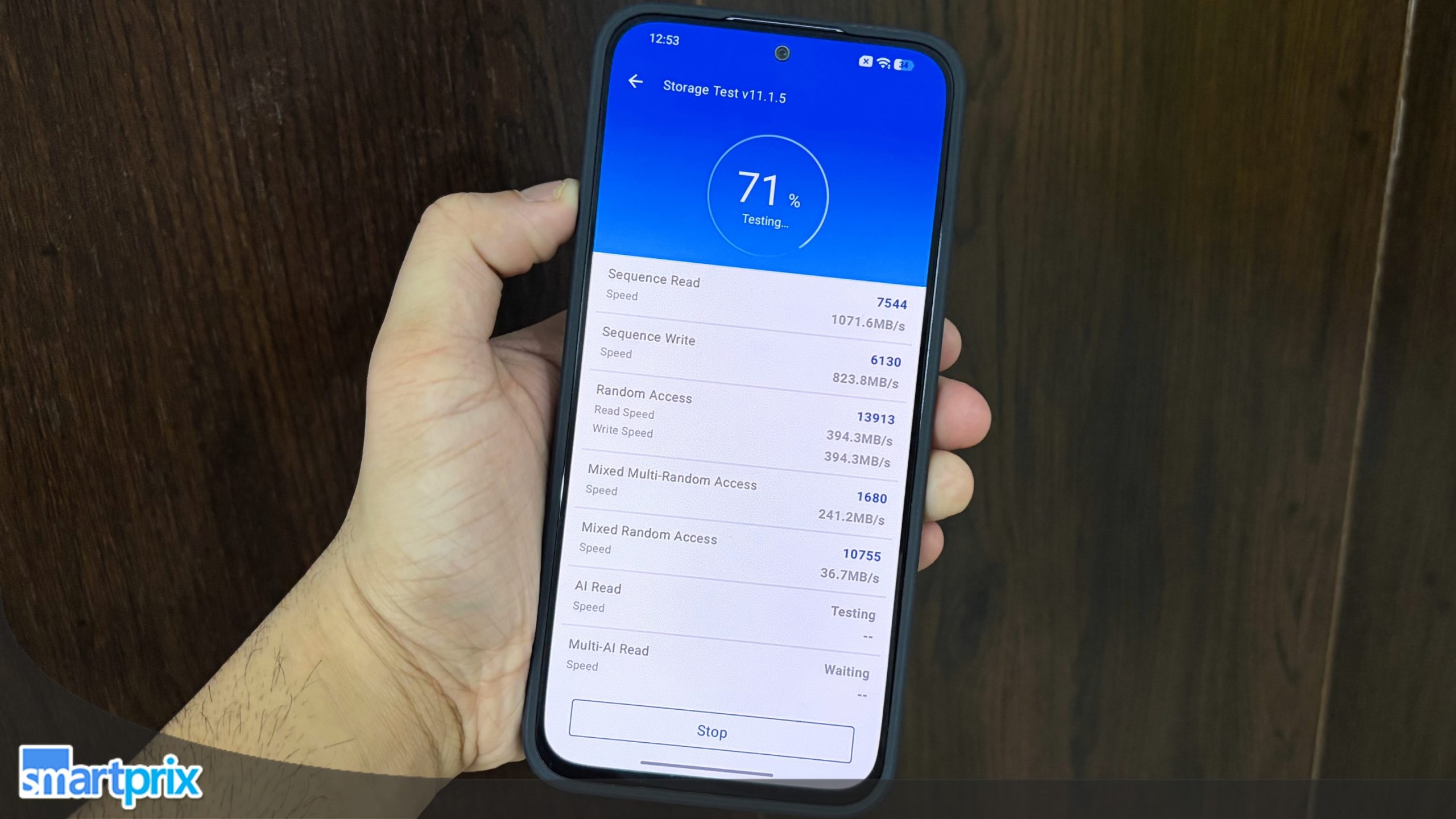
Scrolling through social media, texting, reading, streaming shows, switching between a handful of apps; all of it is mostly fine except for a few noticeable stutters here and there. Push the phone harder, though, and the cracks show.
Heavy multitasking introduced visible hesitation, and I noticed the phone working harder than it should have to keep up. While running GeekBench’s GPU tests, the app crashed two times for me, which is something that I don’t recall facing in a long time.
Synthetic Benchmarks
Given below are the benchmark scores of the phone, which clearly show how the Redmi Note 17 runs behind other phones in the segment.
| Benchmark | Redmi Note 17 5G (Snapdragon 4 Gen 4) | Vivo T5x (Dimensity 7400 Turbo) | Motorola Edge 70 Fusion (Snapdragon 7s Gen 4) |
| AnTuTu Score | 635291 (3D Bench Lite) | 962406 (3D Bench) | 1138456 (3D Bench) |
| Storage (Score, Sequential Read Speed, Write Speed) | Score: 68537; Sequential Read: 1071.6 MB/s; Sequential Write: 823.8 MB/s | Score: 96802; Sequential Read: 2168.8 MB/s; Sequential Write: 1957.7 MB/s | Score: 119279; Sequential Read: 2112 MB/s; Sequential Write: 2131 MB/s |
| Geekbench 6 CPU (Single-Core, Multi-Core) | Single-Core: 954; Multi-Core: 2305 | Single-Core: 991; Multi-Core: 2685 | Single-Core: 1249; Multi-Core: 3507 |
| Geekbench 6 GPU (OpenCL) | OpenCL: 445 | OpenCL: 3047; Vulkan: 3074 | OpenCL: 3566; Vulkan: 5074 |
| 3DMark Wildlife Extreme (Score, Avg FPS) | Score: 189; Avg FPS: 1.11 | Score: 1015; Avg FPS: 6.08 | Score: 1200; Avg FPS: 7.19 |
| 3DMark Wildlife Extreme Stress Test (Best Loop, Lowest Loop, Stability) | Best Loop: 194; Lowest Loop: 190; Stability: 97.9% | Best Loop: 1018; Lowest Loop: 1015; Stability: 99.7% | Best Loop: 1191; Lowest Loop: 1129; Stability: 94.8% |


Gaming
Gaming follows a similar disappointing pattern. Casual titles like Subway Surfers and Fruit Ninja ran fine, but heavier ones like Call of Duty: Mobile and Battlegrounds Mobile India (BGMI) were only available up to 60 fps. Even so, I noticed an annoyingly high amount of frame drops in extended gaming sessions.


To be fair to Xiaomi, this isn’t a phone built for gamers, and it doesn’t pretend to be. There’s a 10,416mm² graphite cooling layer inside, which is a genuinely substantial cooling surface for a chip this modest. However, I think it has more to do with the phone’s long-term stability than any substantial immediate relief from operational temperature.
Redmi Note 17 5G Review: Software
The Redmi Note 17 ships with HyperOS 3 on Android 16.

If you’ve used a Redmi phone in the last couple of years, the experience feels familiar: clean animations, a customizable home screen, Xiaomi’s Themes store for anyone who likes to tinker with icons and wallpapers, and a decent number of pre-installed apps (or bloatware) like Netflix, LinkedIn, Instagram, Facebook, and Spotify.
Giving credit where due, Xiaomi has refined the animations and transitions. Not that it is a bad thing per se, but the interface has an obvious iOS-inspired look and feel. The redesigned Control Center, rounded UI elements, and larger visual elements make the software feel a little more minimal.


In addition, customization remains one of HyperOS’s biggest strengths. You can change practically every visual aspect of the phone, from wallpapers and icons to widgets and lock-screen styles.
What genuinely impressed me is Xiaomi’s commitment to software support here. The phone should get four years of Android OS updates and six years of security patches. In theory, this should take the phone all the way through to Android 20 (around 2032).


However, I’m genuinely concerned about the chipset and whether it will be able to provide a smooth, lag-free day-to-day experience a couple of years down the line, considering that Android upgrades, no matter how efficient they are, are slightly heavier than the last generation due to added features.
There are a couple of software omissions worth flagging, though. The lock screen doesn’t get the depth effect wallpaper feature that’s become fairly standard across HyperOS devices.


And while most of the pre-installed apps can be removed without much fuss, the Indus Appstore cannot be uninstalled, which is a more frustrating limitation than the usual pile of removable bloatware.
And that’s ultimately how I’d describe HyperOS 3 on the Redmi Note 17: it’s feature-rich, polished and highly customizable, but it still carries some of the baggage that has traditionally come with Xiaomi’s software.
Redmi Note 17 5G Review: Cameras
Remember how I mentioned smartphone makers cutting corners to keep a handset’s price under a certain level? The first big hit, in respect to the theme, was the chipset, while the second is clearly the cameras.

The Redmi Note 17 ships with a single 50MP rear camera with an f/1.8 aperture and a 5P lens. There’s no ultrawide, no depth sensor, nothing else riding along.
Up front is an 8MP camera at f/2.0. Both are capped at 1080p at 30fps for video, with no 4K recording and no optical image stabilization anywhere in the system.

Quite a lot of phones under the ₹30,000 segment today ship with a secondary ultrawide camera and support 4K video recording. In fact, Samsung’s Galaxy F70 Pro 5G comes with both OIS on the primary camera and an ultrawide camera and still costs under ₹25,000 for the entry-level variant.
In daylight, though, I came away more impressed than I expected. The pictures retain detail and the dynamic range holds up well under tricky lighting conditions. I’d say that the colors strike the right balance between staying close to natural and the vibrant, punchy look users like and works on social media.


The 2x in-sensor zoom works well as well. Too close-up shots retained detail without falling apart the way digital zoom usually does at this tier. However, very few of the pros hold up at night.
Portrait mode turned out better than I anticipated. While there’s a noticeable level of noise in the background, especially in the darker areas, the overall edge detection feels accurate, and the bokeh effect turns out quite natural. I didn’t come across the over-sharpened, artificial look, something that’s worth appreciating.


The dedicated Night Mode does a reasonable job of lifting shadows without blowing out the highlights. However, it still resists the urge to artificially brighten every frame into daylight or evening-level exposure. That said, low-light performance can still be inconsistent depending on the scene.


Selfies from the 8MP front camera are perfectly serviceable in good lighting, with reasonably balanced skin tones. There’s a default layer of smoothing and beautification that Xiaomi phones have leaned on for years, but you can turn it off from within the camera app.
The rest of the camera software feature set is comprehensive despite the simplified hardware: AI HDR, AI Scene Detection, Dynamic Shots, AI Bokeh, and an AI Editor for post-processing tweaks are all present and functional.
Redmi Note 17 5G Review: Battery Life & Charging
Battery is where the Redmi Note 17 truly redeems itself. The 8,000mAh silicon-carbon battery, the largest ever that the company has fit in a Redmi Note, is backed by Xiaomi’s own Surge G1 battery management chip, and another system called Battery Health 4.0 for long-term capacity retention.

Over the course of my review period, I genuinely stopped thinking about the remaining battery percentage. On an average day of messaging, social media, streaming, navigation, and casual photography, I regularly ended the day with 40 to 50% still remaining, comfortably enough to stretch into a second day of lighter use.
Even on heavier days that included gaming sessions, extended camera use, and running half a dozen benchmarks, the phone still comfortably crossed a full day without me needing to reach for a charger.

Compared to the Note 15’s 5,520mAh cell, this is close to a 45% jump in raw capacity, and it genuinely shows in how the phone behaves day to day.
One thing that came across as weird to me. Despite having an 8,000 mAh battery, the phone only tops out around nine to 10 hours of screen-on time. I’ve seen and used smartphones with a similar battery that last longer than this one, or smartphones with a smaller battery that last as much.

The phone ships with a 45W charger in the box, and a complete recharge with the adapter took around 90 minutes for me: not the fastest, but not too slow either.
Review Verdict: Should You Buy the Redmi Note 17 5G?
The Redmi Note 17 is a phone that picks one thing to be great at, and largely succeeds. The 8,000mAh battery genuinely delivers on its promise. I stopped checking the battery icon within days, and the four-year OS plus six-year security update commitment makes this a phone built to last well beyond its launch specs. The AMOLED display, despite a real drop in peak brightness from last year, still looks vibrant and works well for the streaming-heavy, scroll-heavy use this phone is clearly built around.
But the trade-offs are just as real. The Snapdragon 4 Gen 4 benchmarks meaningfully behind both its own predecessor and direct rivals like the Motorola Edge 70 Fusion, and that gap shows up the moment you push the phone with heavy multitasking or demanding games. The camera system has been stripped down to a single lens with no 4K recording, and the single speaker feels like a genuine step back for anyone who watches a lot of video.
If your priority is a phone that simply won’t die on you and will keep receiving updates for years, the Note 17 delivers exactly that. If performance or camera versatility matter more, look elsewhere in this price bracket first.

Smartprix ⭐ Rating: 8.0/10
- Design and Build: 8.75/10
- Display: 8.5/10
- Speaker: 7.5/10
- Software: 8.25/10
- Haptics: 8.0/10
- Biometrics: 8.5/10
- Performance: 7.0/10
- Cameras: 7.0/10
- Battery Life & Charging: 8.5/10
First reviewed in August 2026.