

TL; DR
- Following the nomenclature prevalent in other models, Maruti Suzuki has given the e-Vitara’s variants a familiar naming scheme.
- To ensure there is sufficient charging infrastructure, the company claims to have installed over 2,000 exclusive charging stations (in collaboration with 13 aggregators) across 1,100 cities in India.
- Similar to the battery pack options, the e-Vitara is available with a slightly less powerful motor on the Delta variant and a more capable one on the Zeta and Alpha variants.
- Just before its launch, Bharat NCAP released the crash test ratings for the Maruti Suzuki e-Vitara, where the e-SUV scored 31.49/32.00 points in the Adult Occupant Protection Test and 43/49 points in the Child Occupant Protection Test.
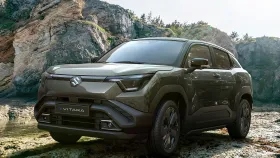
Maruti Suzuki has showcased the e-Vitara in India at an in-person event in Gurugram. At the event, the company unveiled more details about the eSUV, including the variants, the claimed range of the top variant, the availability of the car under the “Battery As A Service” model, and the delivery timeline.
However, even after waiting this long, the company hasn’t revealed the e-Vitara’s pricing. It looks like they’re still exploring and finalizing the financials on how the car could perform with different sales models. Anyway, here’s everything Maruti Suzuki has unveiled at the pre-launch event today.
Also Read: Kia Seltos 2026 Launch on December 10: Here’s Everything We Expect From Tata Sierra Rival
Maruti Suzuki e-Vitara: Variants & Battery Pack

Following the nomenclature prevalent in other models, Maruti Suzuki has given the e-Vitara’s variants a familiar naming scheme. Out of these, Delta is the base variant, Zeta seems to be the mid-specced variant, while Alpha is the top variant.
- Delta: 49 kWh (344 kilometers WLTP)
- Zeta: 61 kWh (543 kilometers ARAI)
- Alpha: 61 kWh (543 kilometers ARAI)
It is essential to mention here that Maruti Suzuki hasn’t revealed the ARAI-claimed range of the smaller battery pack. For the variants with the bigger battery pack, the claimed range is 543 kilometers.

However, this doesn’t align with the company’s initial claim of offering 500 kilometers of real-world range. Generally, the real-world range of EVs is much lower than the claimed range, unless Maruti Suzuki has somehow made the battery and powertrain exceptionally efficient.
To ensure there is sufficient charging infrastructure, the company claims to have installed over 2,000 exclusive charging stations (in collaboration with 13 aggregators) across 1,100 cities in India. Furthermore, the company has launched a new app called “e for me,” which provides details about 70% of the fast chargers in the country.
Maruti Suzuki e-Vitara: Powertrain

- Delta 49 kWh: 144 PS / 192.5 Nm
- Zeta 61 kWh: 174 PS / 192.5 Nm
- Alpha 61 kWh: 174 PS / 192.5 Nm
Similar to the battery pack options, the e-Vitara is available with a slightly less powerful motor on the Delta variant and a more capable one on the Zeta and Alpha variants. However, on all the variants, the motor produces 192.5 Nm of peak torque. For now, the eSUV is only available with a FWD powertrain.
Maruti Suzuki e-Vitara: Sales Models
Battery-As-A-Service
As a part of this option, you buy the car, but rent or lease the battery. So, you effectively pay for the car minus the cost of the battery, which reduces the upfront cost (batteries make up about 30-40% of an EV’s price).
Furthermore, you don’t have to worry about maintaining the battery or its degradation. Moreover, Battery-as-a-Service could make EVs more accessible to the masses. In retrospect, the strategy has worked very well for MG Motors.
Subscription

As part of this sales model, buyers will have to pay a monthly rent for the tenure they want to use the car. Many companies already offer new vehicles for rent or subscription in India. While the rent might sound high at first, it is beneficial for buyers who don’t want to use a car for its entire lifetime and only want to experience it for a limited time, let’s say, in another city where they’ve relocated for work.
When the stipulated tenure ends, the owner can either return the vehicle to the company or buy it.
Also Read: 2025 Hyundai Venue First Impressions: Improvements All Around
Buying The Entire Vehicle
This is the traditional way to buy a vehicle in India: pay the entire cost of the car and battery upfront, along with any other charges that may apply on a state-by-state basis. However, this is also the most expensive way to own a car, and more often than not, it accompanies a car loan.
Maruti Suzuki e-Vitara: Safety Features

Just before its launch, Bharat NCAP released the crash test ratings for the Maruti Suzuki e-Vitara, where the e-SUV scored 31.49/32.00 points in the Adult Occupant Protection Test and 43/49 points in the Child Occupant Protection Test.
As a result, after receiving a five-star safety rating from ENCAP in September 2025, the vehicle has also scored a five-star rating from BNCAP. Not only that, but the score has made the e-Vitara the safest Maruti Suzuki car ever tested by BNCAP.
Maruti Suzuki e-Vitara: Booking & Delivery Timeline
While bookings haven’t officially commenced, Maruti Suzuki plans to begin deliveries in early 2026, likely in January. The vehicle’s pricing should remain in place for the coming days.
Also Read: Tesla Motors Grand Plans For India: Massive Push In EV Infra, Revolutionizing Car Buying in India

You can follow SmarYou can follow Smartprix on Twitter, Facebook, Instagram, and Google News. Visit smartprix.com for the latest tech and auto news, reviews, and guides.