


Mahindra rolled out the facelifted version of its most popular off-roader earlier last month, naming it the Thar OG and pricing it from ₹10.32 lakh (ex-showroom). Rather than a cosmetic touch-up, the update borrows heavily from the five-door Thar Roxx, bringing structural, mechanical and feature changes that go well beyond what the previous-generation Thar which has been on sale since 2020, and was updated with new features just last year. The ‘Thar OG’ brings quite a few updates in terms of features, suspension, steering. The engines, however, remain the same. Let us take a look at how the new Thar OG compares with the outgoing model.
The entry-level price is unchanged at ₹10.32 lakh (ex-showroom) onwards, but the variant structuring has been reworked considerably. Mahindra has introduced a new ZXT trim, which slots in above the existing AXT and LXT variants. It is offered across all three engine choices, pushing the top-end variant’s price up to ₹18.99 lakh (ex-showroom). Elsewhere, like-for-like variants carry only a token increase of about ₹1,000 over the outgoing model, meaning the bulk of the price hike, where it exists, comes from added equipment rather than inflation on identical trims. A new Mahindra Thar LXT 2WD automatic option has also been introduced on the 2.2-litre diesel, a combination that wasn’t offered before.
Size and Dimensions
Comparing the outright dimensions, the Thar OG is only marginally larger than its predecessor: it has grown by 10mm in length to 3,995 mm and by 50 mm in width to 1,870 mm, while height and the 2,450 mm wheelbase remain untouched. Ground clearance has improved by 6 mm to 232 mm. Off-road geometry is a mixed bag on paper, the approach angle has actually dropped by 1.2 degrees to 40 degrees, while the breakover angle has improved marginally by 0.2 degrees to 26.4 degrees. The departure angle stays the same at 36 degrees. In practical terms, none of these shifts are large enough to meaningfully change how the Thar behaves off the road.

Exterior Changes
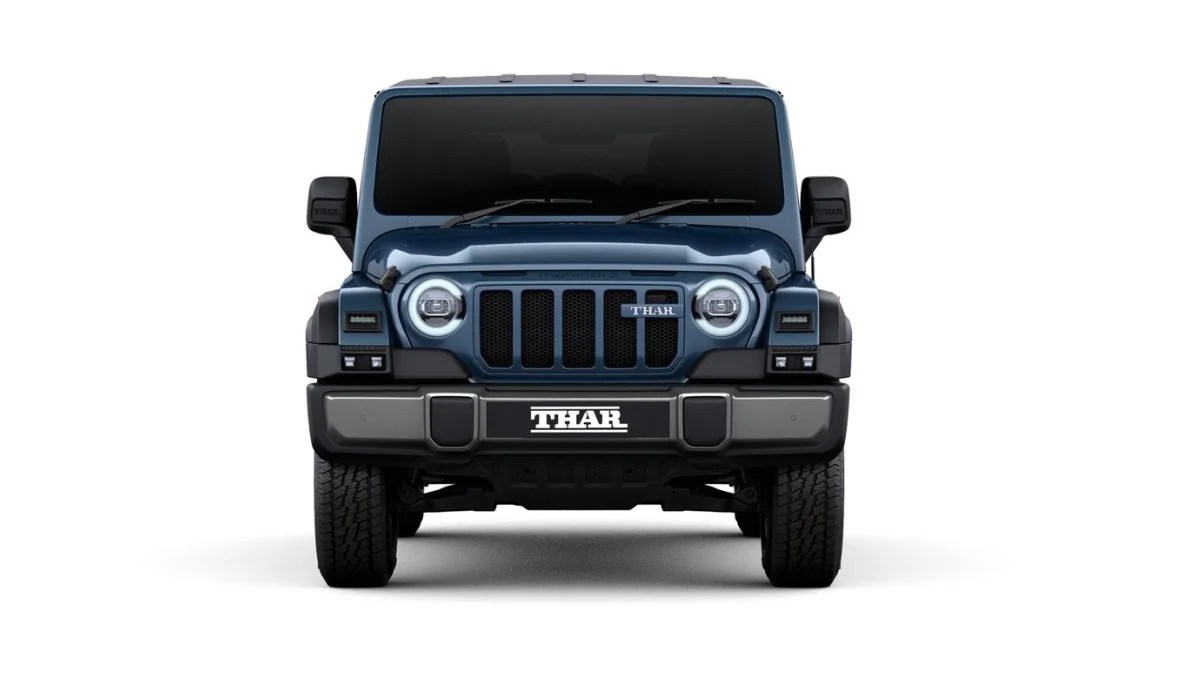
Up front, the Thar OG adopts a five-slat grille in place of the outgoing six-slat design, along with projector LED headlamps, LED daytime running lights and LED tail lamps and indicators carried over from the Thar Roxx. Fender-mounted fog lamps and a simpler, flatter bumper round off the front-end changes, giving the SUV a slightly more contemporary look without altering its boxy silhouette.
The side profile retains its familiar shape, with the most noticeable update being a dual-tone treatment on the same 10-spoke alloy wheel design. At the rear, the tail lamp units have been switched to LED items shared with the Roxx, and the bumper has been squared off compared to the chunkier design it replaces.
Cabin And Features
Inside, the changes are more about finish than layout. The 10.25-inch floating touchscreen infotainment system carries over unchanged in size, but the cabin gets a new brown-and-black colour scheme in place of the previous theme. Space and practicality remain what they were — the cabin is best suited to four occupants with moderate comfort, and the mix of plastic and leatherette on the touchpoints is in line with what rivals in this segment offer.
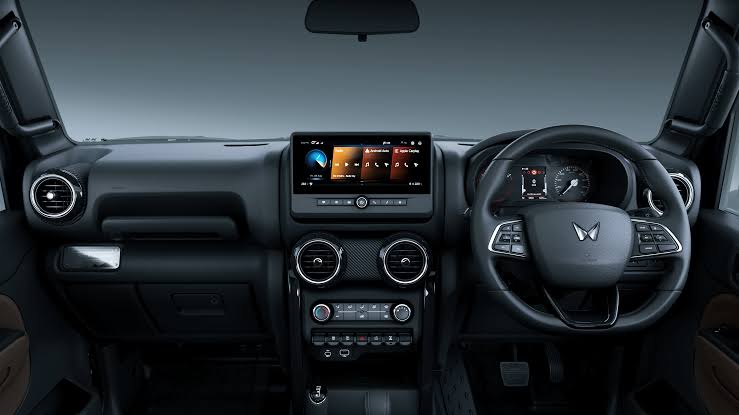
On the equipment front, Mahindra has added a wireless phone charger and push-button engine start, neither of which featured on the old Thar. Carried over are the 10.25-inch touchscreen with wireless Android Auto and Apple CarPlay, a six-speaker sound system, cruise control, a height-adjustable driver’s seat and steering-mounted controls. A digital driver’s display has also been introduced with this update. Safety kit spans six airbags, front and rear parking sensors, ISOFIX child-seat mounts, a rear camera, tyre pressure monitoring, ABS with EBD, and both hill-hold and hill-descent control.
Mechanicals: The Bigger Story

The most significant change is underneath the body rather than on it. The Thar OG now sits on a shortened version of the Thar Roxx’s M-Glyde platform, which brings with it a Pentalink rear suspension set-up using frequency-selective (DaVinci) dampers, technology the outgoing Thar did not have. This is paired with off-road hardware such as an electronic locking differential and a brake-lock differential, both aimed at helping the SUV extract itself from low-traction situations more easily than before. Mahindra’s own positioning suggests this chassis upgrade is expected to sharpen high-speed stability and on-road manners considerably, addressing a long-standing criticism of the outgoing Thar as a comparatively unrefined highway companion.
Powertrains Remain The Same
Engine options are unchanged on paper: a 2.0-litre turbo-petrol producing 162 PS and 330 Nm, a 2.2-litre diesel with 152 PS and 330 Nm, and a 1.5-litre diesel with 118 PS and 300 Nm, the last of which is available only with rear-wheel drive. Both the petrol and the larger diesel can be paired with a 6-speed manual or a 6-speed torque-converter automatic, and are offered with either 2WD or 4WD depending on variant. With outputs unchanged, any difference in how the Thar OG drives compared with its predecessor should come down to the new suspension and chassis hardware rather than added power.
Rivals And Verdict
The Thar doesn’t have a direct rival in the Indian market, though buyers cross-shopping it typically also consider the Maruti Suzuki Jimny and the three-door Force Gurkha, alongside Mahindra’s own five-door Thar Roxx.

Taken together, the Thar OG’s changes read as an update focused on substance over spectacle. The exterior and cabin revisions are incremental, and the feature list, while improved, still isn’t class-leading. But the shift to the Roxx-derived platform, along with the addition of locking differentials and a new suspension setup that seems to work quite well, should make a tangible difference to how the Thar rides and handles, both on tarmac and off it, compared with the outgoing model.
Effectively, this update closes the engineering gap between the three-door Thar and its five-door sibling, while keeping the two visually and dimensionally distinct. For a nameplate that has sold on charisma and off-road credibility more than outright polish, borrowing the Roxx’s underpinnings addresses the area owners have most often flagged as a compromise: composure at speed and on uneven surfaces.