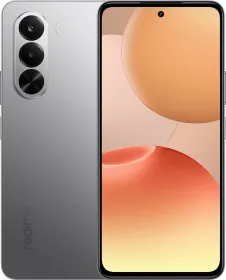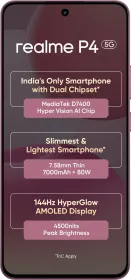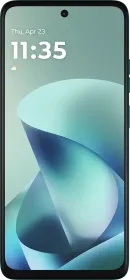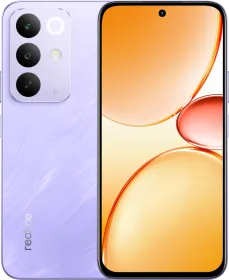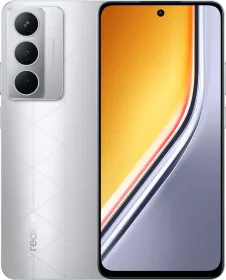


The realme P4x arrives as one of the more intriguing budget smartphones of late, not just because of its aggressive pricing but because it packs hardware and features that feel a class above its segment. From a massive 7,000mAh battery to a Dimensity 7400 Ultra chipset to a 144Hz-rated display and feature-rich software, the phone clearly aims to deliver more than the basics. But how well does it all come together in everyday use? After spending over a week testing the P4x, here’s everything you need to know.
realme P4x Price & Availability
The realme P4x is available in three memory variants: 6GB + 128GB, 8GB + 128GB, and 8GB + 256GB, priced at Rs. 15,999, Rs. 17,499, and Rs. 19,499, respectively. Buyers can avail up to Rs. 2,500 in bank offers, bringing the effective starting price down to Rs. 13,499.
The first sale begins on December 10 at 12 PM and will run for 12 hours across realme.com, Flipkart, and mainline retail stores. The smartphone comes in three colours: Matte Silver, Elegant Pink, and Lake Green.
Pros
- Premium, unique design
- Strong overall performance
- UFS 3.1 storage
- Smooth 120Hz animations
- Excellent battery endurance
- Fast 45W charging is included
- 90fps gaming on BGMI and 120 fps on Free Fire
- Feature-rich realme UI 6
- Good daylight camera detail
Cons
- LCD screen with poor outdoor visibility
- Thick bezels and chin
- HDR processing slow
- Speakers lack clarity
- Weak low-light camera performance
- Average selfie camera
- Some preinstalled bloatware
realme P4x Review: Unboxing

The realme P4x, like most phones in the segment, comes with a pretty heavy box, and that’s a good thing. You get the phone, a transparent protective case, a 45W fast-charging brick, a USB-C to USB-C cable, and a SIM ejector tool. So, you don’t have to spend more money on essentials, as the company takes care of them.
realme P4x Review: Design & Build

The first thing you’ll notice about the realme P4x’s design, at least on the Lake Green variant I received, is the anodized metal back with a grainy finish, which looks different under different lighting conditions. Just pay attention to the images attached in this review, and you’ll see it for yourself.
While the phone appears to have a uniform finish from certain angles, the grains on the back shine and glimmer at other angles, making the phone pleasing to the eye. The camera module (with three cutouts but only two lenses, carved from metal) protrudes quite a bit from the back panel, to the point that the phone wobbles when laid flat on a surface without the back cover.

However, the module’s edges have a shiny finish that reflects light at certain angles, drawing your attention. The side frame on the realme P4x is carved from plastic, but it features a textured, upmarket feel that enhances the in-hand feel and overall grip on the device.
Interestingly, there are no visible antenna bands on the device, similar to the Nothing Phone (3a) Lite but different from the Lava Agni 4. The midrange handset has a side profile of 8.39mm, making it thicker than the Phone (3a) Lite but slimmer than the Lava Agni 4. It weighs 208 grams, which doesn’t feel too heavy in the hand, thanks to decent weight distribution across the entire chassis.

However, the Nothing handset I mentioned earlier is a tad lighter, while the Lava Agni 4 weighs the same. I am yet to determine the front glass material the company uses and whether it uses Corning glass (update: it’s KK glass).
Apart from numbers, the phone feels quite solid in the hand. Similar to other phones, the P4x features the volume rockers and the power button on the right frame, what looks like a tiny speaker grill and a secondary microphone on the top, and the SIM ejector PIN, primary camera, a USB-C port, and the primary speaker grill on the bottom.


The buttons provide a nice tactile feel, but the click and snap aren’t quite as good as the ones on the Phone (3a) Lite. On the front, the phone features a punch-hole screen with thick, uneven bezels and a broad chin that reminds me of smartphones from a couple of years ago. Anyways, it’s an LCD, and given how difficult it is to tuck those under the bottom edge of the cutout, a bottom chin is quite common on such phones.
Last but not least, the phone comes with an IP64 dust- and water-resistant rating. In simpler terms, IP64 means the device is dustproof and splash-resistant, though I wouldn’t take it swimming.


The realme P4x is available to purchase in three colors: Matte Silver, Elegant Pink, and Lake Green.
The Lake Green variant, with its shifting, grainy shimmer, feels like one of realme’s more deliberate attempts to give users something that looks and feels premium from a distance, even if the materials tell a more grounded story up close. That said, the design doesn’t entirely escape the realities of its segment. The uneven bezels and the thick chin immediately place it in the budget class, despite the sophisticated back panel.
realme P4x Review: Display

While design is one of the realme P4x’s strongest suits. Although it features an FHD resolution and supports up to 144Hz refresh rate, the screen can’t produce the deep, inky blacks (and subsequently, better contrast) of an AMOLED panel available on some smartphones in the segment. This manifests as a dark-gray (not black) background in dark mode. The viewing angles aren’t impressive either (again, something related to the display technology rather than the phone itself).
Furthermore, the peak brightness maxes out at 1,000 nits, which is enough for indoor usage, but falls short outdoors, especially under direct sunlight. You’d either have to cover the screen with your hand or squint to see the on-screen items. Like other LCD screens, the edges tend to have uneven brightness when viewed very closely, but it’s unnoticeable for most users. The minimum brightness is slightly higher as well.

While the company says the phone supports 144Hz, only the screen supports that refresh rate; the software maxes out at 120Hz, and hence, that is the maximum refresh you’ll get across the user interface.
Enabling the refresh rate counter in developer options, I noticed that the screen stays at 120Hz on the lock screen, 60Hz on the home screen, and goes up to 90Hz in most apps like Photos, Videos, App Market, and even the Google Play Store. The realme Store, however, only operates at a 60Hz refresh rate. However, while scrolling, using the control center, and the Settings app, the refresh rate remained at 120Hz.
Although the display supports HDR10, HDR10+, and HLG, and has a Widevine L1 certification from Netflix, it isn’t certified.

In the “Display & brightness” menu, you get options to increase/decrease the brightness, enable the auto-brightness option, select the color mode (between Vivid and Natural, although I couldn’t determine an immediate difference between the two) along with the color profiles, select the font and the display size, and toggle options like auto-rotate, auto-screen off, screen attention, and refresh rate.
There’s an AI Eye Comfort feature that claims to detect eye fatigue with AI and adjust the screen color temperature in real time, and it works well. At the end of it all, the realme P4x’s display feels like the one place where its ambition stumbles a tad. It’s not a bad screen by any measure, but in 2025, when even aggressively priced phones are inching toward AMOLED as baseline, an LCD panel feels like a step backward.

Along with the capable screen, the phone also features a dual-speaker setup that reaches a maximum volume of 87dB. There appears to be a tiny speaker at the top, but most of the stereo output comes from the phone’s earpiece (apart from the primary speaker at the bottom, which does most of the heavy lifting). The setup gets pretty loud, but it lacks clarity and fullness at maximum volume.
realme P4x Review: Performance

Performance-wise, the realme P4x has a lot going for it. First and foremost, the handset features the MediaTek Dimensity 7400 Ultra (4nm) chipset, comprising four 2.6 GHz performance cores and four 2.0 GHz balanced cores, paired with the Mali-G615 MC2 GPU, and up to 8GB of LPDDR4X RAM (with up to 10GB virtual RAM). If the chipset sounds familiar, it is because it powers several smartphones in a higher price bracket, such as the iQOO Z10R, the vivo T4R, and the Motorola Edge 60 Fusion.
The realme P4x is among the few phones in the segment to feature up to 256GB of UFS 3.1 storage, which is significantly faster than the UFS 2.2 storage type common in the segment. As a result, the smartphone feels snappy and responsive during boot and app launches. However, there are a few scenarios, like HDR image processing (which takes a few seconds to kick in), where it feels that the phone could have benefited from a more powerful chipset or a better ISP.

Further, the RAM management is quite good, as the phone tends to keep even the seventh or the eighth app active in the background (unless it is a heavy one, like a video game). Moreover, using social media and communication apps like Instgram and WhatsApp, switching between apps, watching content on YouTube or Netflix, and browsing my Gmail email were quite smooth on the handset.
Synthetic Benchmarks


| realme P4x | Moto Edge 60 Fusion | Samsung Galaxy A17 5G | |
| AnTuTu Score | 1,001,028 (v11) | 682,953 (v10) | 613,701 (v10) |
| Geekbench 6 CPU | 1,045 / 2,971 (single / multi-core) | 1,045 / 3,013 (single / multi-core) | 952 / 2,134 (single / multi-core) |
| Geekbench 6 GPU | 3,047 (Vulkan) / 2,930 (OpenCL) | 3,109 (Vulkan) / 3,149 (OpenCL) | 1,314 (Vulkan) / 1,319 (OpenCL) |
Although the brand advertises the realme P4x with an AnTuTu score of over 780,000 points, that should be from the older version of the benchmark. On AnTuTu v11, the phone scored around a million points. The platform has revised its internal scoring system, so there’s a discrepancy between the score advertised and the one we received during testing. Apart from that, the phone’s Geekbench scores are similar to those of the Edge 60 Fusion, a smartphone that costs over Rs. 20,000 in India.
Gaming Performance


On Battlegrounds Mobile India (BGMI), the realme P4x supports Super Smooth + Extreme+ (90 fps) and Smooth + Extreme+ (90 fps) graphics settings, the result of optimization. However, from the Balanced setting onward, the frame rate is stuck at Ultra (40 fps), and the maximum available graphics setting is HDR + Ultra.
I set the game to the maximum frame rate for about 40 to 50 minutes, and during that time, the phone didn’t heat up as much as some other handsets do. This could be due to the 5,300 mm² vapor-cooling chamber inside the phone, but the ambient temperature was also around 20°C, which is quite conducive to semiconductors.


While playing the video game, I noticed a few stutters here and there, where the refresh rate probably dropped, but the phone still delivers a pretty stable 90 fps gaming experience in BGMI. The company also claims to offer 120 fps gameplay on Free Fire.
In the end, the realme P4x punches well above its weight in raw performance, and that’s ultimately what makes this phone feel like it doesn’t quite belong in its own price segment. Navigation gestures, transitions, and animations remain fluid most of the time, with only minor slowdowns when switching quickly between heavy apps.
realme P4x Review: Software

Out of the box, the phone runs on realme UI 6.0 based on Android 15. Further, the brand has promised to provide two years of operating system updates and three years of security updates with the smartphone. Thanks to the 120Hz refresh rate, the system animations, including scrolling between the home screen pages, invoking the control center, and scrolling in the settings menu, feel pretty smooth.
The user interface is loaded with features. To begin with, there’s Flux Themes that provides multiple wallpaper, layout, and font color options. When choosing a wallpaper, you can blur it or enable the depth effect (which makes the subject appear to float over the clock at the center). And yes, you can set different backgrounds for the lock screen and the home screen.

There’s a Smart Sidebar built into the user interface that provides quick access to the File Dock, Recent Files, taking a screenshot or starting a screen recording, language translation, and other frequently used apps. You get plenty of gestures and motion controls as well, such as double-tapping the screen to wake it up or turn it off, swiping down with three fingers to take a screenshot, and raising it to wake.
Like Moto Gestures, the realme P4x can open the torch or camera by shaking the phone. There’s a Glance for realme feature that shows news stories on the lock screen, but since I’m not a fan, I turned it off. For multitasking, the P4x provides Flexible Window options, wherein you can swipe up and hold on an app to transform it into a floating window. You can also swipe down on a notification to open the app in a floating window.

The user interface features several AI-based features, including AI Scanner, AI Recording, AI Smart Loop 2.0, and AI Gaming Coach. To edit pictures, you can use the AI Eraser, AI Motion Deblur, AI Glare Remover, and AI Landscape 2.0. You can also use Google’s Gemini AI voice assistant, Gemini Live, and Circle to Search features on the device.
The feature-rich user interface aside, the P4x comes with plenty of pre-installed apps, including Facebook, Snapchat, PhonePe, and Spotify. Since the phone doesn’t come with an AMOLED screen, it lacks an always-on display. But once you trim the fat, the P4x offers one of the most well-rounded software packages in its segment.
realme P4x Review: Camera

The realme P4x features a dual-rear camera setup (with only one useful sensor) and a single, 8MP selfie camera on the front.
- Primary Camera: 50MP OV50D40 (f/1.8), 2x lossless zoom, 4K30 video
- Secondary Camera: 2MP (f/2.4) monochrome sensor
- Front Camera: 8MP (f/2.0), 1080p videos at 30 fps
Primary Camera

The primary camera utilizes a 50MP sensor that captures excellent details in broad daylight. It has a pretty sharp focal range, the aesthetic background blur (while capturing tiny subjects closer to the camera), and punchy colors. There’s also a “Hi-Res” photo mode, which captures images at an effective resolution of 48MP.
Although the HDR works, it takes plenty of time to kick in, so much so that after capturing some pictures, I had to wait for three to five seconds for the ISP and the chipset to apply the computational processing on an image and show me the final preview. Under challenging lighting conditions and in low-light environments, the camera tends to struggle with exposure, focus, and HDR.


2x Lossless Zoom
The 50MP camera provides room for 2x lossless zoom, delivering a decent close-up focal length with enough detail (at 12MP), sufficient background blur, and crisp focus. However, beyond 2x zoom levels, the camera starts to pull apart, though.


Selfie Camera
The 8MP selfie camera gets the job done, especially in enough light. Colors are mostly consistent, but, like the primary camera, HDR processing takes a while to kick in (enough to let me capture screenshots of how the pictures look without HDR and with it).


Video performance is okay on the device, considering that it doesn’t feature optical image stabilization, and you can only record 4K videos at 30 fps. Moreover, the camera system is decent, but the lack of a secondary sensor and a high-resolution selfie shooter keeps me wanting more.
realme P4x Review: Battery Life & Charging

Another aspect where the phone excels is the battery life. With its 7,000 mAh battery, the phone can easily provide eight to 10 hours of screen-on time on a single charge. When I used the phone with a SIM card, I easily got around 9 hours of screen-on time per day with mixed usage.
Today, I’ve used 36% of the battery writing this review, and the phone has given me 4.5 hours of screen-on time (without a SIM card, GT Mode enabled). So, battery life isn’t something that you need to worry about with the realme P4x. With the 45W charger provided in the box, the phone takes about 90 minutes to fully charge, which is neither too good nor too bad.
Review Verdict: Should You Buy The realme P4x?
The realme P4x delivers excellent value for its price, thanks to strong performance, long-lasting battery life, fast UFS 3.1 storage, and a feature-rich software experience. Its design feels more premium than most phones in its class, and the 90fps gaming support is a genuine bonus. However, the LCD display, delayed HDR processing, average speaker quality, and slow camera post-processing hold it back.
The P4x is ideal for users who prioritize gaming performance (90 fps BGMI gameplay), battery life, and practicality over camera finesse and display quality. If you want AMOLED visuals or consistently strong photography, you should look elsewhere.

Smartprix ⭐ Rating: 8.05/10
- Design & Build: 8.0/10
- Display: 7.5/10
- Speakers: 7.5/10
- Software: 8.5/10
- Haptics: 8.0/10
- Biometrics: 8.0/10
- Performance: 8.5/10
- Cameras: 7.5/10
- Battery Life & Charging: 9.0/10
First reviewed in December 2025.